

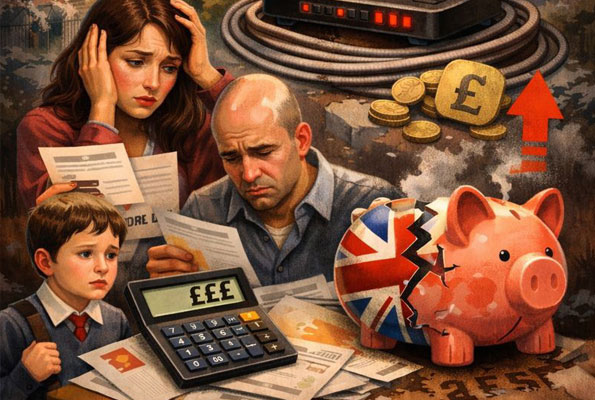
The British economy has spent the last few years navigating a storm of rising costs, yet as the turbulent waves of headline inflation begin to recede, households are finding that the waters in their own bank accounts remain disturbingly high. While policymakers celebrate the return of inflation rates to more manageable levels, a structural issue buried deep within the terms and conditions of everyday service contracts is preventing the cost of living from falling as expected.
Research highlighted by The Conversation, particularly the work of economists like Stefano Fasani at Lancaster University, suggests that the very mechanisms designed to protect businesses from inflation have morphed into engines that perpetuate it. This phenomenon, often driven by automatic price increases in broadband and mobile contracts, creates a disconnect between the official economic data and the reality of monthly bills.
By examining the shift from “turbo price indexation” to the controversial “pounds and pence” pricing model introduced in 2025, we can uncover why UK households remain locked in a cycle of rising costs that defies broader economic gravity.
Mechanism of turbo price indexation
For more than a decade, the telecommunications and utility sectors in the United Kingdom operated under a pricing model that effectively guaranteed revenue growth regardless of service improvements. Millions of contracts for broadband, mobile phones, and other essential services contained clauses that mandated an annual price increase.
These were not random hikes but were calculated using a specific formula: the rate of inflation (usually the Consumer Price Index (CPI) or the Retail Price Index (RPI) published in December or January) plus an arbitrary additional percentage, typically 3.9%.
In an era of low inflation, these increases were irksome but financially tolerable for most consumers. However, as global economic shocks sent inflation soaring into double digits in the early 2020s, this “inflation-plus” formula transformed into a mechanism of aggressive wealth transfer.
Economists have termed this practice “turbo price indexation” because it not merely tracks the cost of living but actively accelerates it. When a service provider increases prices by inflation plus a margin, they are, by definition, raising the real cost of that service.
Research by Fasani and his colleagues indicates that such practices can fuel inflation persistence, creating a feedback loop where higher prices today set the baseline for even higher expectations tomorrow. This creates a form of economic stickiness; even when the initial drivers of inflation (such as energy prices or supply chain disruptions) fade away, the price hikes embedded in contracts ensure that core services continue to get more expensive.
This structural rigidity is exacerbated by a behavioural phenomenon known as “money illusion.” Consumers often focus on nominal income and costs rather than their real value adjusted for inflation.
When inflation is high, households may begrudgingly accept a 10% hike in their broadband bill as a symptom of the times, failing to recognise that the “plus 3.9%” component represents a price increase that outstrips the general rate of inflation.
This acceptance allows companies to protect their profit margins at the expense of household disposable income. The sheer scale of this practice was immense, with estimates suggesting that by 2024, nearly six in ten customers were tied to contracts containing these unpredictable inflation-linked terms. The result was a marketplace where the price of essential connectivity was detached from the actual cost of provision, driven instead by a formula that punished consumers for broader economic instability.
New era of pricing
Recognising the detrimental impact of this uncertainty on household finances, the UK telecoms regulator, Ofcom, intervened with a ban on inflation-linked price rises for new contracts starting from 17 January 2025. The regulator’s logic was grounded in the principles of transparency and fairness. Consumers should not be asked to sign contracts with “nasty surprises” where the future monthly cost is dependent on volatile economic indices they cannot predict.
Under the new rules, providers must state any mid-contract price increases in clear “pounds and pence” figures at the point of sale. This shift was intended to empower consumers, allowing them to compare the total cost of a deal over its lifetime with certainty.
However, the transition to this “pounds and pence” model has revealed a stark reality: transparency does not equate to value. In the absence of the automatic inflation lever, major providers have moved to bake in their revenue expectations through fixed annual increases.
By late 2025, major industry players had updated their terms to include fixed annual rises, typically ranging between £1.50 and £4.00 per month, depending on the plan. While this complies with the letter of the regulation, the financial impact on consumers (particularly those on lower incomes) can be severe.
A £3 increase on a premium £50 broadband package represents a 6% hike, which might align with or slightly exceed inflation. However, the same £3 increase on a budget £10 mobile plan represents a staggering 30% jump in cost. This disparity has drawn sharp criticism from consumer advocacy groups and government officials. In October 2025, controversy erupted when O2 announced that existing customers would face price rises of £2.50 per month, a figure significantly higher than the £1.80 originally communicated to some segments of the market.
This move was branded by consumer champion Martin Lewis as making a “mockery” of the new rules, prompting Chancellor Rachel Reeves and Technology Secretary Liz Kendall to write to industry leaders, urging them to act within the “spirit” of the regulations.
The industry defends these fixed hikes as necessary to fund critical infrastructure projects, such as the nationwide rollout of 5G and full-fibre broadband networks. They argue that network costs rise regardless of headline inflation and that the “pounds and pence” model provides the certainty regulators demand.
Yet, for the consumer, the outcome is that the cost of connectivity is guaranteed to rise every year, regardless of whether the wider economy is booming or busting. The inflation floor has effectively been solidified, meaning prices can only go up, never down.
The evolution of household contracts in the United Kingdom serves as a potent case study in how inflation can become embedded in the structural fabric of an economy. The research led by Fasani illustrates the dangers of “turbo price indexation,” showing how contracts that automatically amplify inflation created a self-sustaining cycle of rising costs. While Ofcom’s intervention to ban these unpredictable rises was a necessary step toward transparency, the industry’s pivot to aggressive fixed-value increases suggests that the underlying pressure on household budgets has merely changed shape rather than disappeared.