

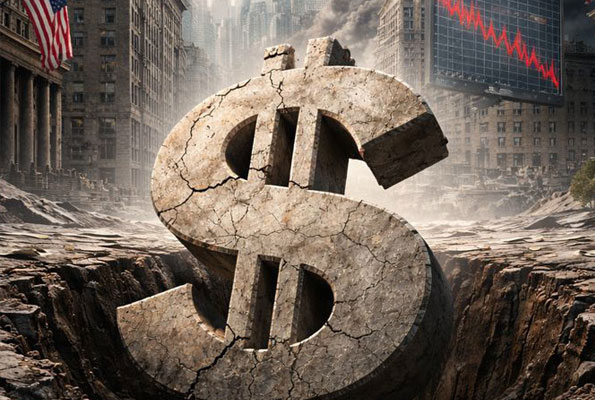
Things have been tough for the American economy of late. President Donald Trump, apart from announcing “reciprocal tariffs” against Washington’s allies and adversaries alike, then backflipping from it, went after Federal Reserve Chair Jerome Powell for keeping interest rates “too high.”
What do these actions suggest? Is Trump panicking? Is the world’s largest economy going into the doldrums due to the Republicans’ tariff game? However, one thing is clear: speculation of a potential recession, which was circulating for some time, has reached a fever pitch due to the chaos created by the new administration’s inconsistent policy moves.
A recession is a period of declining economic activity, commonly defined by at least two consecutive quarters of economic contraction. Although difficult to experience, recessions are a normal part of the economic cycle.
According to the definition above, the United States isn’t currently in a recession. The Federal Reserve Bank of Atlanta estimates economic growth at -2.8% for the first quarter of 2025. However, the Bureau of Economic Analysis estimated the American economy grew by 2.4% in the final quarter of 2024. If the world’s largest economy experiences another period of negative economic growth, it will officially be in a recession by summer.
Not a good environment
Apart from trade tariffs and the resultant tensions with crucial partners like Canada, Mexico, and Europe (along with economic standoff with China through supercharged tariffs), economists claim to see uncertainty in the crucial fronts called consumer confidence and business sentiment. It is worth noting that analysts often track these two parameters to decide whether an economy is showing signs of recession or not.
The Economic Policy Uncertainty Index, which relies upon news articles, tax data, and insights from the Federal Reserve Bank of Philadelphia’s Survey of Professional Forecasters to produce a metric that gauges uncertainty at the intersection of economics and politics, saw the parameter standing at its highest level since the COVID-19 pandemic.
Likewise, the University of Michigan’s index of consumer sentiment has also taken a hit due to tariffs and inflation. In February 2025, it fell nearly 16% compared to a year ago.
“What we’re seeing right now is that consumers over the last two months… have been feeling less and less positive about the economy,” said Joanne Hsu, director of the University of Michigan’s Surveys of Consumers.
In its latest survey of small business optimism, the National Federation of Independent Business recently noted that its index fell by 2.1 points in February to 100.7. That’s down 4.4 points from its peak in December 2024, though still above its 51-year average of 98. The NFIB said its uncertainty index also rose 4 points to 104, the second-highest reading.
Emily Gee, an economist and senior vice president for Inclusive Growth at the left-leaning Centre for American Progress, suggests that the Trump administration’s erratic policy initiatives have created a level of uncertainty that is “more than just vibes.”
The concern is real
Economists defined a recession as a period of economic contraction marked by two consecutive quarters of negative growth. In the fourth quarter of 2024, the United States’ real GDP grew at an annual rate of 2.3%. However, by the end of February 2025, the Atlanta Federal Reserve Bank’s GDPNow forecast for the first quarter of 2025 had dropped to -2.4%.
Donald Trump has downplayed concerns that his seemingly indecisive policy pronouncements may contribute to uneasiness among consumers and businesses. When asked in a recent Fox Business interview about the Atlanta Fed’s warning of an impending economic contraction, he sidestepped the question, saying, “I hate to predict things like that.”
Kevin Hassett, the newly appointed director of the National Economic Council, also defended the White House’s tariff policy by stating, “If we reduce inflation at the aggregate level by cutting $2 trillion in annual deficit spending, that will have a much greater impact on grocery prices than a tariff here or there.”
Hsu said, “Ultimately, the final judgment on the president’s policy will be determined by everyday Americans voting with their cash — whether they continue purchasing cars, furniture, and electronics. Consumer spending makes up 70% of GDP. If consumers cut back on spending due to a significant drop in consumer sentiment, that would make it much harder to avoid a recession.”
The harsh truth right now is that American households and businesses are practising restraint in response to the trade conflict instigated by Donald Trump and his successive policy reversals. This economic policy uncertainty has resulted in a decline in consumer confidence for three consecutive months, with a decrease of over 30% since November 2024, according to the University of Michigan Survey of Consumers. Consumer spending experienced a decrease for the first time in two years in January.
The National Federation of Independent Businesses reported that its uncertainty index fell in March, along with a decline in small business optimism. These entrepreneurs have lowered their expectations regarding their sales prospects in the coming days. Businesses find uncertainty unsettling since they are unsure of the operating environment. They can adapt once economic trends and policies are understood.
“GDP goes negative when businesses and consumers cut back on spending, which triggers a recession. The lack of clarity and difficulty in predicting where we’re headed leads to precautionary reductions in spending,” according to Laura Jackson Young, a professor of economics at Bentley University who has researched the economic effects of uncertainty.
As per her, people and businesses are becoming even more cautious as a result of the extreme uncertainty that Donald Trump’s actions have created.
Uncertainty ahead
Economists, in general, are unsure of what to think due to the seemingly constant policy changes. At the Centre for Strategic and International Studies, a think tank in Washington, Philip Luck, director of the Economics Programme, says the tariff reversal “does very little to resolve the uncertainty.”
According to him, the tariffs may have been “bananas,” but nobody can truly say if they will be lifted in 90 days or even earlier.
Conversely, the global economic system is undergoing a significant reconfiguration as it attempts to address the new normal known as “reciprocal tariffs” and their impact on overall growth.
Washington’s effective tariff rate eclipsed levels reached during the Great Depression, while counteractions from major trading partners markedly increased the global tariff rate. And this doesn’t read well.
The US is not yet in recession, but there are increasing signs of trouble ahead. Reversing policy decisions, trade uncertainties, and loss of confidence are holding back economic outlays by both households and businesses. If uncertainties persist and economic growth remains weak, the chances of recession in the current year would remain high for policymakers and investors alike.