

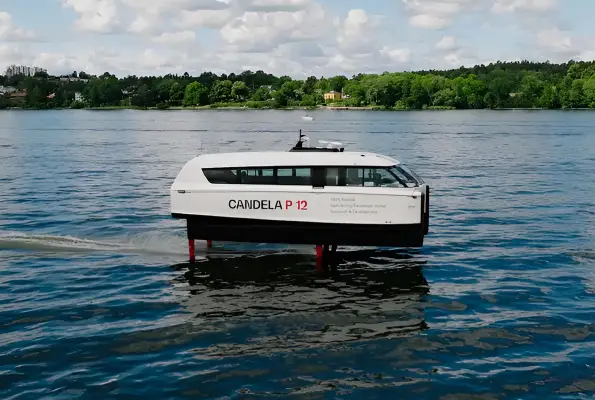
The very first Candela P-12 Business vessel was launched in Stockholm, Frihamnen, and delivered to customers in Mumbai to possibly offer the most significant upgrade ever to boat transfer. For years, boat transfer has been the Achilles heel of luxury travel, as passengers disembark plush aircraft to board rickety, noisy, wave-pounding speedboats, where roaring outboards and choppy waters often leave them arriving at their destination with wobbly legs and seasickness.
Swedish next-generation shipbuilder Candela has elegantly solved this by re-engineering the entire concept of water travel. The Candela P-12 Business has a computer-aided hydrofoil system with underwater wings that lifts the hull out of the water, thereby eliminating discomfort and noise with digital precision (and an acoustically insulated premium interior).
With a cruising speed of 25 knots, the P-12 has a range of 40 nautical miles, the fastest and longest-range electric hospitality transfer vessel in serial production, and a revolution in silent transport. Commissioning trials in Stockholm measured cabin noise levels at just 63-64 dB during cruise – exceptionally quiet for a high-speed craft, which is usually significantly louder than a modern ferry (65-75 dB) or a high-speed express train (70-75 dB), and even louder in a first-class cabin on an aircraft.
Candela CEO and Founder Gustav Hasselskog said, “The P-12 Business experience merges tech and interior craftsmanship. We’ve engineered comfort into the ride itself. It is more akin to sitting in a quiet lounge than being on a fast vessel. Here, the transfer becomes a highlight in its own right.”
Sustainability And Energy Efficiency
Electric vessels, such as those developed by Candela, are a cleaner alternative to traditional marine transport, as the hydrofoil design reduces drag by lifting the hull above water, reducing energy consumption by up to 80% compared to conventional speedboats and lowering operating emissions as part of the wider drive to decarbonise transport. But challenges related to battery range and charging infrastructure remain.
Why Is Mumbai A Strategic Market?
The ship’s delivery to Mumbai is indicative of India’s growing need for high-end, effective coastal transportation. Unreliable and uncomfortable boat transfers have long plagued popular routes like Mumbai-Alibaug. There is a clear chance for next-generation ships to revolutionise short-distance marine transportation, given the rise in high-net-worth travel and luxury travel in the area.
Moreover, with the use of sophisticated sensors and software, hydrofoil systems, which were previously restricted to specialised applications, are being revived. To maintain stability even in choppy waters, Candela’s computer-controlled system continuously modifies the underwater wings in real time. This makes electric propulsion more feasible for commercial use by improving passenger comfort and enabling faster speeds with less energy consumption.
Although a luxury product, the Candela P-12 Business has operating economics that make it a long-term candidate for luxury resorts, private operators, and urban mobility providers (at a higher price point and with a longer lead time to market) as the electric propulsion reduces fuel and maintenance costs, while the launch represents a step towards a wider transition in electric and hybrid marine transport (led by companies like Candela) that is analogous to the early electric vehicles which combined speed, silence, and comfort to make water transport a weak link in the travel experience.