

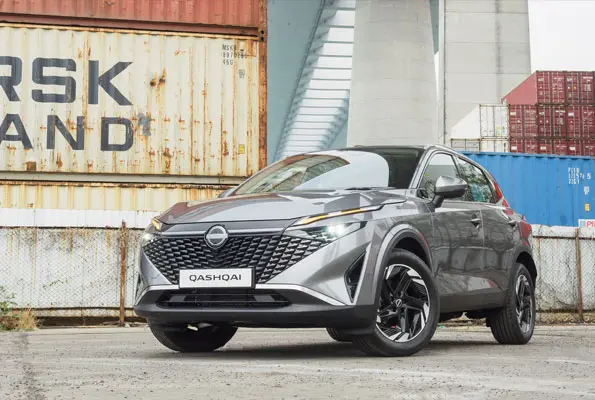
There was a moment, not long ago, when Nissan looked like one of the smarter bets in the electric vehicle race. It had the Leaf, one of the world’s first mass-market battery electric cars. It had a large, well-established factory in Sunderland, in the north of England. And in 2023, it made a public commitment that it would build an electric version of the Qashqai, its most popular car in Europe, at that very plant.
That pledge now sits on the shelf. Development of a battery electric Qashqai was put on hold sometime in the first half of 2025, in a significant revision of the company’s electrification strategy in Europe. There was no press release or prepared statement. It was a quiet abandonment, the kind that says rather a lot about how difficult things have become for one of Japan’s most storied car companies.
The Qashqai Problem
To understand why shelving the electric Qashqai matters, you first need to understand what the Qashqai is to Nissan’s European business. The compact SUV is the company’s best-selling model in the region, accounting for around 45% of total European sales of approximately 330,000 units in 2025.
In a market defined by brutal competition and wafer-thin margins, nearly half your regional sales resting on a single model is a remarkable concentration of risk. Any decision touching the Qashqai goes to the heart of Nissan in Europe.
The carmaker pledged in 2023 to manufacture an electric Qashqai at Sunderland, a commitment the UK government highlighted as evidence of the country’s standing as a global EV manufacturing hub.
No firm delivery date was ever attached to that pledge, which in hindsight looks less like prudent flexibility and more like a warning sign. If the project were now to be revived, sources say the vehicle would not reach market until the early 2030s, leaving Nissan without a full electric version of its defining European product for the better part of a decade.
Nissan cited significant volatility in EV demand and a balanced electrification strategy. The company says it is watching the market and will adapt. But what that language really describes is a retreat, dressed up in the vocabulary of strategic flexibility.
A Company Under Enormous Pressure
The cancellation of the electric Qashqai did not happen in isolation. It is a symptom of a much larger crisis. Nissan posted its largest financial loss in over two decades, a net shortfall of around $7 billion for the 2025 fiscal year, and launched a recovery initiative dubbed “Re:Nissan,” led by newly appointed CEO Ivan Espinosa, aimed at returning to profitability by fiscal year 2026.
The Re:Nissan plan targets a 20% reduction in its global workforce, amounting to 20,000 jobs by 2027, alongside closing seven manufacturing plants and reducing its global factory footprint from 17 to ten. That is an extraordinary degree of contraction for a company once considered a genuine global force in automotive manufacturing.
The model range is also being cut from 56 to 45 vehicles. Fewer models, fewer factories, fewer people. The strategy is, at its core, an attempt to stop the bleeding.
Nissan now expects to post a net loss of approximately $4.2 billion for the fiscal year ending March 2026. The company has reported five consecutive quarters of net losses, shaking confidence among management, investors, and the workforce at plants like Sunderland.
That plant tells its own story. Once producing more than 500,000 vehicles a year, it built around 273,000 cars in 2025. One of its two production lines has since been closed. In June 2026, Nissan signed a non-binding memorandum of understanding (MoU) with Chinese automaker Chery, exploring the possibility of producing Chery vehicles on the idled line from fiscal year 2027.
That a Japanese automaker would lend its flagship European factory to a Chinese rival for contract manufacturing would have seemed unthinkable five years ago. Today it is simply a pragmatic response to excess capacity and an urgent need for revenue.
The Chinese Threat
One of the most uncomfortable truths in Nissan’s current predicament is that much of what has happened was foreseeable. The rise of Chinese EV manufacturers was not a surprise. What proved harder to anticipate was the pace at which those rivals would improve and the degree to which European consumers would embrace them.
BYD overtook Tesla as the world’s largest electric vehicle maker in 2025, delivering 2.2 million battery electric cars, and Chinese brands now account for over 12% of United Kingdom’s electric car sales. Chinese automakers are rapidly gaining customers in Europe’s key SUV segments, precisely the territory where the Qashqai has traditionally been strong.
Chinese manufacturers keep selling prices low through cost-effective production, offering well-equipped cars at prices many European brands cannot match. This advantage, sustained by deep investment in battery supply chains and economies of scale, makes a Chinese electric SUV arriving in a European showroom at a competitive price a genuinely formidable proposition. Several leading models now carry five-star Euro NCAP safety ratings and longer warranties than established rivals, dismantling a quality advantage legacy brands long took for granted.
For Nissan, which has no full electric SUV in the Qashqai segment and will not have one for years, this is particularly uncomfortable. Customers who might have waited for an electric Qashqai are not going to wait until 2032. They will buy something else, and an increasing number of those something else is coming from China.
The Hybrid Pivot and Its Limits
Nissan’s response is to lean into hybrid technology, which pairs a conventional petrol engine with an electric motor but does not run on battery power alone. Rising demand for Nissan e-Power vehicles is a central part of the company’s European strategy, and Nissan argues the market is not yet ready for full electrification.
There is something to this. The United Kingdom’s zero-emission vehicle mandate, requiring one-third of new car sales to be electric this year, has compelled some manufacturers to discount electric vehicles or restrict petrol model sales. The government has committed to reviewing the mandate, potentially allowing more hybrids to count toward the targets, which would give Nissan room to sell its e-Power range without penalty.
But a hybrid pivot is not an EV strategy. Hybrids still burn petrol and occupy a middle ground that is becoming increasingly contested. Regulations across the UK and European Union are tightening, and the direction of travel is not ambiguous.
Nissan’s own position that the Qashqai EV could return in the 2030s reveals how far it has pushed back its electrification horizon. Betting that hybrids will buy enough time while Chinese rivals entrench themselves in electric SUVs is a gamble with considerable downside.
What Comes Next
Nissan is in ongoing discussions with the UK government over financial support for an updated Sunderland roadmap. The new electric Juke is scheduled to enter production at the plant, and the latest Leaf is already being built there. But Sunderland’s future as a hub for EV manufacturing, rather than simply an assembly site for whatever work can be directed its way, depends on decisions that have yet to be made.
The broader question is whether Re:Nissan will generate enough stability and headroom to allow meaningful investment in the next generation of products. The plan targets 250 billion yen in cost reductions and a return to operating profitability by fiscal year 2026. Cost cuts can stabilise a business. They cannot win back market share or close a multi-year gap in product development.
Nissan was one of the genuine pioneers of mass-market electric motoring. The original Leaf, launched in 2010, predates the modern EV era. The company knows how to make electric cars. The question is whether its current financial position will allow it to make the right ones at the right time, and whether enough time remains before the gap becomes permanent.
The electric Qashqai may yet be built. The early 2030s is not the end of the world. But it is a long time from now. And in the electric vehicle industry, a long time is exactly the kind of luxury Nissan can no longer afford.