

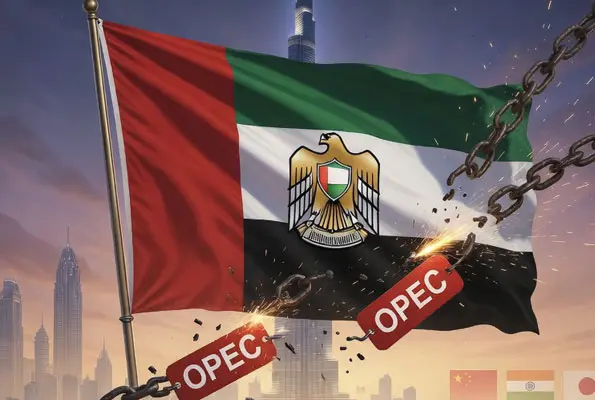
For nearly six decades, the United Arab Emirates played by OPEC’s rules. But it all came to a grinding halt on May 1, 2026. The UAE’s formal withdrawal from the Organisation of the Petroleum Exporting Countries (OPEC), after a 59-year membership, was the final step in a carefully planned, years-long strategy to transform Abu Dhabi into one of the world’s most powerful and independent energy suppliers.
Behind that decision lies a $150 billion investment programme, a pipeline being built at speed through the desert, and a port on the Gulf of Oman that is quietly becoming one of the most strategically important energy hubs on the planet.
Why the UAE left OPEC
OPEC, the cartel that groups major oil-producing nations, operates by assigning each member country a production quota. In theory, this keeps global oil supply controlled, which in turn supports prices. In practice, it meant the UAE was legally barred from selling as much oil as it was capable of producing.
The country’s oil fields can sustainably produce up to 4.85 million barrels per day. Under its OPEC quota, it was only allowed to pump around 3.4 million barrels per day. That gap of roughly 1.4 million barrels a day, multiplied across every day of every year, translated into an estimated $50 billion to $70 billion in lost revenue annually. For a nation that has invested heavily in expanding its oil infrastructure, being told to keep much of it idle was an increasingly difficult position to justify.
The tension between the UAE and OPEC’s dominant player, Saudi Arabia, has been building for years. In 2021, the UAE publicly blocked a major OPEC production deal, demanding a higher baseline quota that better reflected what it had spent on expanding its capacity. The disagreement was papered over at the time, but the underlying conflict never really went away.
The two countries have different financial pressures. Saudi Arabia needs oil prices to stay at roughly $85 to $90 per barrel to balance its national budget, which also funds the Kingdom’s ambitious “Vision 2030” modernisation projects. That is why Riyadh consistently pushes for the cartel to cut production when prices soften. The UAE, by contrast, can avoid a budget deficit as long as oil prices stay above $55 per barrel.
With a much lower threshold, Abu Dhabi has little interest in restricting supply to prop up prices. It would rather sell more oil at a moderate price than less oil at a high one. Free of its OPEC quota, the UAE can now do exactly that.
A crisis that made the urgency clear
The timing of the UAE’s exit coincided with one of the most serious energy crises the region has seen in decades. In late February 2026, following the shutdown of the Strait of Hormuz, the narrow waterway through which roughly 20% of the world’s oil and liquefied natural gas (LNG) passes every day, tankers were blocked, attacked, or turned away. Insurance costs for any ship attempting passage soared, and most simply stopped trying.
The consequences rippled outward almost immediately. Global fuel prices rose by 30%. Fertiliser prices jumped by 50%, squeezing farmers worldwide. International airfares climbed 25%. Within 80 days of the crisis beginning, nearly 80 countries had introduced emergency economic measures to protect their citizens from the fallout.
Japan, which has historically sourced more than a quarter of its oil from the Middle East, was forced to buy 60% of its May oil requirements, and 70% of its June requirements from distant alternatives, including Alaska, Mexico, Ecuador, and Venezuela.
For the UAE, the blockade was both a financial blow and a wake-up call. Its oil export revenue dropped by more than $174 million year-on-year in March 2026 alone, as bunkering activity at its ports declined and shipping was disrupted.
Drone and missile attacks targeted energy infrastructure in the region, including ADNOC facilities. ADNOC’s chief executive Sultan Al Jaber warned that even when the crisis ends, restoring shipping flows through the Strait of Hormuz to 80% of normal levels could take up to four months, with a full recovery unlikely before early to mid-2027.
The crisis simply confirmed that UAE’s strategy was right.
The pipeline that bypasses the problem
The UAE’s answer to its geographical vulnerability runs 360 to 380 kilometres through the desert, from Abu Dhabi’s onshore oil fields in Habshan to the port of Fujairah on the Gulf of Oman. Crucially, Fujairah sits entirely outside the Persian Gulf. Tankers loading oil there never need to enter the Strait of Hormuz at all.
The existing pipeline on this route is the Abu Dhabi Crude Oil Pipeline, known as ADCOP or the Habshan-Fujairah pipeline. Built in 2012 at a cost of roughly $4 billion, this 48-inch pipe can carry up to 1.8 million barrels per day. Since the Strait of Hormuz was closed, ADCOP has been running at maximum capacity, keeping the UAE’s flagship Murban crude flowing to buyers in Asia and beyond.
The problem is that 1.8 million barrels per day is far less than the UAE’s total output, and far less than the five million barrels per day the country aims to be producing by 2027. That is where the West-East Pipeline comes in.
This second, parallel pipeline follows the same route as ADCOP, with a similar diameter and an additional capacity of up to 1.5 million barrels per day. Construction began in 2025 and, as of mid-2026, the project is approximately 50% complete. Crown Prince Sheikh Khaled bin Mohamed has directed ADNOC to accelerate the build, with a target of full operations by 2027.
When both pipelines are running together, the UAE will be able to move 3.3 to 3.6 million barrels per day directly to Fujairah without touching the Strait of Hormuz. Add in Fujairah’s storage tanks and terminal infrastructure, and the port’s total crude export capacity rises to as much as four million barrels per day. That would allow the UAE to send more than 80% of its planned production to international markets through a route that no blockade of the Persian Gulf can disrupt.
The only other Gulf producer with a comparable bypass system is Saudi Arabia, which operates a seven million barrel-per-day pipeline linking its oil processing facilities to the Red Sea port of Yanbu.
Once the UAE’s West-East pipeline is complete, Abu Dhabi will stand alongside Riyadh as one of the few producers in the world genuinely insulated from the chokepoint risk that has paralysed so many others.
Why Fujairah matters to Asia
Fujairah’s growing importance is not just a UAE concern. The countries that import the most oil from the Gulf are in Asia, and they are the ones most exposed to disruptions in the Strait of Hormuz.
India sources 9% to 10% of its total crude oil requirements from the UAE. China is a major buyer of UAE crude and uses it as feedstock for its vast petrochemical industry. Japan and South Korea rely heavily on the Middle East for their energy needs.
The expansion of the Fujairah corridor gives all of these countries a more secure and predictable supply line. Instead of scrambling to find emergency alternatives in Alaska or Latin America whenever tensions flare in the Persian Gulf, they can rely on a pipeline-fed deep-water port that operates independently of whatever is happening in the Strait.
Fujairah is also growing beyond crude oil. In May 2026, AD Ports Group and Borouge, the UAE chemicals manufacturer, signed an agreement to study the creation of a dedicated export hub at Fujairah for polyolefins, the plastics used in packaging, car parts, and countless manufactured goods. This would extend the bypass corridor to high-value chemical exports, which currently have to travel through the Persian Gulf by ship.
The $150 billion machine
The infrastructure push at Fujairah is just one piece of a much larger investment programme. In November 2025, ADNOC’s board approved a five-year spending plan of $150 billion, covering the period from 2026 to 2030.
In May 2026, following the formal OPEC exit, ADNOC announced it would accelerate the deployment of $55 billion of that total, awarding contracts between 2026 and 2028 to fast-track the move to five million barrels per day.
Of that $55 billion, around $38 billion is directed at upstream projects, meaning the expansion of oil and gas production. One major focus is the Ghasha sour gas concession, a large offshore project designed to produce 1.8 billion standard cubic feet of natural gas per day, along with 150,000 barrels of oil and condensates.
Gas development matters because it supports domestic energy needs and frees up more crude for export, while also positioning the UAE as a significant LNG supplier.
The remaining $16 billion goes to downstream operations, which means turning raw crude into more valuable products. Rather than simply pumping oil and selling it at commodity prices, the UAE wants to refine it, crack it into chemicals, and sell finished materials at higher margins. This is a significant strategic shift, moving the country from being primarily a raw material exporter to becoming an integrated energy and chemicals producer.
The centrepiece of this downstream expansion is the Borouge 4 project, a joint venture between ADNOC and the Austrian company Borealis at the Al Ruwais Industrial City in Abu Dhabi. At a cost of $6.2 billion, Borouge 4 adds 1.5 million-tonne ethane cracker and 1.4-million-tonne polyethylene capacity, making the Ruwais site the world’s largest single-site polyolefin complex. As of mid-2026, the project is more than 90% complete.
At the same site, ADNOC is building the Ruwais LNG Export Terminal, a $5.5 billion facility with two large liquefaction trains capable of processing 9.6 million metric tonnes of LNG per year. That would more than double the UAE’s current LNG production capacity.
What makes the Ruwais terminal especially notable is that it will be the first LNG export facility in the Middle East and Africa to run entirely on clean, zero-carbon power. It is expected to begin commercial operations by late 2028. Japan’s JBIC and SMBC have already contributed $689 million to support the Japanese trading firm Mitsui’s 10% stake in the project.
Building the domestic supply chain
A strategy this large depends on importing enormous quantities of specialised industrial equipment, from drilling rigs to pipeline valves to process chemicals. The conflict in the region has shown just how vulnerable that supply chain can be when shipping is disrupted or infrastructure is targeted.
ADNOC’s response is its Industrial Resilience Programme, launched in May 2026. The goal is to manufacture $24.5 billion worth of critical industrial products inside the UAE by 2030, covering more than 150 categories of equipment.
ADNOC is backing this with a commitment to channel approximately $60 billion back into the UAE economy through what it calls the In-Country Value programme, which requires international contractors working on ADNOC projects to give priority to locally made products.
The initiative has already produced results. Since 2022, ADNOC has signed local manufacturing agreements worth around $22 billion, and its partners have invested more than $1.2 billion in building new factories inside the country. Around 19,000 UAE nationals are now employed in companies certified under the programme.
What happens to oil prices
The UAE’s departure from OPEC, combined with its investment programme, raises a question that matters to every country that uses oil, which is every country on earth. What does this mean for prices?
In the short term, the answer is, ‘not much’. The Strait of Hormuz closure has kept global oil prices elevated despite the UAE’s exit. But once the crisis resolves, and ADNOC’s chief executive believes that could take until early 2027, the calculation changes.
The UAE will then be free to add nearly one million barrels per day of additional crude to global supply, all of it flowing through Fujairah without any dependence on OPEC’s quota decisions.
This will weaken OPEC’s ability to manage prices through coordinated cuts. If the UAE is producing at full capacity regardless of what Riyadh decides, the cartel’s leverage shrinks.
The UAE’s exit is already influencing other major producers. Kazakhstan, which has repeatedly broken its OPEC quota and produces over two million barrels per day, has signalled its own desire to leave. Venezuela, sitting on some of the world’s largest reserves, has strong incentives to follow.
If multiple large producers shift to market-based production strategies, global oil supply will increase substantially. The long-term result is likely to be downward pressure on prices. The UAE has prepared for exactly this scenario. With a fiscal breakeven of $55 per barrel, it can remain profitable in a lower-price environment where Saudi Arabia and many other producers would face serious budget problems.
The UAE has left a trade cartel and repositioned itself for a world in which oil prices may be lower, supply may be more abundant, and the geography of energy trade may look very different from the map that defined the previous six decades. Whether the rest of the world’s energy industry is ready for that shift is another question entirely.