

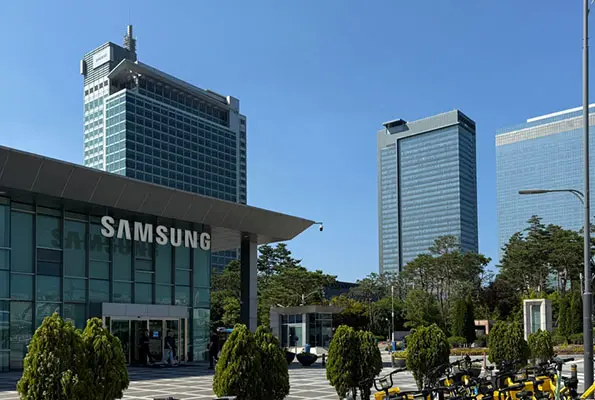
Samsung Electronics has reportedly raised prices for some advanced contract chipmaking services by up to 15% for new orders, as demand for AI chips tightens capacity in a business long dominated by TSMC (Taiwan Semiconductor Manufacturing Company).
While Samsung has seen strong demand from Chinese customers, the South Korean conglomerate has been unable to meet all orders, as it faces the test of meeting its commitments in the United States while reserving a part of its capacity to support its chip production.
“Chinese customers are among those accepting the steepest price increase, underscoring how US curbs on exports of advanced chipmaking equipment to China have increased local firms’ reliance on overseas foundries,” reported Reuters.
The price hikes also mark a turnaround for Samsung’s foundry business, which has been a loss maker since 2022, according to industry estimates. The division has struggled to narrow the gap with TSMC, despite the parent conglomerate reporting record profits, driven by soaring prices for memory chips used in AI systems.
The latest price hikes follow a similar move the company took in July, keeping in mind the mismatch between strong demand and weak supply of chips made using its 4-nanometer process, known as SF4.
Prices for SF4 customers in China and the United States have now been increased 10% to 15% from the previous month, while customers in Taiwan, home to TSMC, will be facing hikes ranging between 5% and 10%.
Prices for wafers from Samsung’s 5-nanometer SF5 process have also increased by 10% to 15%, while those for its older 8-nanometer technology rose by nearly 10%.
Samsung produced 7% of global foundry revenue in the first quarter of 2026, compared with more than 70% for TSMC, according to research firm Counterpoint.
However, demand for AI chips has booked up much of TSMC’s leading-edge capacity. The South Korean giant now expects advanced processes to account for more than half of foundry revenue in 2026, while AI and high-performance-computing applications would make up more than 30%, up from 15% to 20% in late 2025.
If TSMC’s production activities face capacity-related bottlenecks, analysts see Samsung having more leverage to raise prices.
“As TSMC faces tight capacity and raises prices, customers are shifting to rivals such as Samsung and Intel, prompting Samsung to raise its prices as well. If Samsung raises prices from here, its foundry business could potentially become profitable as early as next year, earlier than previously expected,” said Lee Min-hee, a Seoul-based analyst at BNK Investment & Securities.
Samsung’s SF4 production line at its Pyeongtaek, South Korea, plant has been reportedly running at full capacity since late 2025. The line produces logic chips for customers, including Qualcomm, as well as base dies used in Samsung’s own multi-layer high-bandwidth memory (HBM) chips.
Improvements in its production activities have also yielded to Samsung securing more customer contracts. In July, Broadcom also joined the ranks of companies, including Tesla and Apple, that have entered into chip manufacturing agreements with Samsung. Nvidia CEO Jensen Huang said in March that Samsung would manufacture the tech giant’s new AI inference processor.
Google is also in reported talks with Samsung to manufacture chips using SF4.