

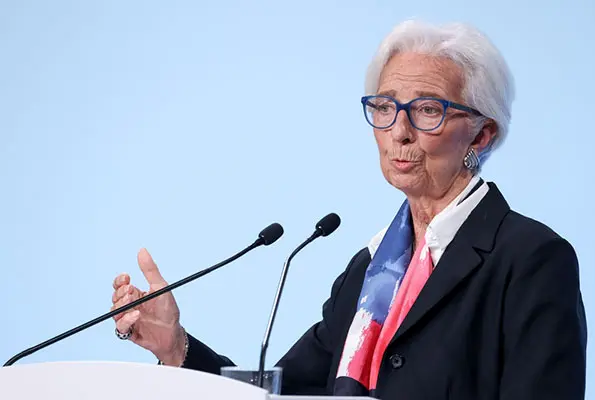
The European Central Bank (ECB) has kept interest rates unchanged, while holding the door open to another increase in September 2026, with renewed conflict between Iran and the United States erasing any hope of a quick moderation in energy costs.
While the ECB last raised its interest rate in June, things have been highly volatile since then. The return of oil prices to USD 100 per barrel, along with the fresh disruptions at the Strait of Hormuz, did stir talk of policy tightening during the latest policy meeting, said ECB President Christine Lagarde, supporting market bets that a rate hike in September is likely.
“There were some governors who asked themselves whether we should not consider a hike, in other words, raising the three interest rates. The Governing Council’s decision to keep the benchmark deposit rate unchanged at 2.25% was nevertheless unanimous,” Lagarde told a news conference.
As per Lagarde, “The ECB had flagged a hold in the weeks leading up to Thursday’s meeting on the premise that energy prices were falling quickly and moving closer to the mildest of three scenarios it set out in March. But the recent reversal, coupled with a surge in natural gas prices to more than three-year highs, has also reset energy price expectations. As we stand now today, (the milder scenario) looks quite unlikely; let’s face it. The full effects of the energy shock have yet to play out.”
Reading into Lagarde’s remarks, economists said the ECB president’s view was consistent with a hike in September.
“Lagarde’s comments at the press conference clearly point to a September rate hike. The European Central Bank has again turned more hawkish, suggesting that a September rate hike is almost a done deal,” ING economist Carsten Brzeski said, while interacting with Reuters.
The US Federal Reserve and the Bank of England, both of which will announce their monetary policy decisions next week, are also looking at possible interest rate hikes.
Investors are now betting on the ECB announcing almost three more interest rate increases in 2027, with the first move fully priced in by October and the second by next February. Elevated energy prices will play a more important role than economic fundamentals. The ECB targets an inflation rate of 2%.
“The key reason the ECB was in no rush to act on Thursday was that long-feared second-round effects of the energy price spike have yet to materialize. We are not seeing a second-round effect,” Lagarde said.
“Firms surveyed by the bank did not point to such impacts in their pricing or pay decisions, and wage growth is continuing to slow, as the ECB has long forecast. None of those elements for the moment… are giving us second-round effects indications,” she added further
“One reason why such impacts may be slow to materialize is that the labor market remains relatively soft—particularly in Germany, the bloc’s biggest economy—while surveys point to muted pay pressures. Consumers have dialled back their price expectations, and services inflation actually slowed last month. Trade tensions, high energy costs, and China’s expansion into some of Europe’s key export markets, meanwhile, suggest that the bloc’s industries will continue to struggle, putting downward pressure on labor demand,” the ECB President noted.
The central bank also sees scorching summer weather in much of Europe as a potential risk, as there are higher chances of crops getting damaged, which could end up pushing food prices, while low water levels on key rivers could create shipping bottlenecks.