

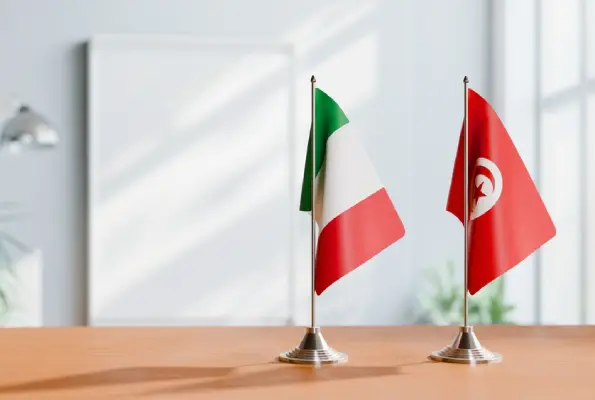
Across the Mediterranean, another form of connection is generating controversy. The authorisation and funding of the Tunisia-Italy (ELMED) electrical interconnector in 2025 has moved the project from the drawing board to reality. This is a prototype for the future of Afro-European relations, a physical manifestation of the concept of “energy interdependence.”
However, as the financing agreements with the World Bank and the European Union (EU) are signed, the mood in Tunis is not one of celebration, but of scepticism. The project has become a lightning rod for debates about “green colonialism,” sovereignty, and the true cost of the energy transition.
600 Megawatts Under The Sea
The ELMED project involves the construction of a 200-kilometre high-voltage direct current submarine cable connecting the Cap Bon peninsula in Tunisia to Partanna in Sicily. With a capacity of 600 megawatts, the bidirectional cable is designed to integrate the electrical grids of Europe and North Africa.
The project is a financial behemoth. The total cost is estimated at nearly €1 billion. In 2025, the funding puzzle was completed with a $268.4 million loan from the World Bank to Tunisia, alongside a massive €307 million grant from the European Union’s Connecting Europe Facility (CEF). Contracts were awarded to major players like Prysmian for the cable manufacturing, signalling the start of the industrial phase.
On paper, the logic is flawless. Tunisia has abundant sunshine and wind potential; Europe has an energy deficit and a mandate to decarbonise. The cable allows Tunisia to export green energy to Europe, generating hard currency revenue, while allowing Europe to stabilise Tunisia’s grid during peak demand.
Debt For Export
The reality, detailed in critical studies and opposition reports in 2025, is far more complex. Critics argue that the project is structured to benefit Europe’s energy security at the expense of Tunisia’s financial sovereignty.
The core of the critique is the debt load. The Tunisian state utility, STEG (Societe Tunisienne de l’Electricite et du Gaz), is borrowing millions to fund its share of the project. Critics point out that this increases STEG’s external debt by at least 15%. This debt is denominated in hard currency, while STEG’s revenues are largely in the depreciating Tunisian dinar.
Furthermore, the “green” credentials of the project are under scrutiny. Tunisia currently faces a significant energy deficit, importing 11% of its electricity needs and relying on Algerian natural gas for 94.5% of its power generation. The idea that Tunisia will have “surplus” green energy to export seems optimistic to local analysts.
The fear is that Tunisia will end up exporting the clean solar energy produced by private European concessions while continuing to burn dirty gas to keep the lights on in Tunis. A study by the Tunisian Observatory of Economy warns that STEG’s share of national electricity production could plummet from 88% in 2023 to just 36% by 2030, as the sector is opened up to private power producers to feed the export cable. This effectively privatises the profitable renewable sector while leaving the debt-laden state utility to manage the legacy fossil fuel infrastructure.
Green Colonialism
The term “green colonialism” has moved from academic journals to the political discourse in Tunis. The narrative posits that the ELMED cable is a neocolonial extraction mechanism. Instead of oil or phosphates, the resource being extracted is “decarbonisation.” Europe gets to claim the carbon credits and the clean power to meet its Paris Agreement goals, while Tunisia bears the environmental impact of the land use and the financial risk of the infrastructure debt.
This critique is bolstered by comparisons to European nations. In 2023 and 2024, countries like Norway and Sweden rejected similar interconnection projects (e.g., cables to Scotland or Germany) specifically to protect their domestic energy security and keep local prices low. If wealthy Northern nations are rejecting these cables to protect their sovereignty, why is Tunisia being pushed to accept one?
The answer, they argue, is the imbalance of power. Tunisia’s economic crisis makes it dependent on World Bank and EU financing. The ELMED project is part of a broader “package” of support that the country cannot afford to refuse. The “Working Group for Energy Democracy” argues that the project externalises Europe’s decarbonisation costs onto the Global South, creating a “green exchange” that is fundamentally unequal.
Sovereignty Vs Solvency
The ELMED project is a microcosm of the Global South’s dilemma in the 2020s. To access the financing needed for the energy transition, nations must agree to integrate their infrastructure with the Global North.
Tunisia needs the grid stability the cable offers. It needs foreign direct investment to reach its goal of 35% renewable energy by 2030. But the price of admission is a loss of energy sovereignty. The cable creates a physical dependency. Once connected, the flow of electrons and the flow of money become subject to the geopolitical whims of Brussels and the market dynamics of Milan.
Moreover, the pricing mechanism exposes Tunisia to European market volatility. If Tunisia imports electricity, it pays European market prices, which can spike due to geopolitical events like the Ukraine war. This risks importing European inflation into the fragile Tunisian economy.
In 2025, the ELMED authorisation is a fait accompli. The cable will be built. The question remains. Will it be a bridge for development, or an extraction tube for the 21st century’s most valuable commodity?
The era of “soft” globalisation (of borderless data and frictionless trade) is fading. It is being replaced by the era of “hard” infrastructure. There are cables, payment rails, and physical headquarters. And in this new era, he who owns the infrastructure, owns the sovereignty.