

For the first time since records began, Morocco has knocked South Africa off the top of the continent’s industrial rankings. A new report from the African Development Bank (AfDB) places Morocco at number one in its 2025 Africa Industrialisation Index, ending a dominance South Africa had held since the index launched in 2010.
This is not a fluke. It is the result of two decades of relentless, unglamorous work of building factories, training workers, laying railway lines, and digging out one of the world’s largest port complexes on the Atlantic coast.
And it is happening at one of the most turbulent moments in global trade in recent memory.
The Numbers Tell the Story
The AfDB scores countries on a composite scale that includes industrial output, investment levels, infrastructure, education, the ease of doing business, and macroeconomic stability.
Morocco scored 0.8415 to South Africa’s 0.8396, a thin margin, but a historically significant one. More telling than the gap itself is the direction of travel. South Africa’s score has fallen steadily from 0.8819 in 2010, while Morocco’s has climbed year after year.
South Africa’s decline is not mysterious. Its national power utility, Eskom, carries debt exceeding 400 billion rand and has subjected businesses and households to years of rolling blackouts. Its state rail and port operator, Transnet, has become a bottleneck rather than a facilitator of trade, inflating costs for exporters and pushing manufacturers to look elsewhere.
President Cyril Ramaphosa has acknowledged that South Africa needs the equivalent of roughly $520 billion in infrastructure investment to meet its 2030 development targets. That is a staggering hole to fill.
Morocco, by contrast, has benefited from policy consistency. Its “New Development Model,” backed by royal patronage rather than changing administrations, has allowed industrial plans to run across election cycles without being dismantled or reoriented. Projects get built. Commitments get kept.
Cars, Planes, and Drones
The most visible result of this consistency is Morocco’s automotive sector, which has now overtaken South Africa to become the continent’s largest. Renault and Stellantis operate major plants in Tangier and Kenitra, with supply chains deeply embedded in the local economy.
In 2025, Morocco produced just under 500,000 passenger cars compared to South Africa’s 330,000, and automotive exports to Europe reached over €15 billion. In January 2026 alone, vehicle manufacturing revenues surged 60 per cent year on year.
Aerospace has followed a similar arc. What was once a niche industry has grown into a $2.87 billion export sector, centred on component assembly, maintenance, and complex wiring systems near Casablanca.
Morocco is also building something newer: a drone manufacturing hub at Benslimane, supported by partnerships with Israeli, Turkish, and Portuguese defence firms. A plant near Rabat is producing armoured military vehicles in partnership with India’s Tata Group. Morocco is no longer just buying defence equipment, it is making it.
Feeding the World, Greening the Future
Agriculture remains a critical part of the economy, and Morocco has modernised it substantially. State policies launched in 2008 and updated through a 2020-2030 strategy have shifted farming toward high-value export crops such as citrus, olives, strawberries, tomatoes, which are sold primarily to European markets, with heavy investment in drip irrigation to manage the country’s persistent water scarcity.
After several severe drought years that wiped out hundreds of thousands of agricultural jobs, heavy winter rains in early 2026 refilled reservoirs to 72% capacity, up from less than 37% the year before. Forecasters expect agricultural output to rebound by 15%, providing a meaningful boost to growth.
Then there is OCP Group, the state-owned phosphate giant, which sits on 70% of the world’s phosphate reserves and produces 15 million tonnes of fertiliser annually. OCP is expanding capacity to nearly 20 million tonnes by 2027 through a programme funded partly by a $1.75 billion international bond issue.
The centrepiece of this expansion is a green ammonia complex in Tarfaya, powered by over four gigawatts of solar and wind energy. The logic is straightforward: if your fertiliser factories run on sun and wind rather than imported gas, price shocks in global energy markets hurt you far less.
When the Shipping Routes Break
This matters enormously right now. War in the Middle East, including strikes on Iran and a resurgent Houthi campaign in the Red Sea, has effectively shut down two of the world’s most critical maritime chokepoints: the Strait of Hormuz and the Bab el-Mandeb. Ships that would normally transit the Suez Canal and the Red Sea are instead rerouting around the Cape of Good Hope, adding weeks to journeys and pushing freight costs sharply upward.
For Morocco, which imports 90% of its energy needs, the effect is real and measurable. Oil prices crossing $100 per barrel are expected to widen the country’s trade deficit by about $1.4 billion in 2026, push inflation up by half a percentage point, and shave roughly half a point off GDP growth. These are not trivial pressures but the IMF and OECD still project growth of between 4.4% and 5% for 2026, with average inflation remaining low at around 1.6%.
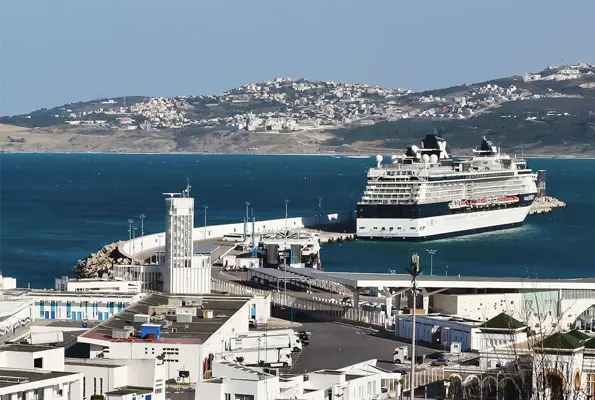
Morocco’s buffer comes from two sources. First, it holds foreign exchange reserves of nearly $49 billion and has access to the IMF’s Flexible Credit Line, a facility reserved for economies with strong fundamentals. Second, its main port (Tanger Med) is positioned not on the Red Sea but on the Strait of Gibraltar, Morocco’s western coastline facing the Atlantic.
As shipping lines have rerouted, Western Mediterranean ports have surged in traffic. Tanger Med handled 10.24 million shipping containers in 2024, an increase of nearly 19% on the previous year, and saw only a marginal dip during the Red Sea crisis. While Egypt’s Port Said lost 8.5 million containers in throughput.
Chinese electric vehicle and green energy companies, looking to bypass United States and European trade tariffs, are increasingly manufacturing at Tanger Tech City precisely because the port gives them a safe, direct route to European customers.
The Gaps That Remain
Morocco’s success story has a shadow. Youth unemployment stands at 37.3%, and more than a quarter of young Moroccans are not in education, employment, or training. These are serious structural problems for a country still building its industrial workforce. The agriculture sector continues to shed jobs even as it grows in output, reflecting mechanisation. And Morocco still imports most of its energy, leaving it exposed to geopolitical shocks it cannot control.
The government knows this. Its renewable energy targets aim for more than half of electricity generation to come from clean sources by 2030. The full opening of the Nador West Med port complex in 2026 is expected to create new jobs in the country’s historically underdeveloped north-east. And OCP’s green ammonia push is a structural hedge against the energy vulnerability that has long constrained Moroccan industry.
What It Means for Africa
Africa as a whole remains a minor player in global manufacturing, accounting for less than 2% of global output despite being home to 18% of the world’s population. Intra-African trade sits at just 14.4% of total trade, which is lower than any other major region.
The “African Continental Free Trade Area” has the potential to change this, with projections showing a 48% increase in manufactured trade between African countries by 2045 if implemented effectively. Morocco, with its established industrial base and functioning logistics network, is positioned to be one of the primary beneficiaries and drivers of that integration.
For now, though, the headline is simpler: a small country on the north-western tip of Africa, with no oil wealth and a challenging climate, has built itself into the continent’s most industrialised economy through 20 years of patient, deliberate work.