

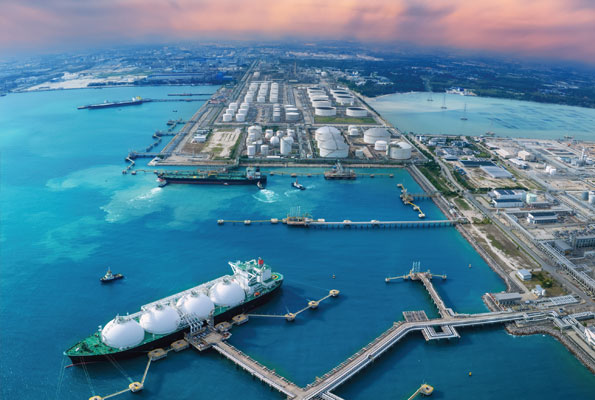
Qatar’s economic model rests on aggressive LNG expansion and the accumulation of a massive sovereign liquidity buffer. In early June 2026, the foundations of both of these pillars have been shaken.
Military strikes on Ras Laffan Industrial City followed the closure of the Strait of Hormuz, bringing immense pressure on the domestic banking sector. The attack, which happened on March 2, resulted in the Gulf country suspending its LNG production.
The Ras Laffan complex, located 80km (50 miles) northeast of Doha, is the world’s largest LNG production facility and produces about 20% of the global LNG supply, playing a major role in balancing both Asian and European markets’ demand for the fuel. However, post the strike, Qatar’s LNG export capacity has now reduced by 17%, resulting in a potential $20 billion annual revenue loss. Repairs may take three to five years, causing massive disruption to global energy supplies.
The volatile geopolitics have also transformed Qatar’s financial reserves from an instrument of intergenerational equity into a guard against national insolvency. Qatar’s estimated $500-$547 billion sovereign wealth fund, managed by the Qatar Investment Authority (QIA), and the $72 billion in central bank reserves might not be sufficient to prevent a financial crisis.
Architecture of the safety net
There are two complementary levels to Qatar’s safety net. As the first line of defence, the Qatar Central Bank (QCB) maintains the riyal’s peg to the US dollar at 3.64. As of the end of December 2023, the QCB held $72 billion in international reserves and foreign currency liquidity.
This is a deliberate strategic positioning that covers roughly 10.1 months of imports, exceeding international benchmarks. Notable shifts in the Qatar Central Bank’s strategy include gold holdings surging by 73.1% year-on-year to QR 58.5 billion, indicating that Qatar no longer believes in holding purely dollar-denominated assets.
Additionally, foreign bonds and treasury bills stood at QR 120.4 billion, while balances with foreign banks plummeted by 39.6%, signalling a move toward consolidated liquidity.
The second level is the Qatar Investment Authority (QIA). Established in 2005, the QIA is one of the world’s largest sovereign wealth funds, valued at approximately $557 billion as of August 2024. It serves as a deeper reserve for the nation. In 2023, its mandate was updated under “Amiri Decision Number 34” to include stabilising the local economy alongside creating long-term value.
Key aspects of the QIA include a diverse portfolio with investments spanning healthcare, infrastructure, technology, and financial services across global markets. This includes strategic investments such as the Series C instrument in the AI firm Anthropic, which has been part of the portfolio since early 2024.
Despite this robust architecture, the system is currently facing a challenge. There is a growing dichotomy between growth and survival, a phenomenon economists call “the great liquidation.”
The 2026 energy shock
While oil markets experienced crashes in 2014 and 2020, the 2026 crisis stems from the literal destruction of production infrastructure. On March 18 and 19, targeted strikes on LNG trains at Ras Laffan caused critical damage to Train 4 and Train 6, resulting in long-term force majeure declarations. This event removed 12.8 million tons of annual export capacity from the market, effectively eliminating 70% of the total LNG output.
Beyond the LNG trains, gas-to-liquid facilities sustained moderate damage and operations at primary export terminals were paused. The collateral impact on helium units has further extended the crisis, leading to disruptions across all global technology supply chains.
As per Saad al-Kaabi, QatarEnergy’s CEO and state minister for energy affairs, The Gulf country imposing force majeure will not only see massive revenue losses due to now-suspended long-term contracts for LNG supplies bound for Italy, Belgium, South Korea, and China, American oil major ExxonMobil, a partner in the damaged LNG facilities, along with Shell, a stakeholder in the damaged GTL facility, will have to undergo financial burdens due to repairs.
The economic consequences of these events are dire, with annual revenue losses estimated at approximately $20 billion. Furthermore, the cost to restore Ras Laffan is projected at $26 billion and is expected to take between three and five years. By 2030, the cumulative revenue shortfall will exceed $100 billion, rendering the previously planned expansion of the North Field projects highly unlikely.
The situation has been exacerbated with the closure of the Strait of Hormuz on March 4. Although Iran is permitting passage to non-hostile ships, transit has reduced to a trickle. The dual blow of infrastructure damage and maritime blockade has dampened production capacity and the ability to export resources.
Stabilising the banking sector
The Qatari Bank demonstrated strong performance and stable foundations in the fourth quarter of 2025. During this period, the bank maintained a capital adequacy ratio of approximately 20% and a Tier 1 capital ratio of 19.5%. Furthermore, it reported a system-wide liquidity coverage ratio of 190%, a non-performing loan ratio of 3.57%, and a return on equity of 14.5%.
However, the net debt was at $121 billion, which meant that it was highly sensitive to international credit market disruptions.
Qatar knows well about banking stabilisation. In 2017, during a diplomatic blockade, Qatar repatriated approximately $20 to $43 billion in QIA assets into the domestic system to offset the withdrawal of non-resident deposits.
This is being done again. With non-resident deposits totalling approximately $19 billion, the QIA’s $500-plus billion pool gives the state the theoretical capacity to effectively buy out every foreign creditor and prevent a banking crisis.
Real estate is a major component of the bank loan portfolio, and occupancy rates have collapsed by 71% alongside tourism revenue, which means there might be a sharp rise in NPLs.
The same instruments that were deployed during the 2020 pandemic are being redeployed, including a QR 75 billion QCB support package, zero-interest repo facilities, and national guarantee programmes for SMEs.
Fiscal break-even
Despite the Ras Laffan disruption, Qatar’s fiscal break-even oil price remains among the lowest in the world, estimated at $43.1 per barrel in 2024 and $44.7-$45.1 in 2025, against a conservative budget assumption of $60.
With oil prices spiking toward $150 in crisis scenarios, the theoretical margin is enormous. The problem is execution. The break-even calculations assume the ability to produce and export. With 17% capacity offline and the Hormuz passage effectively closed, Qatar must shift from current-revenue financing to drawing down the QIA’s principal.
A basic fiscal model illustrates the pressure. Assuming a 2026 pre-crisis revenue target of $60 billion, a $20 billion revenue loss from Ras Laffan, a $26 billion repair cost, and non-discretionary government expenditure of $56 billion, the projected 2026 deficit approaches $42 billion. This represents approximately 8% of QIA’s total assets, manageable for one year, but a five-year prolonged crisis would produce a cumulative $210 billion drain, nearly half of the estimated fund liquidity. Qatar’s already projected pre-crisis deficit of $13.2 billion (revised upward from an initial $3.6 billion estimate based on $60 oil) now looks modest by comparison.
Revenue diversification measures, long delayed by post-World Cup economic optimism, are now urgent. A 5% VAT, recommended repeatedly by the IMF, could generate an additional 1.2%–1.5% of GDP annually, providing a meaningful non-hydrocarbon floor. The 15% global minimum corporate tax under BEPS Pillar Two should similarly be accelerated to late 2026 or early 2027.
National Vision 2030
The Third National Development Strategy (NDS3, 2024-2030) was designed as the final push toward “Qatar National Vision 2030,” targeting 4% average annual GDP growth and $100 billion in FDI. The IMF had forecast 6.1% growth for 2026; that projection is now severed from reality. Across every key sector, the post-strike outlook is significantly worse than the trajectory entering 2026.
Tourism, which had recorded 71% occupancy growth in the first half of 2025, faces severe contraction due to regional security risk. Construction, which had grown 8.7%–9.6%, must now redirect capacity toward Ras Laffan reconstruction rather than new development. Manufacturing faces feedstock disruption, as Ras Laffan supplies the ethane, condensates, and naphtha for Qatar’s petrochemical sector; condensate exports alone are expected to fall 24%.
The ICT sector, projected at 11.6% CAGR, faces constraints from a 14% drop in helium production, which has global implications for semiconductor fabrication. Financial services, previously growing at 11.1%, must now adopt a defensive posture. Expenditures on mega-projects like the $5.5 billion Simaisma tourism city must be suspended in favour of the Ras Laffan restoration.
The great liquidation
If hostilities persist through late 2026 and beyond, the QIA’s capacity to fund domestic deficits without triggering global market disruptions becomes the critical variable. The fund holds significant stakes in European banks, London real estate, and US technology companies.
Forced liquidation of these assets could destabilise equity markets and deflate the AI-driven asset bubble. More broadly, any large-scale Gulf sovereign selling of US Treasuries to cover domestic expenditure would push yields higher, complicating Federal Reserve policy at a moment of potential hyper-stagflation driven by record energy prices. The feedback loop is self-reinforcing. Asset sales depress portfolio values, which reduce the effective size of the buffer, which compels further sales.
Qatar’s survival toolkit has been tested before. In 2017, a four-nation blockade was defeated through a combination of QIA asset repatriation, import rerouting via Oman and Turkey, rapid commissioning of the $7.4 billion Hamad Port, and private sector subsidisation through rent reductions and direct financial support.
The 2020 COVID-19 response demonstrated that the Qatar Central Bank could deploy a QR 75 billion package to protect SMEs and maintain credit stability without a systemic banking failure. These experiences have hardened institutional crisis management capacity, and the same levers are being pulled again.
The 2026 crisis is more severe in two respects. The physical destruction of infrastructure creates a multi-year production constraint that cannot be resolved through diplomacy alone, and the maritime blockade multiplies the revenue impact of the facility damage. No amount of reserve repatriation addresses the fundamental problem of having less to sell and less ability to ship it.
The geopolitical exposure
The strikes on Ras Laffan, part of a broader campaign involving the North Field–South Pars infrastructure shared with Iran, have exposed the structural vulnerability of Qatar’s mediator role.
By positioning itself as an intermediary between Israel, Hamas, the United States, and Iran, Qatar arguably drew attention to its national infrastructure. Following the March strikes, Qatar formally paused its mediation efforts. The United States has presented a 15-point proposal to Iran, but hostilities continue.
In the longer term, the 2026 Gulf energy shock may function as an accelerant for the global energy transition in the same way the 1973 oil embargo reshuffled energy security priorities. Asian economies are already rationing energy and curtailing fuel exports. Qatar’s LNG expansion, premised on gas as a bridge fuel through mid-century, has been materially undermined.
Force majeure declarations extending to five years will redirect long-term buyers toward US and Australian LNG suppliers, eroding Qatar’s market share in ways that cannot be recovered simply by repairing infrastructure.
The evidence supports a nuanced conclusion. Qatar’s $500 billion safety net can prevent a financial collapse, but cannot prevent an economic crisis. It is sufficient to stabilise banks. The QIA’s reserves are nearly five times the total non-resident deposit exposure of $109 billion. It is sufficient to support government operations, as liquid reserves can fund essential salaries ($18.5 billion annually) and social subsidies for well over a decade with zero energy revenue. And at less than 5% of QIA’s AUM, the $26 billion Ras Laffan repair bill is a manageable capital expenditure, contingent on military stabilisation.
What the buffer cannot prevent is the multi-year GDP contraction from lost export capacity and the Hormuz blockade, the reputational damage to Qatar’s status as the world’s most reliable LNG supplier, or the global market disruption from forced asset liquidation. Each year of delay in restoring Ras Laffan and reopening the Strait compounds the fiscal drain and narrows the strategic options available.
Qatar’s fiscal fortress will hold. The safety net was built precisely for a scenario of this kind, and the institutions managing it have performed under pressure before. But the nation that emerges from the 2026 crisis will be measurably poorer, strategically more cautious, and diplomatically more constrained. The buffer has transformed from a growth vehicle into a lifeline, and though it will keep Qatar solvent, the return to 5% annual growth will be the defining economic challenge of the decade ahead.