

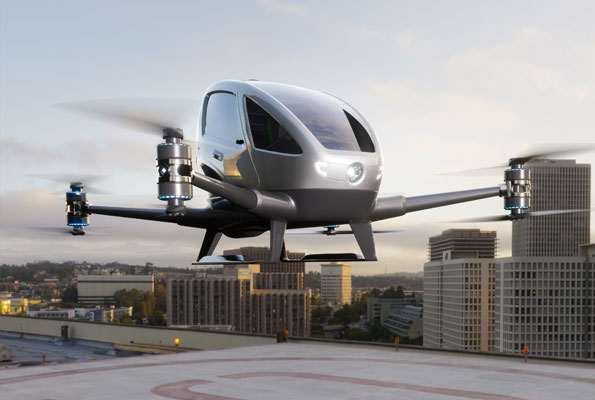
The advent of fully electric, self-flying air taxis and cargo drones reflects a bold new horizon in aviation. As global air travel rebounds to record levels, the pressure is on to find new ways to increase capacity and efficiency.
According to the International Air Transport Association (IATA), the airline industry is poised to exceed $1 trillion in annual revenues by 2025. It will be the first time it breaks that barrier, and this growth is fuelled by around 5.2 billion passengers (up 6.7% year-on-year) and 72.5 million tonnes of air cargo (up 5.8%).
This soaring demand is prompting aerospace giants and innovative startups alike to explore autonomy as a way to scale operations and cut costs. Boeing, Airbus, Lockheed Martin, Northrop Grumman, and others are investing in autonomous flight systems, and a new crop of eVTOL startups such as Wisk, Joby, EHang, and Elroy Air are racing to turn autonomous air travel into a reality. Countries with deep pockets for R&D, notably the US, China, and some European Union (EU) nations, are leading the push with government-backed programmes and defence-driven technology transfer.
Despite the hype, analysts caution that pilotless passenger aeroplanes remain years away from routine service. As aerospace historian Dan Bubb observes, “fully autonomous aeroplanes could still take several years to be available to the open market,” and many expect that true pilot-free jets will not dominate civil aviation until the 2040s.
In the meantime, incremental steps—from enhanced autopilots to hybrid crew/autonomy models—are expected to roll out. Dr. Walter Stockwell of ANELLO Photonics notes that in the near term, we’ll see autonomy in niche roles (military drones, surveillance, speciality missions, cargo), with commercial passenger applications emerging in roughly 10-15 years, and “hybrid models combining autonomy with human oversight” in service by the early 2030s.
Likewise, Sylvester Kaczmarek of OrbiSky Systems predicts that automated cargo and logistics aircraft could be ready for large-scale operations within five to ten years, potentially easing current supply-chain bottlenecks. In short, a stepwise approach, starting with drones and cargo and gradually expanding to passenger service, seems most likely.
Economics powering autonomy
The drive toward autonomy is shaped by market forces as much as by technology. In the cargo sector, soaring e-commerce and geopolitically driven supply-chain delays have created demand for faster, more flexible air logistics. Fully unmanned cargo planes and delivery drones could slash labour costs and operate around the clock, easing capacity crunches.
Bill Irby, CEO of AgEagle Aerial Systems, emphasises the potential. If airlines and militaries can even out pilot shortages and surpluses with automation, the payoff would be “huge.” Indeed, autonomous aircraft can significantly improve operational efficiency by optimising flight routes and fuel use, reducing maintenance downtime, and tackling dangerous missions without risking crew.
For passenger travel, the picture is more speculative but no less ambitious. “Urban Air Mobility” concepts, think fleets of small air taxis shuttling commuters across cities, promise to revolutionise short-range travel. Industry experts envision new ride-sharing models in the sky, and instead of airline hubs and runways, travellers might board on-demand eVTOL shuttles at “vertiports” on city rooftops or parking garages.
These vehicles could carry a handful of passengers (typically four to six) over distances of a few dozen miles, bypassing traffic, and potentially charging a premium for convenience.
According to a recent survey by Honeywell, nearly all frequent fliers (98%) said they would be willing to try an air taxi, and 80% indicated they would travel more often if a convenient air taxi to the airport were available. This suggests strong latent demand, at least among business-oriented travellers. That said, actual air-taxi networks will require new infrastructure (vertiports, charging/refuelling hubs, UAS traffic management) and regulatory frameworks before they can scale. Other niche services will also emerge. Drones for infrastructure inspection, agriculture monitoring, or emergency response can deliver immediate value at lower risk, since they often involve cargo or unmanned flights over sparsely populated areas. In fact, several experts expect that the first widespread impact of autonomy will be felt in these support roles.
Michael Healander of Airspace Link argues that as “digital infrastructure matures,” we will see integration between traditional aviation and autonomous operations, eventually extending to passenger air taxis for people and cargo alike, and even opening new revenue streams for airports and municipalities. In essence, autonomy will replace existing business models and create entirely new ones. From “high-frequency” drone delivery networks to distributed urban air transit systems, and from remote-piloted cargo hubs to on-demand aerial services.
However, these new opportunities come with tough economics. Developing a safe autonomous aircraft is extremely costly. A recent McKinsey report estimates that each company developing such an aircraft might spend $1-$2 billion on engineering, prototyping, and certification alone. While some Advanced Air Mobility (AAM) firms are already injecting tens or hundreds of millions into research (often backed by venture capital or corporate partners), experts caution that this is only the start.
Irby said, “Government tech investments need to increase to match what militaries have done in conflict zones.”
Likewise, Healander notes that even in the United States, a potential leader in AAM, major aerospace and logistics companies must boost their R&D spending and work with regulators to create new equipment and airworthiness standards.
Rules of the sky?
Aviation is one of the most heavily regulated industries, and the move to autonomy adds layers of complexity. Regulators worldwide are scrambling to update rules, certify new vehicle types, and ensure safety in mixed airspace. In the United States, the FAA (Federal Aviation Administration) has already taken concrete steps. For example, by late 2024, it issued final regulations for “powered-lift” aircraft (the category including eVTOLs), setting pilot training and operational standards. In mid-2023, it expanded the definition of “air carrier” to explicitly include powered-lift commercial operators. The FAA has also released an “Innovate 28” roadmap to guide AAM integration by 2028 and even published vertiport design standards to lay the groundwork for physical infrastructure.
Additionally, the FAA is collaborating with international partners, including the United Kingdom, EU, Japan, Korea, and others, to harmonise certification and airspace rules, so that AAM systems can eventually operate across borders.
In Europe, regulators have been equally proactive. The European Union Aviation Safety Agency (EASA) has created a unified set of EU-wide drone and eVTOL regulations, aimed at the “highest safety standards.” EASA highlights that it now covers over 1.6 million drone operators under a single rulebook, and it claims to have “the most advanced rules and standards for safe and secure drone operations” in the world. This includes risk-based categories (open, specific, certified) and a framework (SORA) for authorising complex operations.
EASA is also building an “Innovative Air Mobility” hub to coordinate stakeholders (cities, manufacturers, operators) and address issues like noise, sustainability, and airspace management. In practice, Europe is allowing some AAM trials (for example, in France, Germany, and the Nordics) but remains cautious on fully pilotless passenger flights until safety case data is mature.
China, too, has begun paving its regulatory path. In March 2025, it made headlines by granting the first-ever commercial operating certificates (AOCs) to autonomous passenger drone services. Companies EHang and Hefei Hey Airlines received CAAC approval to fly UAV “air taxis” for tourism and sightseeing.
Notably, these approvals came after the companies already obtained technical certification (type, production, and airworthiness), meaning regulators first ensured the aircraft met safety specs before allowing them to carry people. China is also rolling out “low-altitude economy” policies across cities to promote drone deliveries and eVTOL services, effectively treating them as part of the national industrial strategy.
Despite all the progress, major regulatory challenges remain. Authorities must define how autonomous flights will share airspace with conventional aircraft. Concepts like UAS Traffic Management (UTM) or Unmanned Aerial Systems (NAS) need to scale up to thousands of daily flights in cities. Existing air traffic control (ATC) systems were not designed for autonomous corridors, and managing mixed operations is “difficult,” to use Stockwell’s word.
Questions of liability, privacy, and security also loom large. For example, who is at fault if an AI pilot errs? How to prevent unauthorised drones from entering controlled airspace? How to ensure passenger privacy in a world of ubiquitous sensors? Regulators will need to address these with new laws and standards. As Irby and Bubb warn, easing the public’s deep concern over safety will require not only solid rules but years of proven reliability, especially given high-profile failures in related technologies like self-driving cars.
Engineering the impossible
Autonomous flight pushes the boundaries of sensors, computation, connectivity, and navigation. Every potential collision must be avoided, and this requires “detect-and-avoid” systems that work even in crowded, complex environments (downtown Manhattan or busy urban canyons).
Building those systems is non-trivial. Current machine-learning autonomy demands tremendous onboard computing power, which in turn adds weight and energy consumption—a major trade-off for aircraft.
Advanced inertial navigation and sensor fusion (radar, lidar, computer vision) will be needed to maintain precision even when GPS signals fade or communications lag. In short, true machine-learning and autonomy are very complex areas that are fundamentally constrained by aircraft size, weight, and power considerations.
Urban air taxis will fly low and fast, often below tall buildings, so reliable networks are vital. Luckily, work is already underway, and NASA recently tested 5G cellular links between a research aircraft and ground stations, finding that 5G can “manage a lot of data at once” and handle low-latency demands for air taxi operations.
In fact, NASA engineers suggest that existing 5G networks might meet roughly 80% of aviation comms needs, with only modest upgrades needed. This kind of leveraging of commercial telecom infrastructure could save billions versus building a bespoke network. Nevertheless, operators will need redundancy to avoid single points of failure.
Autonomous aircraft will rely on digital command links and onboard computers for essential functions. Like any connected system, they could be vulnerable to hacking, spoofing, or software bugs.
A high-impact event could be catastrophic in a crowded sky. The recent Microsoft/CrowdStrike blackout is a reminder that even the biggest tech systems can briefly fail. A robust aviation-grade cyber defence strategy, covering navigation data, command-and-control channels, and cloud services, will be mandatory.
Testing and validation pose a final barrier. Unlike self-driving cars that can pull over safely after a glitch, an aeroplane cannot just land on the shoulder. Any flight test of an autonomous aircraft carries real risk. As Stockwell notes, gaining access to controlled airspace for test flights and winning acceptance for occasional test failures is critical to progress.
Governments may need to sanction special test corridors or simulation environments where new systems can be trialled extensively. Synthetic testing will also play a major role, but ultimately, real flight hours will be required to certify safety.
Public perception and trust
Recent crashes (of drones, experimental aircraft, or even incidents involving partial autonomy like Tesla’s autopilot) feed into a deep-seated fear that machines might “take off and not return” reliably. As aviation historian Bubb points out, the bar for safety will be extraordinarily high. Given “the deep concern the public has about aviation safety,” even minor setbacks could slow adoption. Convincing lay passengers to board a pilotless jet could take a generation of proven flight hours and transparency about safety cases.
On the other hand, Honeywell’s 2024 poll found that a remarkable 98% of frequent flyers would be willing to take an air taxi, and 80% said they would fly more if a convenient eVTOL service were available to the airport. Younger demographics and frequent business travellers expressed even higher interest.
These numbers suggest that, if carriers can ensure safety and reliability, the market appetite may be strong, especially if air taxis can deliver on speed and convenience. Public acceptance will likely emerge in phases. Success stories in cargo and commuter drones might build trust before passenger service is phased in. Outreach campaigns, transparent safety reporting, and perhaps gradual steps will all help assuage public fear.
Enabling autonomous air mobility will require significant infrastructure, digital, and safety-related upgrades, which won’t be fulfilled without a massive, long-range investment. Aerospace companies are used to decade-long development cycles and multibillion-dollar budgets, but autonomy raises the stakes even higher.
Early adopter countries, those willing to invest now in vertiports, test corridors, and regulatory frameworks, stand to reap future economic benefits by hosting this new industry. Countries lagging in infrastructure risk watching domestic companies struggle overseas. In that sense, the flight path to autonomy is not just a technical one but a strategic national project as well. In the race to autonomous flight, foresight will matter as much as flight control.