

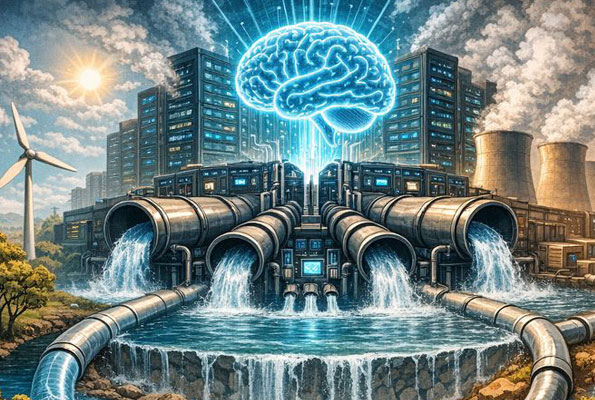
Although artificial intelligence (AI) has created amazing new opportunities, there is an environmental cost that is often overlooked: water. Even though discussions about AI’s energy requirements have made headlines, its enormous and expanding water footprint is still mostly hidden. Experts caution that there may be major repercussions from that blind spot.
“We have no universal approach to assess how much water is consumed while using or training artificial intelligence,” Salah Al-Kafrawi, senior consultant at EY for data and AI, told Arab News, leaving the true scope of the issue unclear.
The majority of businesses, from e-commerce to aviation, are ignorant of their water consumption, despite the fact that a few tech companies release approximate water usage estimates.
Al-Kafrawi said, “Many people aren’t even aware of their water footprint.”
Even the data currently available probably underestimates reality by a factor of ten or more. AI’s growing thirst is a silent crisis that necessitates innovation, transparency, and smarter systems in a world where water is becoming scarcer.
The water usage of artificial intelligence is complicated. It covers both direct consumption, like cooling servers, and indirect consumption related to the electricity used to power them.
“AI requires significant data for training and evaluation, along with electricity to operate and cooling systems to prevent overheating,” Al-Kafrawi said.
Those power sources frequently use a high quantity of water to generate electricity. A hidden environmental cost that is rarely included in sustainability reports is the “millions of gallons of water daily” used by nuclear and coal-fired power plants for cooling and steam production. To prevent their servers from overheating, data centres use enormous amounts of water.
“Water cooling towers are frequently used by data centres to dissipate heat produced by their servers,” Al-Kafrawi stated, adding that this creates “another significant source of water usage.”
This creates a harmful cycle where AI requires power, which produces heat, necessitating additional water for cooling.
“The combination of water needed for electricity generation and cooling systems means that AI’s water footprint extends far beyond what might be immediately apparent,” Al-Kafrawi said.
It is more important than ever to manage this balance in Saudi Arabia, where water is limited, and AI infrastructure is growing.
The majority of data centres worldwide depend on drinkable water, even though it is scarce, according to Abdulelah Al-Shehri, an assistant professor of chemical engineering at King Saud University. According to him, a system’s lifespan is directly impacted by water purity.
Reclaimed water does carry the risk of microbial contamination and corrosion, but there is growing momentum to safely repurpose non-potable sources. The majority of data centres in the Kingdom now employ hybrid cooling systems.
“Saudi data centres rely on high-efficiency mechanical cooling systems combining air-cooled and water-cooled chillers,” said Al-Shehri, referencing Microsoft’s climate-adaptive guidelines and the Saudi Telecom Company’s 2023 Sustainability Report.
The cost of even these effective systems is high. According to Al-Shehri, the cooling infrastructure for the 300 MW of operational data centres in the country uses two to three litres of water per kilowatt-hour.
“If we look at current capacity operating at full load year-round, annual water use would approach 6.7 million cubic metres,” he warned — roughly the same amount used by 160,000 Saudi households each year.
This is only the first step. Al-Shehri stated that capacity could more than quadruple to 1,300 MW in five years, matching the water consumption of 700,000 households.
He went on to say, “These numbers only reflect direct water use for cooling.”
Even higher is the indirect cost associated with the production of energy from fossil fuels. There are promising solutions despite the rising demand, according to Al-Shehri, but they call for funding and foresight.
Several water-saving data centre cooling solutions are being developed, but investors are frequently put off by the high upfront costs and expensive retrofits. The idea of reconsidering conventional cooling standards is one of the most promising.
“These ‘high-temperature data centres,’ which Microsoft and Google have piloted, would effectively drive the direct water footprint to zero,” he added.
Systems can use more air than water by increasing operating temperatures from 21°C to 35°C.
Other technologies concentrate on heat recycling. Al-Shehri stated, “Absorption chillers can recover up to 40% of waste heat here and repurpose it for cooling,” citing international examples like Infomaniak, a Swiss company that currently uses server heat to warm 6,000 homes. The energy mix should also be taken into account.
“It’s not a straightforward swap to diversify energy sources for AI power,” he noted.
The water footprint, data centre accessibility, and resource availability all play a key role.
The research revealed that the most water-efficient sources are wind and solar. Al-Shehri stated that biomass, a renewable energy source that is heavily promoted, has the potential to use “up to 100 times more water than natural gas.”
The Saudi Arabian managing director of the international water solutions company Ecolab, Abdullah Al-Otaibi, emphasised that the treatment and transportation of water itself represent another unconsidered expense.
“Water must be moved, heated, cooled and treated to be fit for business use, which requires energy,” he said.
He framed water and energy as interconnected levers — what scientists call the water-energy nexus. Water serves a dual purpose in data centres. It cools the infrastructure directly and gets consumed indirectly when generating the electricity that powers high-performance computing.
Challenges remain
There is danger in not managing this interdependency. Ignoring water poses a risk, especially in areas like Saudi Arabia, where water is limited, and digital infrastructure is growing quickly. Better data and AI tools can assist businesses in understanding and minimising their energy and water footprints, according to Al-Otaibi.
“Businesses can increase the visibility and manageability of water use by utilising the appropriate data and technologies,” he remarked.
Ecolab’s audits indicate that substantial gains are achievable. Clients have used their tools to reduce energy use by 22%, emissions by 12%, and water usage by 44%, all while increasing dependability.
Al-Otaibi said, “Water efficiency can become a business enabler, supporting uptime and sustainability targets at the same time.”
As the infrastructure of artificial intelligence spreads quickly throughout the Gulf, Al-Otaibi called on stakeholders to take immediate action, particularly during the design phase.
He referenced Ecolab’s collaboration with international data centre operator Digital Realty, noting that their AI-powered system is anticipated to stop the annual withdrawal of 126 million gallons of drinkable water and cut water consumption by up to 15%.
In Saudi Arabia, where water is scarce and technological aspirations are high, such efficiency is not only wise, but necessary.
The growth of AI brings clear benefits, but it also places heavy pressure on water resources. Without better data, smarter design, and early action, water use will rise sharply. Managing water and energy together is essential, especially in water-scarce regions.