

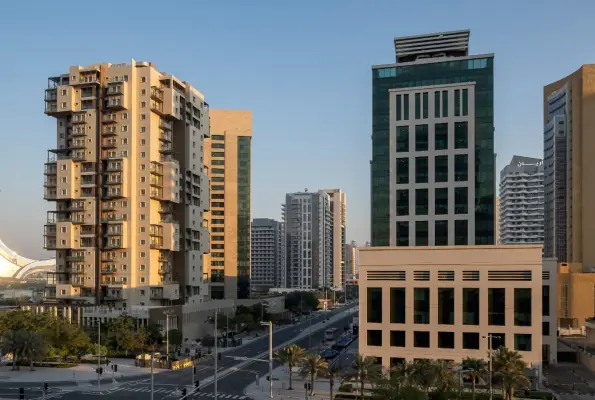
The Qatar real estate market started 2026 on a strong footing, with the total value of property transactions crossing 2.71 billion Qatari Rials (approximately USD 744 million) in February.
According to the latest data released by the Gulf country’s Ministry of Justice’s Real Estate Registration Department, the transaction volume of 384 property deals in the month displayed healthy market liquidity. This indicates that despite higher global interest rates, local financing policies have supported property acquisitions. The diversity of the transactions reveals that growth is due to developments in multiple segments and is not concentrated in a single niche.
Growth has been spread across key municipalities, but some among them have come out as champions. Municipalities of Doha, Al Rayyan, and Al Dhaayen have become investment magnets. Doha, of course, being the commercial and political hub, commanded the highest value transactions, mostly driven by commercial plot acquisitions and high-end residential sales.
Al Rayyan and Al Dhaayen, on the other hand, saw significant infrastructure developments and expanding suburbs, catering to a growing middle-class population and expatriate workforce.
The residential sector has emerged as the most active asset class in the market, with vacant land plots witnessing higher demand, which usually leads to future construction activity, indicating a desire for developers and private citizens to build in the coming years.
The Qatari policy is also very conducive and aims at transparency and simplification of the registration process to improve investor confidence. Areas have been demarcated where only non-Qatari nationals can own property, which attracts FDI. These are called “freehold zones,” examples of which are the Pearl and Lusail City, where international buyers are shopping for luxury assets.
Qatari real estate in 2026 looks promising. February’s success is a testament to economic diversification and momentum under the framework of “National Vision 2030.” There are many infrastructure projects lined up, and the stable macroeconomic environment and property sector are well positioned to remain as a cornerstone of the Gulf nation’s non-oil economy for the foreseeable future.
Industry analysts expect that if current trends continue, the annual total for 2026 could surpass previous benchmarks, further cementing Qatar’s status as a premier investment destination in the Middle East, despite the ongoing geopolitical uncertainty around Iran. As we move into March 2026, the momentum from February’s USD 744 million high has faced a more complex global backdrop, characterised by a sharp rise in regional tensions that pushed global oil prices above USD 100 per barrel.
Despite these external “risk-off” shocks, the Qatari market has shown remarkable resilience. Early March data indicate that weekly transaction values have remained robust, occasionally exceeding the benchmark of 1.2 billion Qatari Rials. This suggests that the local market is increasingly decoupled from global volatility, anchored instead by the nearing production phase of the “North Field East LNG” expansion, which continues to underpin long-term investor confidence in the state’s fiscal stability.
Furthermore, March has seen a strategic shift as the government intensifies its Third National Development Strategy (NDS3), specifically targeting a transition toward a more mature, private-sector-driven economy. While higher global interest rates have caused some cooling in other regional hubs, Qatar’s recent affirmation of its “AA” credit rating by S&P Global in mid-March has reinforced its status as a safe haven.
Investors are currently pivoting toward high-yield “defensive assets,” particularly in the industrial and specialised residential sectors, as the country prepares for a packed international events calendar and the resulting surge in hospitality demand.