

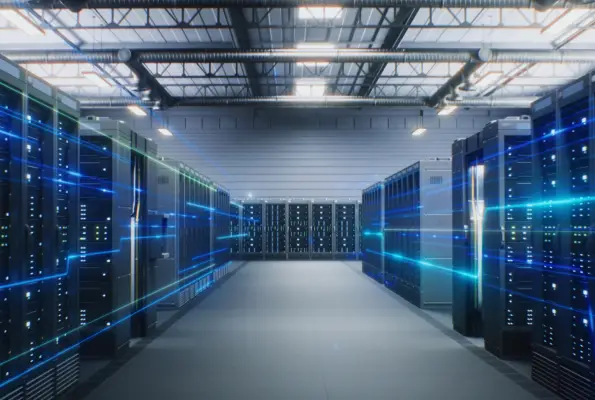
AVEVA will extend its industrial software playbook into AI infrastructure, one of the fastest-growing segments of the digital economy. In a new collaboration with NVIDIA, a world leader in AI computing, the Cambridge-headquartered company will integrate its engineering and operations software into the chipmaker’s “Omniverse DSX Blueprint,” creating a lifecycle digital twin architecture for large-scale AI factories.
The idea is to give operators a single digital environment to design, simulate, build and optimise high-density data centres before deploying solutions in the physical world.
The deal comes at a time when AI data centres are getting larger, denser and far more power-hungry, turning infrastructure design into a strategic bottleneck for cloud providers, enterprises and utilities.
The International Energy Agency (IEA) projects that global electricity demand from data centres will more than double to 945 terawatt-hours by 2030, up from 415 terawatt-hours in 2024, largely because of AI workloads. In practical terms, this means the economics of an AI facility will increasingly depend on how efficiently operators can manage power, cooling and equipment utilisation.
That is where AVEVA sees an opening. According to the company, customers will be able to bring OpenUSD SimReady assets into AVEVA Unified Engineering, manage equipment and configuration changes through AVEVA Asset Information Management, and use AVEVA Process Simulation to model advanced liquid-cooling networks for AI factories.
Its PI System will aggregate IT and OT data across the NVIDIA Omniverse DSX Exchange, with a roadmap that includes anomaly detection and forecasting from systems such as building management, power monitoring, cooling infrastructure, server racks and workloads.
For operators, the business case is less about visual novelty than about reducing costly delays and performance losses. AVEVA says the architecture is designed to accelerate “time-to-token,” the industry shorthand for how quickly a data centre can be deployed and begin producing usable AI compute output.
By connecting design data with real-time telemetry, the company is pitching digital twins as a way to improve GPU efficiency, catch degradation early and support faster root-cause analysis as rack densities rise.
The move also broadens AVEVA’s addressable market at a time when demand for AI-ready infrastructure is reshaping the industrial technology sector. Schneider Electric, AVEVA’s parent, said data centres remain a standout growth engine, with 2025 revenue rising 8.9% organically and North America up 15% year-on-year.
Reuters also reported triple-digit growth in Schneider’s pure data centre segment. These figures help explain why industrial software vendors are increasingly repositioning themselves as core enablers of AI infrastructure, not merely back-end automation suppliers.
AVEVA enters this push with meaningful scale. The company says more than 90% of leading industrial enterprises rely on its software, while over 20,000 enterprises in more than 100 countries use its platforms and applications.
If digital twins become standard architecture for AI factories, AVEVA’s expansion from plant engineering into compute infrastructure could mark a significant shift in how the business software stack for the AI economy is built.