

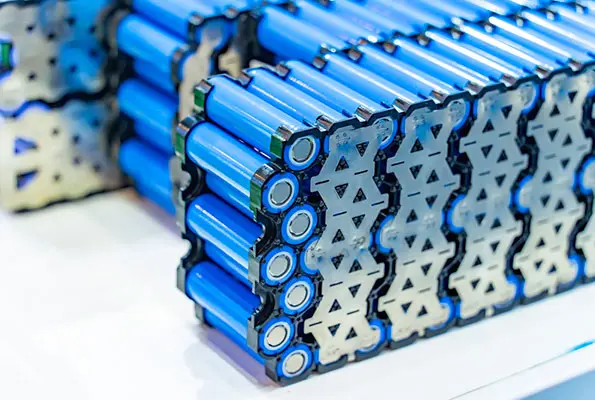
Lithium-ion batteries are everywhere. They power mobile devices, electric vehicles, and they enable the large-scale energy storage systems that support the transition to renewable electricity generation. As global demand surges, the transport and logistics sector has become crucial to a rapidly evolving supply chain, tasked with safely handling, storing, and transporting these potentially high-risk goods.
Defective, damaged or incorrectly handled batteries can fail and go into thermal runaway. This is a self-accelerating reaction, in which rising temperatures drive more chemical reactions and further temperature increases.
Why these fires are different
Lithium-ion fires behave differently from conventional ones. They reach high temperatures much faster, burn at up to 1,200 °C, and can sustain that level for a long time. They are also hard to extinguish, partly because internal reactions can release oxygen, making them less dependent on external oxygen.
Therefore, conventional firefighting methods that rely on smothering the fire by removing oxygen are unsuitable. These fires can also reignite hours, days or even weeks after being extinguished.
State of charge (SOC) matters, but it is not a safeguard in itself. One simulation of LMO batteries at 50% SOC filled a warehouse with smoke and vapour in 120 seconds, while batteries at 100% SOC took just 30 seconds.
Even so, reducing SOC lowers the energy available to fuel a thermal runaway event but does not eliminate the risk of fire, toxic gas release, or vapour cloud explosion. So, warehouses should not assume low-SOC batteries are inherently safer.
Start with the contract
Risk management begins before a single pallet arrives. Contractual risks increase when operations extend beyond basic warehousing into value-added services such as repacking or charging, which can introduce significant scope creep. That can expose the operator to liabilities not adequately covered by standard trading conditions or insurance.
The advice is threefold:
- Define the scope of services in the contract, including what is explicitly excluded.
- Treat know-your-customer principles as a primary risk management tool.
- Ensure subcontractors are contracted on back-to-back terms.
Operators should also watch for inventory that becomes stagnant in storage and risks being abandoned. Identifying affected cargo early and holding a contractual lien over it can be critical.
Design the warehouse around the hazard
There are currently no mandatory global standards for storing Li-ion batteries in warehouses. So, operators must apply sound judgement. It is good practice to have a dedicated storage area or, preferably, a separate warehouse for Li-ion batteries.
Once a fire starts, pallet flow, drive-in, double-deep and push-back racking systems carry increased risks, as there is no readily available access to all pallets. To extinguish a Li-ion battery fire, firefighters and the firefighting medium must have direct access to the batteries to cool them. Very narrow aisle racking presents a different problem. Because the distance between aisles is smaller, a fire will spread more easily from aisle to aisle.
But spacing alone cannot solve the problem. According to one simulation, the critical shelf spacing to prevent fire spread from NMC Li-ion batteries at 100% SOC was 8.3 metres, which is clearly impractical. The better answer lies in the building itself. Dividing the warehouse into fire-resistant ‘compartments’ limits the spread of fire, smoke and toxic vapours. Because compartments are a passive form of protection that needs no system activation, they buy critical time for evacuation, and help avoid large-scale damage to the warehouse and goods.
Thermal runaway warning technology is critical for ensuring Li-ion battery safety. Having thermal detectors in the Li-ion battery storage area is strongly recommended. Detectors should also be installed for gases such as carbon monoxide and methane, and specialist hydrogen fluoride detectors are available.
Suppression needs equal care, because traditional systems that target fuel, oxygen or heat may not be as effective for Li-ion battery fires, as the cells can produce their own oxygen. ESFR sprinkler systems are strongly recommended, and in-rack sprinkler systems can be effective.
Whichever system is chosen, Li-ion battery fires usually require vast quantities of water to extinguish them.
People come first
Products marketed as “Li-ion extinguishers” should not be read as an expectation that employees will approach a battery that is venting, overheating, or in thermal runaway. Even with the correct PPE, only professional firefighters should try to extinguish the fire. The toxic hazards are serious.
Experiments show Li-ion battery fires can release up to 200g of hydrogen fluoride per kWh of capacity. The harmful effects of inhaling it may not become apparent until several hours after the incident.
Preparation with the emergency services is, therefore, essential. Early communication ensures first responders know that Li-ion batteries are present, and exactly where and how they are stored. The 2021 Morris, USA warehouse fire shows the scale of the problem. Around 60 tonnes of Li-ion batteries caught fire, and around 3,000 to 5,000 people were evacuated.
No single measure will manage this hazard on its own. The hierarchy of controls ranks risk mitigation measures from most to least effective. Engineering controls, such as compartmentalised storage zones, fire-resistant construction, enhanced ventilation and early detection systems, form the next essential layer of defence, while PPE serves as the final safeguard where residual risks cannot be designed out.
Warehouse design, inventory control and staff training are critical. Contracts must define scope and liability clearly, and fire suppression must be tailored to Li-ion battery behaviour. Regulatory standards remain inconsistent globally. So, operators must stay informed and vigilant.
(Mike is the Managing Director of Loss Prevention at TT Club. He started working for TT Club in 2010 as a Claims Executive providing advice to transport operator Members globally, having previously held operation management roles within the logistics industry for 13 years)