

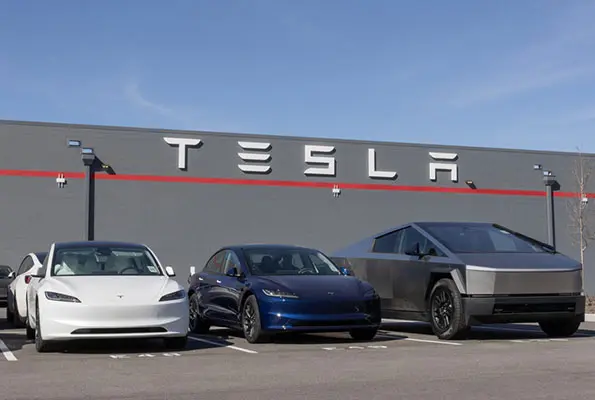
Elon Musk-led electric vehicle giant Tesla has posted record-setting second-quarter delivery numbers that smashed past Wall Street estimates, led by a tremendous rebound in Europe, feeding hopes that in 2026 the EV maker can end its two-year streak of annual sales declines.
The company delivered 480,126 vehicles in the April-June 2026 period, a record Q2 tally and up about 25% from a year earlier, easily surpassing analysts’ average estimate of 402,776 vehicles, according to Visible Alpha data.
On the production front, the number stood at 451,758 during the quarter. The deliveries exceeded production by more than 28,000 vehicles, leading the company to draw down inventory that it built up during Q1 this year.
In China, Tesla’s EV sales rose significantly, helped by production of the refreshed Model Y, despite stiff competition from BYD and other domestic automakers.
The venture’s strong Q2 performance also gives a timely and much-needed boost to Musk’s expensive ambitions in domains like autonomous driving and artificial intelligence (AI), divisions that have also emerged as the main drivers of the company’s USD 1.6 trillion valuation.
Talking about Tesla’s recovery in Europe, it was aided by a surge in fuel prices, along with tailwinds like government EV incentives, faster electrification of corporate fleets, and easing of the consumer backlash over CEO Elon Musk’s far-right politics.
“I think the huge growth in Europe is the key driver for Tesla right now. US sales still appear to be down, albeit less than the broader US EV decline, while China is seeing small growth,” said Seth Goldstein, senior equity analyst at Morningstar, while interacting with Reuters.
Goldstein, one of the analysts who had expected a third straight annual decline, said after the report’s publication, “I think it would be very hard to see a decline for the full year at this point.”
To offset its poor market runs, Tesla, in 2025, introduced stripped-down, lower-cost variants of its Model 3 compact sedans and Model Y SUVs, apart from deploying attractive incentives and financing options.
“Their pricing and their products are helping the buyers overcome any issues they might have with Elon Musk personally. Demand in the United States, Tesla’s biggest market, however, remained strained after the removal of the EV tax credits late last year. We’re cautiously optimistic for some growth this year,” said Sam Fiorani, vice president at research firm AutoForecast Solutions.
Analysts also said that the elimination of incentives for new EV purchases in the United States last year has continued to weigh on Tesla’s sales, while rebooting and upgrading the aging model lineup have paid rich dividends in the Chinese market.
Tesla, meanwhile, has launched its six-seater variant of the Model Y in the United States. The three-row, longer-wheelbase EV, the Model Y L, boosted Tesla’s prospects in China, and now the automaker is pinning its hopes on the vehicle to help revive demand in the American market.
As per the reports, expanding its focus far beyond making electric vehicles, Tesla now expects to spend more than USD 25 billion on capital expenditures in 2026, nearly triple the 2025 figures of USD 8.5 billion. AI infrastructure, battery production, Cybercab manufacturing, and Optimus robots will see maximum spending allocation in the coming days.
Tesla has continued to roll out its Full Self-Driving (FSD) advanced driver assistance software in Europe. Availability, however, has been restricted only in a handful of countries. Analysts, however, don’t expect many hiccups for the technology’s further launches, especially in the continent’s bigger markets.
The EV giant has also expanded its robotaxi operations after launching a limited commercial service in Austin in June. As per Musk, the company intends to rapidly expand the service deployment through 2026. Production of the Cybercab, Tesla’s purpose-built autonomous vehicle without pedals or a steering wheel, is expected to ramp up by the year-end.