

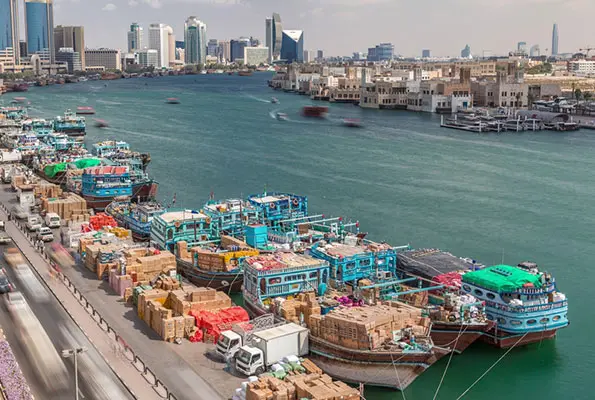
In the first half of 2026, the UAE’s non-oil foreign trade reached approximately AED1.937 trillion, representing a 13.1% growth, compared to the same period in 2025. The rate was 39.6% more than the first half of 2024 and 54.5% more than the first half of 2023, while registering an uptick of 78.8% compared to the same period in 2022.
The latest figure, which was made public during the review meeting attended by His Highness Sheikh Mohammed bin Rashid Al Maktoum, Vice President and Prime Minister of the UAE and Ruler of Dubai, reflects a sustained upward trajectory in UAE trade over recent years, despite geopolitical volatilities.
“Today, we reviewed the UAE’s non-oil foreign trade results for the first half of 2026 – and they are exceptional by every measure. Our non-oil foreign trade has approached the AED2 trillion mark in just six months, reaching a final figure of AED1.937 trillion, representing an annual growth of 13.1%. Our national non-oil exports also reached a new historic record of AED452.8 billion. These figures are more than trade statistics; they are a testament to the strength of our economy, the effectiveness of our development choices and the world’s confidence in the UAE,” His Highness said.
Non-oil foreign trade in the first half of 2026 more than doubled the levels recorded during the same period in both 2019 and 2021, becoming the leading driver of the Gulf major’s trade performance in H1 2026. The tally grew 23.9% year on year to reach AED452.8 billion, which is 77.3% more than the first half of 2024.
The share of non-oil exports in the UAE’s total non-oil foreign trade climbed to 23.4%, up from 21.3% in the same period of 2025, 18.4% in 2024, and 16.9% in 2023, reflecting a qualitative shift in the national economy towards a model driven by production, exports and value addition.
China retained its position as the UAE’s largest trading partner with non-oil trade of AED180.7 billion, followed by Switzerland (AED138.4 billion) and India (AED107.5 billion). Egypt, Oman and Hong Kong also recorded strong growth rates among the Gulf country’s key trading partners.
“Non-oil foreign trade with the UAE’s top ten trading partners grew by 12.6% in the first half of 2026, while trade with the rest of the world grew by 13.6%, reflecting the breadth and diversity of the UAE’s trade relationships and the continued expansion of its global economic partnerships,” the administration remarked.
“H1 2026 data confirmed the growing contribution of the UAE’s Comprehensive Economic Partnership Agreements (CEPAs) to trade performance. Non-oil trade with countries with a fully implemented CEPA reached AED304.3 billion, with imports from these countries reaching AED193.5 billion. Non-oil exports to CEPA partners reached AED66.1 billion,” it added further.
Non-oil exports now account for 21.7% of the UAE’s total trade with in-force CEPA partners, up from 19.1% in 2022, reflecting the broad market access these agreements are delivering for UAE products and companies.
Gold remained the leading commodity in the non-oil trade, with a value of AED706.2 billion in H1 2026 for a year-on-year growth of 48.8%. It was followed by the telecoms sector (AED189.7 billion), then gold jewellery, automobiles and diamonds. The top ten commodities together accounted for approximately 67% of the UAE’s total non-oil merchandise trade in the first half of 2026.
Apart from the solid non-oil trade data, the UAE’s economic transformation roadmap has also received a boost from the International Monetary Fund (IMF), whose staff team, during their visit to the country that lasted from 7th to 16th July 2026, found the nation remaining resilient despite the ongoing Iran war.
The delegation also discussed with His Excellency the latest economic and financial developments, the future outlook, and the policy priorities of the relevant authorities, as well as preparations for the 2026 Article IV Consultation Mission.
Khaled Mohamed Balama, Governor of the Central Bank of the UAE (CBUAE) and Governor for the UAE at the IMF, emphasised the importance of the consultations in strengthening communication, exchanging views on the latest economic and financial developments in the UAE, and discussing priorities of mutual interest during the meeting His Excellency chaired with the IMF staff team.
“These consultations provide an important platform for strengthening our existing cooperation with the IMF and exchanging views on the latest developments and future priorities. We also value the close cooperation among the relevant entities in the UAE and remain committed to reinforcing monetary and financial stability while strengthening the financial system’s preparedness and capacity to keep pace with the regional and global changes and developments. The positive outcomes of the visit reaffirm the resilience of the UAE economy and the soundness of its financial sector,” the senior official said.
The IMF staff team commended the notable resilience demonstrated by the UAE economy amid geopolitical developments in the Middle East, supported by sound economic fundamentals and ample buffers, in addition to swift response and targeted support measures.
Said Bakhache, head of the IMF staff team, said, “The UAE economy has demonstrated significant resilience amid the geopolitical conflict in the Middle East. Sound fundamentals, ample policy buffers, advanced preparedness, and a swift policy response have contained the overall impact of the shock. The authorities’ timely and well-targeted support measures have helped preserve financial stability, safeguard essential supply chains, support affected sectors and households, and sustain market confidence, underscoring the UAE’s institutional capacity to navigate a major external shock.”
The staff team found the UAE’s banking sector maintaining strong levels of capital and liquidity, as credit continued to grow, supported by the robust financial positions established by banks ahead of the Iran war.
The staff team also highlighted the role of the CBUAE’s “Proactive Financial Institution Resilience Package”, launched in mid-March, in supporting financial sector stability, enhancing the preparedness of financial institutions, and enabling them to continue their operations and deliver services efficiently, as the ongoing geopolitical volatility in the Gulf region is showing no signs of settling down.
While noting the UAE’s resilience in sectors like trade, aviation and logistics activities, together with the continued strength of domestic demand, supported economic activity and limited the impact of regional developments, the IMF delegation predicted the fiscal balance to remain in surplus, supported by higher oil prices, a forward-looking approach to budgeting and strong policymaking, with low levels of public debt providing ample fiscal space.