

UAE developer Arada is betting USD 7 billion on the future of Syria with plans for a vast mixed-use community west of Damascus, in one of the clearest signs yet that Gulf private capital is beginning to move from cautious engagement to large-scale investment in the country.
Arada and the state-owned Syrian Sovereign Fund are partnering to develop the project, known as New Damascus.
The four-million-square-metre development will combine homes, hotels, serviced apartments, education, healthcare, offices, retail, recreation and government facilities.
The agreement represents Arada’s first project in Syria and one of the largest foreign real estate investments announced since the country began its post-war reconstruction drive. Reuters reported that the project will include residential complexes as well as health, education and entertainment facilities.
Arada’s plans are considerably broader than a conventional property development. The company says the site will contain 11,000 homes, including apartments, villas, townhouses and branded residences, alongside 500 hotel rooms and 1,000 serviced apartments.
A 700,000-square-metre public park will form a major part of the scheme. Education facilities will have capacity for 5,000 students, while a 300-bed hospital will provide healthcare services.
The plan also includes offices, commercial spaces, shops, recreational facilities, and government service buildings.
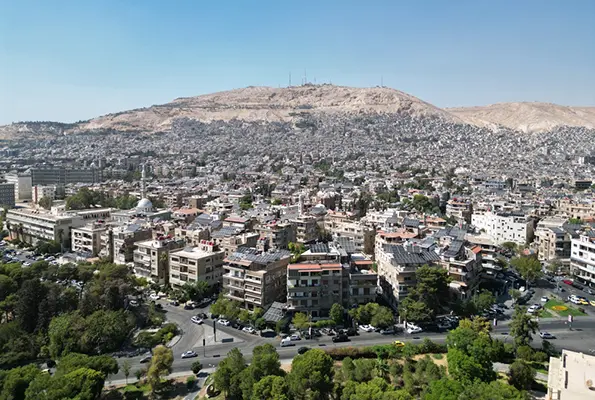
The development is located near Damascus’s Mezzeh district, on a plateau about 10 minutes from the city centre and 25 minutes from Damascus International Airport, according to Arada. The master plan will be prepared with Syrian government authorities and is intended to align with national reconstruction priorities.
The model draws directly from Arada’s experience in the UAE, particularly its Aljada and Masaar communities. That gives the project an explicitly UAE-style development model: rather than building isolated residential towers or housing compounds, Arada is seeking to create a self-contained urban community in which residents can live, work, shop, study and access healthcare within the same development.
That approach could prove important in a country where years of war have left basic infrastructure severely damaged.
The World Bank estimates that Syria’s post-conflict reconstruction bill will reach USD 216 billion. Direct physical damage from the conflict was estimated at USD 108 billion, including USD 52 billion of infrastructure damage, USD 33 billion to residential buildings and USD 23 billion to non-residential structures.
Against that backdrop, the USD 7 billion New Damascus project is significant not simply because of its size, but because it points to a potential new investment model for Syria. Large Gulf developers can bring capital, master-planning expertise and international operating partners, while Syrian institutions provide land and local access.
The timing is also crucial. Syria’s economic isolation has begun to ease, improving the prospects for international investment. The European Union lifted its economic sanctions on Syria in May 2025, while retaining targeted measures against individuals and entities linked to the former Assad regime.
More recently, the US removed Syria from its list of state sponsors of terrorism, removing a major barrier for banks and international companies considering business in the country. International payment networks Visa and Mastercard have also begun testing card transactions in Syria, signalling a gradual return to the global financial system.
For Gulf investors, those developments could change the risk-reward equation.
The UAE has maintained ties with Syria, while the country has sought to rebuild diplomatic and economic relationships following the fall of Bashar Al-Assad. Arada’s agreement comes as other Gulf-linked investors assess opportunities across property, infrastructure, energy, logistics and tourism.
The company itself is expanding rapidly. Arada now has a development pipeline valued at about USD 42 billion across four markets, with more than 66,000 homes across the UAE, UK, Australia and Syria. The Syrian venture therefore represents both a major new market and an extension of its strategy of exporting the master-development model beyond the UAE.
Arada Executive Vice Chairman Prince Khaled bin Alwaleed said Syria was at a pivotal moment and that the scale of the rebuilding opportunity was significant. He said the project would create jobs, develop local skills and support Syrian businesses.
The Syrian Sovereign Fund, meanwhile, has described the partnership as a demonstration of the country’s willingness to attract international businesses and long-term investment.
Yet the opportunity comes with substantial risks. Syria’s infrastructure remains badly damaged, its financial system is rebuilding international links, and investors must navigate political, regulatory and security uncertainties after years of conflict.
There is also no announced construction timetable or detailed financing structure for New Damascus, meaning the USD 7 billion figure represents the project’s estimated gross development value rather than an immediate cash investment.
For Arada and Syria, however, the symbolism is powerful. New Damascus is a test of whether the Gulf’s master-development model can be transplanted into a post-conflict economy — and whether property can become one of the first engines of Syria’s return to the regional investment map.