

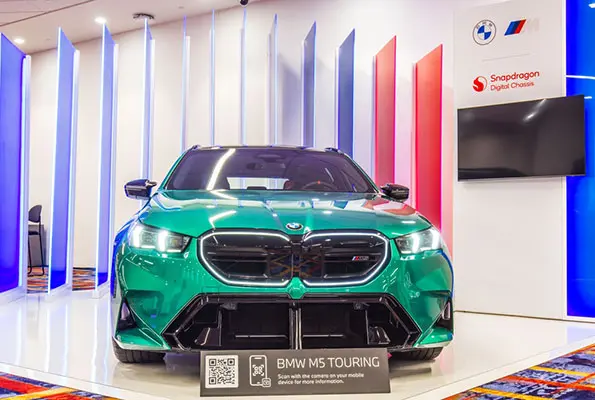
American semiconductor company Qualcomm has signed a long-term deal to supply chips for German luxury automaker BMW’s future digital cockpit and advanced driver-assistance systems.
The agreement, under which the R&D activities will be carried out throughout the next decade, comes amid the intensifying competition in the automated driving market, with Nvidia and Mobileye Global also aiming to supply chips and software platforms to automakers.
The deal includes Qualcomm’s Snapdragon Digital Chassis solutions, including cockpit processors, automated driving chips, and AI accelerators, which the companies said would establish the hardware basis for BMW’s AI-led platforms. The existing partnership has seen the launch of the Snapdragon Ride Pilot driver-assistance system in BMW’s electric iX3, which offered drivers hands-free highway driving, automatic lane changes, and parking assistance.
While Qualcomm, a leading supplier of the chips used in smartphones, has been pushing deeper into automotive electronics, from infotainment to advanced driver-assistance systems, the deal comes at the right time for the BMW, which is bleeding financially due to increasing global competition and volatile geopolitics.
“As agentic and physical AI drive a new generation of intelligent vehicles, this collaboration enables both companies to define the future of mobility,” said Nakul Duggal, group general manager for automotive, industrial, and embedded IoT and robotics at Qualcomm.
The German luxury automaker, in Q2 2026, witnessed a 35% pretax profit drop, with a steep reduction in China sales and negative consumer confidence in the Middle East hurting the company’s financials.
Pretax profit fell to 1.7 billion euro (USD 1.95 billion), while the operating margin in its core automotive business narrowed to 2.3% from 5.4% a year earlier, though the ratio was just ahead of analysts’ consensus forecast of 2.2%.
BMW’s new CEO Milan Nedeljkovic has termed the results “not satisfactory.”
And BMW is not alone, as Porsche and parent Volkswagen are also facing tight financials that have forced them to cut jobs and overhaul operations.
“The automotive industry is faced with rapidly escalating challenges — intense global competition, increasing regional regulatory requirements and the implications of geopolitical conflicts will shape our business model in the years ahead,” Nedeljkovic said, while expressing hope that the venture becomes leaner and more competitive through a voluntary severance programme and a review of long-standing structures.
“We are taking a critical look at how we work, including revisiting core processes and structures that previously were considered untouchable,” the CEO said further.
BMW has reaffirmed its full-year guidance, targeting an automotive operating margin of 1% to 3%. After issuing a profit warning in June that triggered talks with workers over cost cuts, the company reportedly plans to axe 8,000 jobs under a voluntary redundancy program.
As per Nedeljkovic, BMW’s restructuring push would include streamlining across sales, procurement, production, and development.
The company is also looking to trim its product portfolio, reviewing model variants in certain markets as EV adoption diverges between countries, such as China, where such cars dominate, and the United States, where combustion-engine vehicles are still the preferred choice among the people.