

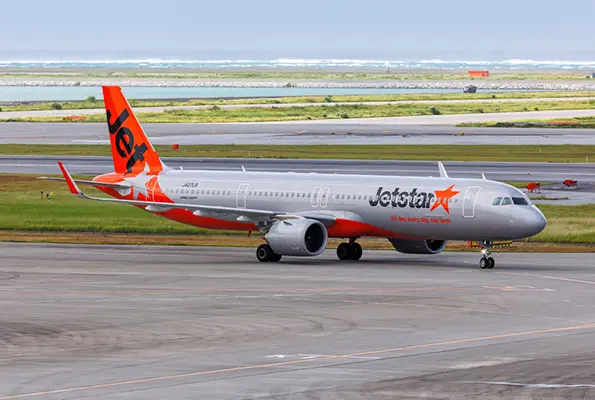
Australian flagship carrier Qantas Airways has signed an 8.2 billion yen (USD 52.11 million) binding agreement with Japan Airlines (JAL), under which the Aussie venture would exit Jetstar Japan through a share buyback.
The buyback of Qantas’ 33.32% stake in the budget carrier will pave the way for a Japanese capital-led ownership structure for the low-cost carrier.
While Jetstar Japan will buy back Qantas’ minority stake, the Development Bank of Japan will join as a new shareholder. JAL and Tokyo Century will retain their respective stakes.
After Qantas’ divestment, Jetstar Japan will rebrand to drop the “Jetstar” brand as it seeks to strengthen its position in Japan’s low-cost carrier market.
Welcoming the move, Qantas said the development would allow the flagship carrier to redirect capital towards Qantas and Jetstar’s operations in Australia and across its international networks.
The share buyback plan is expected to generate an estimated gain of about AUSD 115 million (USD 80.49 million) for Qantas in items outside underlying earnings, predominantly in 2027.
The airline would continue to recognise its share of Jetstar Japan’s profits or losses until the transaction is completed, expected by June 2027.
Jetstar Japan, established more than a decade ago by Qantas, Japan Airlines, and Mitsubishi Corporation, began operating as a low-cost carrier in 2012 from Narita Airport near Tokyo.
Meanwhile, JAL posted a whopping 80.2% decline in net profit during the April-June period of the 2026 fiscal year, according to a recent company statement.
The flag carrier’s net profit fell to USD 34 million as rising fuel prices linked to the Middle East conflict weighed on earnings.
“Revenue for the three-month period rose 11.2% to USD 5.9 billion. Revenue from international flights increased 14.4% to USD 1.3 billion, while domestic flight revenue climbed 3.6% to USD 886.1 million,” the venture said further.
JAL Chief Financial Officer Yuji Saito flagged rising costs, apart from telling the investors and analysts that outbound tourism was weaker than during the same period in 2025.
The airline, as per Saito, aims to achieve a net profit of USD 701.3 million for the fiscal year ending March 2027.