

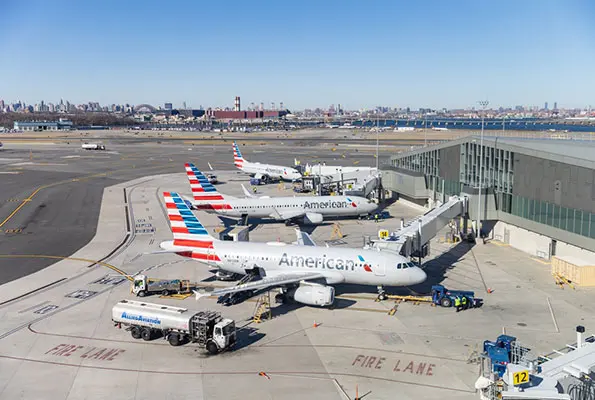
As the ongoing Iran war disrupts the global energy flow and keeps the jet fuel price in the higher territory, American Airlines, United Airlines, and Southwest Airlines are scaling back planned flight schedules, as they prefer holding on to their profit outlooks.
The announcements from the executives of the carriers come amid the American airline industry leaning on tighter capacity, resilient demand, and higher fares to absorb a runup in fuel costs since the Iran war began.
Executives at all three carriers said that while demand remained strong even after price increases, helping the businesses offset much of the higher cost of jet fuel, the latest price jump has prompted them to reassess less-profitable routes and their prospects in the coming months.
For American, the latest jump in fuel prices alone was adding about USD 1 billion to its fourth-quarter costs, while United said some flights planned for December would no longer operate and that further adjustments could follow in the first quarter and into 2027.
Southwest too has chopped down its planned 2026 capacity growth in half and could trim further if fuel costs remained elevated.
Shares of all three carriers have fallen since August. American and United are down about 14% and 15%, respectively, while Southwest has lost about 11%.
American CEO Robert Isom said at a Morgan Stanley conference that he felt “really good” about the carrier’s forecast for Q3 revenue to rise 16% to 19% from a year earlier and expected the vast majority of the recent revenue gains to prove durable.
“Revenue strength was broad-based across domestic and international markets and both premium and coach cabins. We’ve absolutely done a great job of recapturing a tremendous amount of that expense,” he said.
Speaking at the same conference, American Chief Financial Officer (CFO) Devon May said Q4 fuel prices had risen roughly USD 1 a gallon from the level assumed in July.
“Every one cent move in fuel changes American’s quarterly costs by about USD 10 million,” May stated, while announcing that the carrier would continue adjusting capacity late in the fourth quarter in response to the increase.
As per United’s CFO Michael Leskinen, some flights that had been planned for December would no longer operate because higher fuel costs had made marginal routes less attractive.
“If fuel remains high, United could make further adjustments in the first quarter and into 2027. We are not flying to maximize market share. We’re flying to maximize profitability and free cash generation,” Leskinen told the Morgan Stanley conference.
He further described United’s fourth-quarter bookings as “tremendously strong” and said there was very little evidence of demand destruction.
“Premium travel remained strong, corporate business was improving, and economy demand was also holding up,” Leskinen noted.
While Leskinen still hoped for United to recover the higher fuel expense through pricing, his Southwest counterpart Tom Doxey said the carrier’s autumn revenues were running ahead of expectations, helping offset higher fuel costs and allowing the airline to maintain its third-quarter earnings guidance.
“Southwest had initially planned year-over-year capacity growth of about 2% to 3% for 2026. If fuel is higher for longer, trimming capacity would be the natural response,” Doxey concluded.