

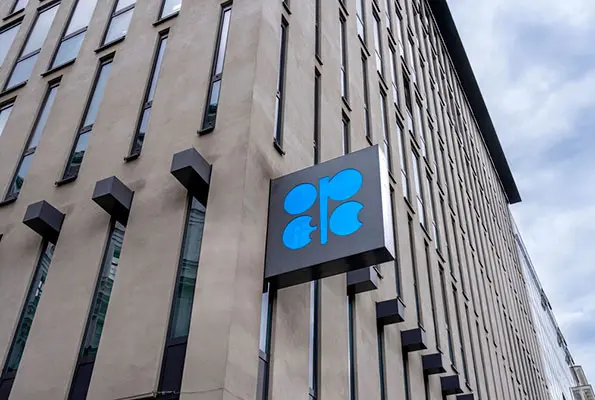
On its Sunday meeting, OPEC+ agreed to keep oil production targets steady for November, in line with analysts’ expectations about further output policy adjustments being unlikely in 2026.
Seven core members of the group comprising the Organization of the Petroleum Exporting Countries (Saudi Arabia, Russia, Iraq, Kuwait, Algeria, Kazakhstan, and Oman) and allies, including Russia, made the decision in a brief online meeting on Sunday.
Gulf OPEC+ producers have been pumping well below output targets in the face of continuing export disruptions originating from the Iran war.
In recent months, exports fluctuated between 60% and 80% of normal levels. However, as per the last week’s Kpler data, the Middle East topped pre-war levels in September, with Gulf producers ramping up more cargoes for the coming months despite attacks on vessels crossing the Strait of Hormuz.
Talking about the impact of the Iran war on OPEC+, the conflict has also delayed the group’s output capacity review, crucial to determine members’ 2027 output quotas.
OPEC+ has been raising output targets for much of 2026 after years of production cuts, but most of the increases stayed on paper because of the ongoing volatile geopolitics.
In August, the seven core OPEC+ members pumped 25 million barrels per day, up 630,000 bpd from July, yet still roughly five million bpd below prewar levels in February, OPEC data shows.
OPEC+ still has about two million bpd of output cuts in place covering most members.
As per the sources cited by Reuters, before making any decision on the output level cuts, the OPEC+ members need to evaluate the results of such a move.
Saudi Arabia, meanwhile, has announced an oil price cut for its Asian customers.
While the new price, set to be implemented in November, is the lowest in the past six years, it will remain elevated for the northwest European and the Mediterranean buyers.
The largest Middle Eastern crude exporter set the November Arab Light crude oil official selling price to Asia at USD 5 a barrel, below the average of Oman and Dubai prices, down USD 3 from the previous month.
State oil company Saudi Aramco has cut the November OSPs (Official Selling Prices) of heavier grades, Arab Medium and Arab Heavy, sold to Asia by USD 5 a barrel.
Aramco has reportedly been looking at offering discounts for oil loaded off Oman to compensate buyers for record freight rates while seeking to protect its market share after disruptions on the export front due to the Iran war.
The cost of booking a massive crude carrier capable of hauling two million barrels of oil from the Gulf to China on a time charter basis was USD 1.2 million a day on Friday, as per the LSEG data.
It was about USD 80,000 a day a year ago.
Since September, Aramco has been selling millions of barrels of crude through ship-to-ship transfers outside the Strait of Hormuz, pushing oil flows through the strategic waterway to pre-conflict levels.
The Kingdom also resumed loading at the port of Yanbu on the Red Sea after a brief suspension from a militant drone attack shut its key east-west oil pipeline.