

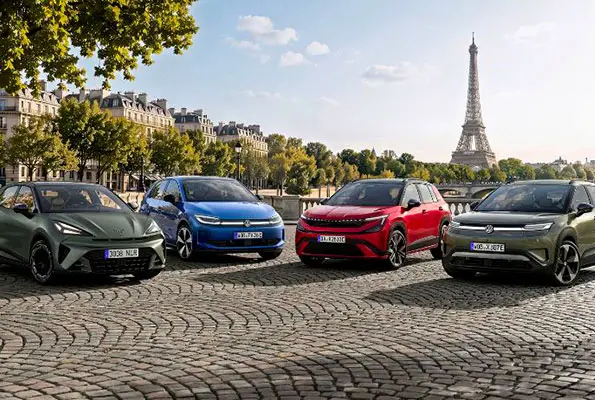
German automaker Volkswagen, already under stress due to American tariffs and Chinese competition, continued its troubled sales run, with global deliveries witnessing a 14.3% decline in the third quarter.
The drop was the sharpest one in more than four years, as weakness in China, Volkswagen’s largest market, continued to weigh on sales.
While Volkswagen’s Q3 deliveries fell to 1.89 million vehicles, the numbers in China were down by 38.5%.
The ratio, in the first nine months of the year, went down by 30.2%.
Deliveries fell 5.8% in North America and 2.8% in Western Europe but rose 1.4% in Central and Eastern Europe.
“The sharp decline in the overall market in China remains an industry-wide challenge,” Martin Sander, a member of the group’s extended executive committee, said in a statement.
The drop in deliveries was Volkswagen’s steepest since a 22.4% decline in the second quarter of 2022.
Weak Chinese sales have been a common phenomenon across the German automobile industry, with sports car maker Porsche and Mercedes-Benz reporting similar figures as well.
Global deliveries of battery-electric vehicles fell about 5% in the quarter despite a near 20% increase in Europe, reflecting weaker demand in China and growing competition from domestic manufacturers.
Volkswagen’s poor numbers came a day after CEO Oliver Blume appealed for assistance from European policymakers to create the framework needed to make the German automaker’s restructuring a success.
At an event titled “For Europe” on the eve of the Paris motor show, Blume said Volkswagen was working to reduce complexity across the company, whose brands range from mass-market VW to high-end marques like Porsche and Lamborghini.
Blume again reiterated the reorganisation as “the biggest transformation programme in our history.”
“This is a shared responsibility: The business community must become more competitive and create attractive opportunities, while policymakers must establish the right framework conditions,” he said.
As part of its ongoing restructuring, Volkswagen is racing to update its mass-market EV offering as Chinese competitors rapidly gain ground in Europe.
China, the world’s largest automobile market, has been battered by an EV price war and falling sales that have affected both the Chinese and non-Chinese automakers.
While the Chinese automakers have been expanding aggressively around the world to make up for the domestic sales shortfall, Volkswagen is witnessing a sales downturn in other major markets as well.
In his speech, Blume backed proposed “Made in Europe” rules to incentivize local manufacturing and welcomed a deal between the EU and China that could cut Chinese imports of plug-in hybrid vehicles to the bloc by more than half.
“Those who sell here should compete under comparable conditions and create jobs and value here in Europe too,” Blume said at the event, attended by France’s minister for industry Sebastien Martin.
The reorganisation has been a make-or-break kind for Blume, who has been dealing with multiple headwinds, sweeping job cuts, plant closures in Germany, and pressure from investors to prove his turnaround strategy to muscle up Volkswagen’s efforts in product development and software.
Image Courtesy: Volkswagen