

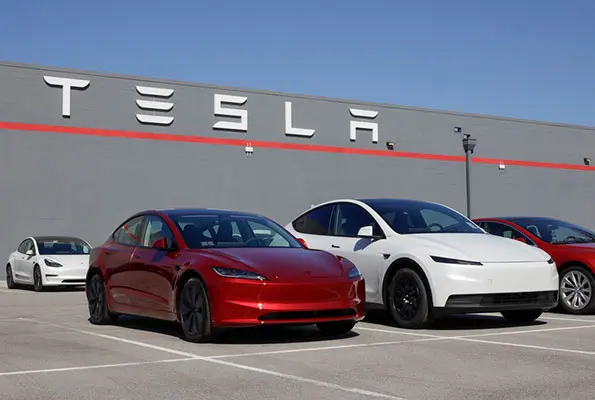
Elon Musk-led Tesla saw registrations of its new cars rising across several Northern European markets in October, as the American electric vehicle maker extended its regional sales recovery despite growing competition from Chinese automakers.
In Sweden, Norway, and Denmark, Tesla’s registrations soared 248%, 131%, and 34%, respectively, data from Mobility Sweden, Norway’s OFV, and Denmark’s bilstatistik.dk showed.
The rebound has been aided by easier year-ago comparisons, higher fuel prices, government incentives, and continued growth in EV demand, as per the three agencies.
Performance, however, varied across the region.
While Tesla saw strong gains in Norway and Sweden, it was found chasing several Chinese rivals in Denmark.
In Norway, Tesla recorded its best October on record and was the country’s top-selling car brand with a 9.8% market share, according to OFV.
Despite that, Chinese brands continued to expand their footprint in the European nation, accounting for 22.5% of new passenger car registrations, their highest monthly share on record.
Tesla’s market share in Denmark was only 0.73%, behind BYD, Leapmotor, Xpeng, and SAIC-owned MG, which captured between 1.6% and 5.5% of the market each.
“Northern Europe is quite open to the new players as long as they are efficient EVs. That’s what allowed Tesla to get to a leading position, and it’s what is allowing the Chinese to gain ground fast,” industry analyst Felipe Munoz, who runs the Car Industry Analysis platform, told Reuters.
Despite Chinese rivals gaining popularity in Denmark, Tesla remains one of Europe’s strongest EV brands due to its Model 3 and Model Y.
The automaker said in October it had ended the third quarter with its largest backlog of passenger vehicle orders in four years.
Talking about BYD, the Chinese electric vehicle maker continued its overseas upsurge, by posting a sixth straight month of sales growth in October. On its home market in China, the Tesla rival, however, is witnessing sluggish demand and intense price competition.
BYD’s third-quarter profit growth, however, slowed to 28% year-on-year, missing forecasts.
What could make BYD’s overseas dominance a tough one to maintain in the coming days is the new China-EU deal, under which the continent will be curbing hybrid imports at its backyard.