

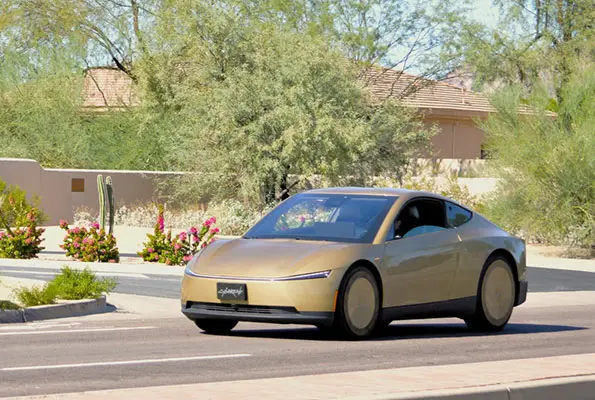
Elon Musk-led Tesla accelerated its efforts to commercialise its autonomous driving technology by inviting “select customers” to purchase its Cybercab robotaxi for personal use as the maverick tech leader pushes ahead with plans to turn the EV maker into an AI and robotics company.
The company announced last Friday that it was offering the two-seater autonomous vehicle to selected customers at a price of USD 29,990, alongside a monthly ‘Autonomy Subscription’ costing USD 299.
Tesla shared the announcement on the popular micro-blogging platform X (formerly Twitter), featuring the gold-coloured vehicle with its distinctive butterfly doors. Musk subsequently indicated that the offering would eventually become available across the United States, subject to federal regulatory approvals.
However, the Tesla chief ended up admitting that the proposed subscription price was too expensive.
Musk also suggested that the monthly fee should be closer to the combined cost of Tesla’s Full Self-Driving (FSD) package and connectivity services available for other models, which amounts to around USD 115.
The development comes as Tesla prepares to begin selling its Cybercab robotaxis to the public by the end of 2026, but regulatory uncertainties surrounding vehicles without conventional driving controls could complicate the rollout.
The Cybercab has become one of the most important products in Musk’s long-term vision to reduce Tesla’s dependence on traditional vehicle production and expand into self-driving mobility.
Unlike traditional passenger vehicles, the Cybercab has been designed without a steering wheel, accelerator, brake pedals or conventional mirrors.
Its two-seat configuration, butterfly doors and fully autonomous operating system distinguish it from Tesla’s existing electric vehicle lineup.
Speaking after the company’s third-quarter earnings announcement last month, Vice President of Vehicle Engineering Lars Moravy said Tesla intended to begin delivering Cybercabs to customers before the end of 2026.
“As Tesla grows, we’ll mainly deliver fully designed autonomous vehicles to our customers, and Cybercabs will be the first,” Moravy told analysts.
He added that the initial rollout would be relatively small, allowing Tesla to understand the challenges associated with vehicle delivery, ownership and fleet management before expanding production.
Tesla’s Head of Artificial Intelligence (AI), Ashok Elluswamy, also said the Cybercab would run without human supervision in the same geographical areas as the company’s existing robotaxi service.
Expanding manufacturing would be relatively easy, Elluswamy said; it would be more a matter of prioritising getting the necessary regulatory approvals.
Tesla began its unsupervised robotaxi service in Austin, Texas, in June 2025, and then expanded operations to Dallas and Houston in April 2026 and Miami in July 2026.
The Cybercab will be a significant part of the network, eventually taking over from the traditional Teslas as the flagship driverless model.
But the company’s autonomous vehicle strategy is under regulatory scrutiny by the National Highway Traffic Safety Administration, or NHTSA.
The US auto safety regulator opened an investigation into the Cybercab shortly after Tesla began offering paid rides using the vehicles in Austin.
The investigation focuses on how Tesla determined that a vehicle without conventional manual controls complies with federal safety requirements for motor vehicles.
Existing US regulations were largely developed around human-operated vehicles and generally require conventional driving controls.
The requirements pose regulatory hurdles for fully autonomous vehicles designed without steering wheels and pedals.
Unlike many other global markets, the U.S. allows automakers to self-certify their vehicles as meeting federal safety standards before they are used on public roads.
However, self-certification does not exempt manufacturers from compliance requirements or subsequent regulatory investigations.
NHTSA has also proposed changes to federal safety standards to accommodate autonomous vehicles without human controls. Until those changes are finalised, existing requirements remain in effect.
The regulator had previously asked Tesla to explain the basis of its Cybercab certification and clarify how it determined that certain safety standards did not apply to the vehicle.