

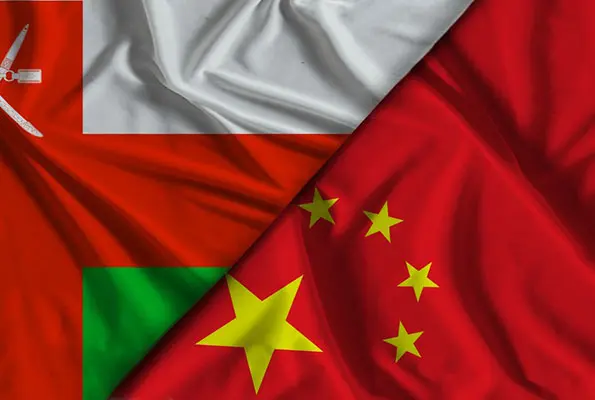
Oman and China have signed 23 investment agreements and partnerships worth several billion dollars, covering renewable energy, mining, logistics, artificial intelligence (AI) and space technology, as the Gulf state seeks to attract Chinese capital and expertise to diversify its economy.
The agreements were signed during Sultan Haitham bin Tarik’s state visit to Beijing, the first by an Omani ruler to China since diplomatic relations were established in 1978.
The deals involve the Oman Investment Authority (OIA), Omani companies and Chinese institutions.
The package includes joint investment funds, industrial projects and cooperation in digital infrastructure. Separately, the two governments witnessed the signing of a currency swap agreement between the Central Bank of Oman and the People’s Bank of China, along with 14 memorandums of understanding (MoU) and a cooperation protocol covering green development, AI, space, data and industrial supply chains.
Among the largest financial commitments is a preliminary agreement between the OIA and China’s Silk Road Fund to establish an USD 800 million joint investment fund.
Most of the capital will be invested in Oman, with the remainder allocated to China and other emerging markets.
The OIA also signed a term sheet with China Merchants Bank for a USD 300 million fund, with the two sides contributing equally.
The partnership builds on an earlier fund of the same size established in 2019 to invest in China’s technology sector.
In renewable energy, the OIA signed a USD 100 million partnership with BCG and Hui Mills to develop solar projects in Oman and establish a factory to manufacture solar inverters.
Mining is another major area of cooperation. Minerals Development Oman signed a 10-year contract worth USD 418.7 million with Hongda International for services at the Mazoon Copper and Gold Project in Yanqul.
The contract covers open-pit mining, ore transport, road construction and operational facilities.
The agreements also target energy storage. Nama Holding signed a framework agreement with State Grid International Development to assess and develop two battery storage systems, each with a capacity of 500 megawatts, at Duqm and Ibri.
Technology and space-related projects form another part of the package. Huawei will work with Omantel and Oman’s Ministry of Transport, Communications and Information Technology on the deployment of Ascend neural processing units, specialised chips for AI computing.
In the space sector, Omani company Adasat Oman and StarVision Aerospace signed agreements covering satellite development, training and technology transfer.
The first phase of the Space Silk Road programme envisages seven satellites and a satellite assembly, integration and testing facility in Oman.
A separate five-year programme is expected to sponsor 30 Omanis for postgraduate studies in China, train 1,000 specialists and establish a joint laboratory focused on space-related AI. The programme aims to build local expertise and manufacturing capabilities.
Logistics is also a priority. Asyad Group signed an agreement with Chinese e-commerce company JD.com to develop three distribution warehouses at Muscat International Airport Free Zone, Khazaen Economic City and Sohar Free Zone.
The partners aim to serve Gulf and East African markets through connected networks and digital supply-chain solutions.
In financial services, Sohar International signed a memorandum of understanding with Shanghai Pudong Development Bank covering syndicated financing and debt capital markets.
It also agreed to distribute investment funds managed by E Fund Management in Oman and work with BOC International Asset Management to market products, including gold-backed exchange-traded funds, to qualified investors.
The currency swap agreement is intended to facilitate trade and financial cooperation by supporting transactions in the two countries’ currencies.
The investment push builds on expanding trade ties. Bilateral trade reached about 9.6 billion Omani rials (USD 24.9 billion) in 2025, with Omani exports to China accounting for 7.7 billion rials and imports 1.9 billion rials.
China was Oman’s largest trading partner, accounting for 23.8% of its total trade.
During talks with Chinese President Xi Jinping, Sultan Haitham proposed a preferential trade and investment agreement. Xi described closer ties as a shared strategic choice.
For Oman, the agreements offer a way to bring in capital, industrial know-how and technology as it pursues economic diversification under Oman Vision 2040. For China, they strengthen its position in a strategically located Gulf economy and expand opportunities in energy and logistics.
The key test will be converting the agreements and preliminary commitments into funded projects, operational facilities and lasting economic activity. The partnerships are also intended to strengthen links with global production networks.