

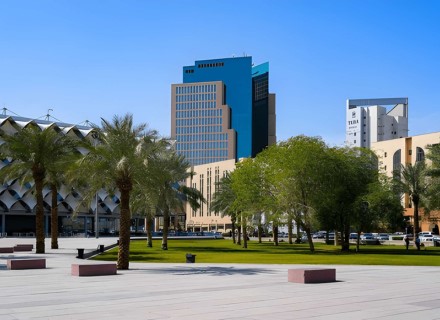
Saudi Arabia’s real estate market, in Q3 2026, witnessed a strong occupier demand, along with tailwinds like continued investment activity and expanding development pipelines across the sectors like the office, residential, retail, hospitality and industrial, said a CBRE Middle East report.
As per CBRE Middle East’s Saudi Arabia Real Estate Market Review, while the Kingdom’s broader economy continued to demonstrate positive underlying momentum despite a 4.8% year-on-year contraction in real GDP during Q2 2026, non-oil sectors including construction, transport, professional services and manufacturing remained key contributors to activity.
The Riyad Bank Saudi Arabia PMI increased to 55.3 in September, its highest reading since February.
The Kingdom’s inflation, on the other hand, remained relatively contained at 1.9% in September, although cost pressures linked to construction materials, logistics and project delivery continue to impact parts of the real estate sector.
“Development activity across the Kingdom remained focused on project execution, particularly on infrastructure delivery. Diriyah was among the most active destinations during the quarter, with approximately SAR2.73 billion in contracts awarded for hospitality and residential developments within Diriyah Square, including six luxury hotels and branded residential offerings,” CBRE noted.
“Meanwhile, nationwide real estate transaction values reached SAR24.4 billion in August, with residential assets accounting for 73% of total transaction value, equivalent to SAR17.9 billion,” it added further.
The office market remained one of the Kingdom’s strongest-performing asset classes.
Riyadh’s Grade A office occupancy, as per CBRE’s estimates, reached approximately 97% during Q3 2026, while occupancy within King Abdullah Financial District (KAFD) remained close to full capacity at around 99%.
Strong demand from multinational occupiers, regional headquarters and expanding domestic businesses continued to outpace supply, helping drive a 3% year-on-year increase in prime office rents to SAR 3,320 per square meters per annum.
Grade A rents averaged SAR 2,570 per square metre per annum, while Riyadh’s total office stock surpassed 6.3 million square metres.
An additional 1.7 million square metres of office space are scheduled for delivery between late 2026 and 2028.
In the residential sector, affordability and accessibility remained key themes. Residential transaction values and transaction volumes declined by 8% and 7% year-on-year, respectively, while average countrywide apartment prices per square metre fell by 3.6%.
Riyadh continued to outperform broader market trends, recording apartment price growth of 2.3% year-on-year.
“Residential leasing performance varied across districts, with apartment rents increasing by 5% in Al Sulaymaniyah and 4% in both Al Nasim Al Gharbi and Al Yarmouk, highlighting continued demand within selected submarkets despite broader market moderation,” CBRE noted.
“The retail sector fundamentals also remained positive, supported by domestic consumer spending. Nationwide point-of-sale spending increased by 3.5% to SAR13.37 billion over a seven-day tracking period ending in September, with hotels, recreation, restaurants and cafés all recording double-digit growth. Looking ahead, major developments such as Westfield Riyadh, which is expected to add approximately 120,000 square metres of retail space by year-end, and The Avenues Riyadh are set to further expand the Kingdom’s retail offering,” the report added.
Within the Kingdom’s hospitality market, domestic tourism continued to offset softer international travel trends.
Domestic trips increased by 16% year-on-year during the first quarter of 2026, reaching 28.9 million, while total tourist numbers grew by 8% to 37.2 million. Inbound arrivals declined by 13% to 8.3 million visitors, contributing to a 2% decline in overall tourism spending, which fell to SAR 82.7 billion.
Despite these challenges, hotel operating performance remained relatively stable nationally, with September ADR and RevPAR increasing by 3.7% and 3.3% year-on-year, respectively.
“The industrial & logistics market continued to benefit from growing occupier demand and ongoing investment in supply chain infrastructure. The Saudi Ports Authority reported cumulative investments of approximately SAR14.6 billion across the Kingdom’s ports and logistics ecosystem, while logistics developer ESR announced plans for a new platform targeting Saudi Arabia and the UAE with a development pipeline exceeding three million square meters. Rental growth remained particularly strong across key logistics hubs, with Riyadh East recording average rents of SAR313 per square metre per annum, up 15.1% year-on-year. Jeddah South recorded the strongest growth nationally, with rents increasing 16.7% year-on-year to SAR217 per sq m per annum,” CBRE said.
Matthew Green, Head of Research at CBRE MENA, commented: “Despite the geopolitical landscape regionally, Saudi Arabia’s real estate market continues to be supported by powerful long-term drivers linked to Vision 2030, economic diversification and sustained investment across infrastructure, tourism, logistics and urban development. Whilst a more cautious operating environment has evolved since March, occupier demand across key sectors remains robust and development activity continues to progress. The office market remains characterised by exceptionally low vacancies and a shortage of premium space, while residential demand continues to be supported by population growth and housing initiatives. At the same time, the logistics sector is benefitting from Saudi Arabia’s growing role as a regional trade and distribution hub, and the continued expansion of tourism infrastructure is creating new opportunities across the hospitality and retail sectors.”
He added: “Looking ahead, we expect the Kingdom’s real estate market to remain firmly supported by ongoing public and private sector investment, a substantial project pipeline and the continued delivery of Vision 2030 initiatives.”