

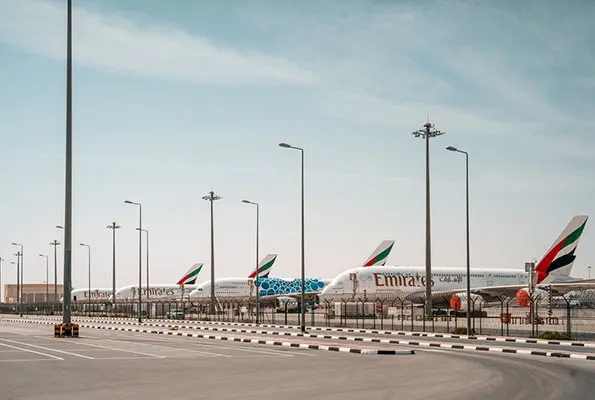
Dubai is set to award a further Dh55 billion (USD 14.8 billion) in construction contracts by the end of 2026 for Al Maktoum International Airport, as work on the megaproject continues despite regional conflict and global supply-chain pressures.
Dubai Airports chief executive Paul Griffiths said Dh13 billion of contracts are already under construction, with about 9,000 workers currently on site. The project has logged 10 million work hours over the past 15 months, while 17,000 piles have been driven into the ground and 45 million cubic meters of earth moved.
Griffiths said the pace of construction had not slowed because of the regional conflict. While supply chains remain under pressure, he said the challenge was global and had persisted since the Covid-19 pandemic. Dubai Airports is therefore mobilising suppliers from around the world to keep the project on schedule.
The scale of the investment underlines Dubai’s determination to expand its aviation infrastructure before Dubai International Airport (DXB) reaches its capacity limits. Griffiths said DXB would be at capacity by 2032, leaving the city little choice but to develop a larger hub if it wants to sustain passenger growth and protect its position as a global aviation center.
The first phase of Al Maktoum International, also known as DWC, is scheduled to begin operations in 2032 with an annual passenger capacity of 150 million. When fully developed, the airport is expected to handle 260 million passengers and 12 million tonnes of cargo a year, making it the world’s largest airport.
The project is already attracting major infrastructure commitments. Mitsubishi Heavy Industries has been selected to build the automated people-mover system that will connect DWC’s concourses. The Japanese company already operates the train linking Terminal 3 and Concourse A at DXB.
Changes in aircraft technology are also shaping the airport’s design. Griffiths said long-range narrow-body aircraft such as the Airbus A321XLR could allow DWC to serve smaller markets that cannot economically support regular wide-body flights.
He expects the aircraft to potentially increase the number of cities served directly from DWC by about three times, with as many as 600 destinations possible once the airport opens. Smaller cities in Europe, the Far East, and Africa could become commercially viable destinations because long-range narrow-body aircraft can offer lower capacity and reduced commercial risk than wide-body jets.
The new airport is part of a wider strategy to ensure aviation infrastructure does not become a constraint on Dubai’s economic expansion. Dubai announced in 2024 that all operations at DXB would eventually transfer to DWC, with the first phase of the transition planned for 2032.
Griffiths said he could not see two major hubs operating close to each other for an extended period. The eventual move from DXB to DWC would instead become one of the largest airport transition programs ever undertaken. The Dubai government will ultimately decide the future of DXB after the transfer.
Investment is continuing at DXB in the meantime. A refurbished hammerhead terminal area, together with a new retail zone, is due to reopen shortly. Terminal 1 is also being upgraded, including new flooring and additional security lanes.
New screening technology from Smiths Detection is being introduced to allow passengers to leave liquids and laptops inside their bags during security checks. The changes are intended to make the passenger journey faster and more convenient.
The continued investment at both airports comes despite the impact of the regional conflict on Gulf aviation. Military hostilities and attacks on aviation assets disrupted flights across the region during the early stages of the conflict, adding pressure to airlines and airports already dealing with international supply-chain constraints.
Griffiths nevertheless said Dubai Airports’ trading performance remained positive and that cash remittances to the government remained strong. That, he argued, supported the business case for continued investment in both DWC and DXB.
For Dubai, the airport expansion is therefore more than a construction programme. It is a long-term bet on passenger traffic, cargo, tourism, trade, and the city’s role as an international connecting hub. The Dh55 billion pipeline of new contracts, alongside the Dh13 billion already under construction, shows that the strategy is moving into a more intensive spending phase.
The immediate challenge will be delivering a highly complex project on an ambitious timetable while managing supply-chain risks and an uncertain regional environment. But the construction figures indicate that Dubai is pressing ahead, with DWC positioned as the infrastructure backbone for the emirate’s next phase of aviation-led growth.
The spending is also likely to generate work across construction, engineering, transport technology, security, and airport services, creating a pipeline for contractors and suppliers. As the terminal and supporting infrastructure move through successive packages, the project should deepen Dubai’s position as a major market for international infrastructure companies.
For investors, the commitment signals that the emirate continues to prioritise long-term connectivity and future capacity even when regional conditions are difficult. That approach reflects Dubai’s wider economic model, which relies heavily on aviation to support tourism, commerce, and global business activity.