

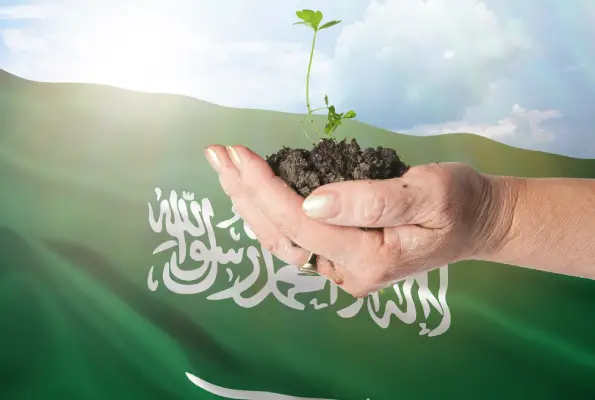
Almost two million people arrive in Saudi Arabia every year for Hajj. The holy city of Makkah and the surrounding sacred sites create a pop-up city that functions with the density of Manhattan and the logistical complexity of a military deployment. For decades, the primary challenge was crowd management and safety. However, in the wake of the Kingdom’s socio-economic diversification agenda named “Vision 2030,” a new priority has ascended to the top of the agenda: sustainability.
As the custodians of the “Two Holy Mosques,” Saudi Arabia has embarked on a massive ecological transformation. The goal is to align the spiritual purity of the pilgrimage with environmental stewardship, reducing the carbon and waste footprint of the world’s largest annual gathering. Two key initiatives (the “Green Mosques” project and the “Smart Waste” management of Hajj) highlight how tradition and futuristic technology are merging to create a greener path for pilgrims.
Green Mosques Initiative
The “Green Mosques” is an idea conceived by the “Saudi Green Initiative,” which works under the crown and aims to plant 10 billion trees across the Kingdom. It’s an ingenious plan because there are numerous mosques in the desert Kingdom, and they are the heart of communal life in Saudi Arabia. This makes mosques the best agents of localised climate change and cultural shifts.
The model’s success was exemplified in the Al Baha region in 2025. With its mountainous terrain and relatively milder climate, Al Baha became the pilot ground for an ambitious afforestation project led by the Ministry of Islamic Affairs, Dawah, and Guidance. In a project that connects religious infrastructure directly to national climate goals, the Ministry launched a campaign to plant 50,000 trees around mosques throughout the region.
This project goes beyond simple landscaping. It is designed as a functional ecological intervention. The trees selected are local, drought-resistant species capable of surviving with minimal irrigation while providing maximum shade and air purification. By increasing vegetation cover around these spiritual centres, the initiative actively lowers the ambient temperature, a crucial benefit in a warming climate, and creates natural carbon sinks.
The Al Baha project serves to reverse land degradation and reduce emissions. By integrating these targets into the management of mosques, the Ministry is sending a powerful message that environmental care is a religious duty (Khalifa), turning every mosque into a hub for community-led sustainability.
Smart Waste Of Hajj
While the “Green Mosques” initiative focuses on regeneration, the challenge of Hajj is one of immediate waste management. The environmental footprint of millions of pilgrims eating, drinking, and living in temporary camps for five days is immense. To tackle this, the National Centre for Waste Management (MWAN) has deployed high-tech solutions that prioritise a circular economy over landfills.
One of the most persistent issues during Hajj is food waste. In the vast tent cities of Mina and Arafat, the volume of discarded food can be staggering. In the 2024 and 2025 seasons, MWAN introduced a technological breakthrough to address this using on-site “digestor” devices.
These machines are a marvel of rapid composting. Deployed directly within the camps, they act as mechanical stomachs. According to recent reports, a single unit can process approximately 200 kilogrammes of food waste in a cycle of just 12 to 18 hours.
The process is odourless and efficient. Instead of trucking rotting waste hundreds of miles to a landfill (generating methane and carbon emissions along the way), the digestors treat the waste on-site, converting it into high-quality soil fertiliser. This fertiliser is then used to support the very afforestation projects mentioned earlier, creating a closed-loop system where the waste from the pilgrimage feeds the greening of the holy sites.
The Sustainable Ihram
Perhaps the most visible symbol of the Hajj is the Ihram, the two white, unstitched cloths worn by men to signify equality before God. Millions of these garments are purchased, worn for a few days, and traditionally discarded, creating a massive textile waste challenge.
To combat this, the “Sustainable Ihram” initiative has revolutionised how these sacred garments are handled. Rather than treating used Ihrams as trash, MWAN and its partners have established a collection and recycling infrastructure. In the most recent Hajj seasons, the initiative successfully diverted over 50 tonnes of Ihram cloths from landfills.
The bedding in the camps has also been targeted. Approximately 300,000 pillows were collected and sent for recycling alongside the Ihram cloths, which undergo a rigorous sanitisation and reprocessing cycle. After being shredded and spun into new fibres, they are used to manufacture rugs, insulation materials, or even new garments. This initiative reduces the volume of waste and introduces the concept of a “circular Hajj,” where the materials used in the pilgrimage are given a second life.