

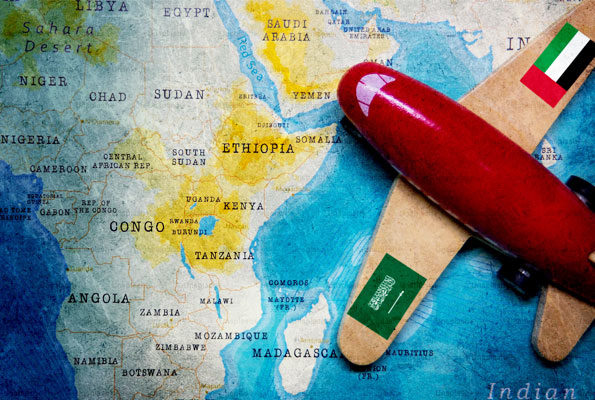
The economic geography of the Global South is witnessing a tectonic shift, characterised by the rapid and structural reintegration of the Arabian Peninsula with the African continent. This phenomenon, driven primarily by the Gulf Cooperation Council (GCC) states, specifically Saudi Arabia and the UAE, represents a fundamental departure from the historical norms of Afro-Arab relations.
No longer defined solely by religious philanthropy, transactional crude oil arbitrage, or labour migration, the emerging corridor is built upon a sophisticated scaffolding of critical infrastructure ownership, digital sovereignty, energy transition partnerships, and logistical dominance.
This report provides an exhaustive analysis of this strategic pivot, positing that the GCC’s engagement is not merely an opportunistic search for yield but a “post-oil” grand strategy. For the Gulf states, Africa represents the necessary hinterland to secure food supplies, control global maritime choke points, and dominate the supply chains of critical minerals essential for the post-carbon era.
Strategic imperatives
The surge in GCC activity across Africa results from calculated national strategies (Saudi Vision 2030 and the UAE’s “Projects of the 50”) intersecting with Africa’s demographic realities and resource endowments. The strategic imperative driving this engagement is tripartite: economic diversification, security architecture, and the necessity of establishing a non-Western sphere of economic influence.
Historically, Gulf engagement with Africa was characterised by chequebook diplomacy, including grants and aid aimed at securing political loyalty. The contemporary era is defined by “patient capital,” long-term investments in hard assets, where GCC states have collectively invested over $100 billion in the last decade.
This capital is operationally active. Emirati firms do not merely finance projects—they build, operate, and own them. This ownership model allows the UAE to control nodes of trade, while Saudi Arabia utilises the Public Investment Fund (PIF) to execute a rapid “catch-up” strategy, shifting from passive financial deposits to active industrial partnerships.
Despite its immense wealth, the Gulf views food security as an existential threat, a reality made stark by global supply chain disruptions. Riyadh is investing heavily in agricultural technology and farmland to reduce its dependence on 80% food imports.
Saudi Arabia is focusing intensely on the Greater Horn of Africa due to its geographic proximity and the fertility of the Blue Nile basin. By exporting capital and technology to these regions, it aims to re-import food security. Simultaneously, Emirati firms are investing in the logistics cold chains required to move perishables, ensuring that produce grown in Africa can be reliably transported to Gulf markets.
This “farm-to-fork” control is complemented by a security architecture focused on the Red Sea, the jugular vein of GCC energy exports. Instability in the Horn of Africa directly impacts national security, prompting initiatives like the “Council of Arab and African Coastal States on the Red Sea and Gulf of Aden,” which blend economic aid with maritime security cooperation.
While hard infrastructure dominates the headlines, the GCC is simultaneously deploying significant soft power through humanitarian aid and cultural diplomacy to build goodwill. The King Salman Humanitarian Aid and Relief Centre (KSrelief) acts as a vanguard for deeper engagement, launching food security projects in Burkina Faso and conducting medical missions in Mauritania.
In Sudan, despite conflict, KSrelief continues to distribute aid, maintaining a humanitarian corridor that keeps diplomatic channels open. Furthermore, the UAE has institutionalised cultural diplomacy through platforms like “UAE Africa Connect,” which promotes joint research and celebrates cultural heritage.
These efforts are designed to soften the image of the Gulf states from mere extractors of wealth to partners in development, although this narrative is constantly tested by the realities of their commercial interventions.
Logistics, trade, and infrastructure
If oil was the currency of the 20th century for the Gulf, logistics is the currency of the 21st. The strategic objective is to transform the Arabian Peninsula into the central node connecting Africa, Asia, and Europe. The UAE has effectively ring-fenced Africa with a network of ports, free zones, and inland logistics hubs, primarily through DP World and AD Ports Group.
In 2024 and 2025, AD Ports Group significantly deepened its footprint by securing a 20-year concession to operate the Noatum Ports Luanda Terminal in Angola. This $250 million investment secures a critical node for the export of copper from the Central African belt.
Simultaneously, DP World continues its vertical integration strategy, exemplified by its acquisition of South Africa’s Imperial Logistics, which grants it control over trucking and rail networks across Southern Africa. This “pit-to-port” strategy allows Gulf firms to capture the entire logistics premium, bypass inefficient state-run providers, and challenge the historical dominance of European operators.
Trade architecture is being formalised to support this physical infrastructure. The UAE is aggressively pursuing Comprehensive Economic Partnership Agreements (CEPAs) to institutionalise trade flows. Following the UAE-Mauritius CEPA, the UAE signed agreements with the Republic of Congo in April 2025 and Kenya in January 2025.
These agreements reduce tariffs, simplify customs, and create financial gateways for UAE capital to enter African markets, effectively bypassing slower continental frameworks like the AfCFTA. Saudi Arabia is ramping up trade volume. Also, non-oil exports to Africa have seen double-digit growth, driven by chemicals and machinery, with the Saudi Export-Import Bank (EXIM Bank) working to finance these flows.
Financial integration is the third pillar of this connectivity backbone. The Saudi Fund for Development (SFD) has shifted from passive aid to strategic infrastructure financing that paves the way for Saudi corporate entry. With over $10.7 billion financed across 46 countries, the SFD is now partnering with the Africa Finance Corporation (AFC) to jointly finance infrastructure.
This collaboration blends Saudi sovereign capital with African multilateral expertise to de-risk projects and ensures local buy-in. Furthermore, the entry of Qatar into the fray, with Al Mansour Holding pledging over $100 billion across six African nations in 2025, signals a new phase of intra-Gulf competition for African assets, although analysts remain cautious about the execution of such massive headline figures.
Energy transition and digital sovereignty
The “Green Paradox” of the GCC engagement is that the world’s largest hydrocarbon exporters are financing Africa’s renewable energy revolution and digital transformation. This is driven by a desire to export the “post-oil” model and capture the value chain of the future.
In the energy sector, Masdar (UAE) has committed $10 billion to deliver 10GW of clean energy in Africa by 2030, with projects spanning from wind farms in Egypt to solar plants in Angola. Saudi Arabia’s ACWA Power is similarly dominant, with the Redstone Concentrating Solar Power (CSP) plant in South Africa providing critical baseload renewable energy. These investments position North Africa as a future green hydrogen battery for Europe, financed and developed by Gulf capital.
A critical component of this future-proofing is the race for critical minerals. To fulfil Vision 2030’s goal of producing 500,000 electric vehicles annually, Saudi Arabia needs a secure supply of lithium, cobalt, and copper. Manara Minerals, a joint venture between PIF and Ma’aden, is tasked with acquiring global mining assets, focusing on the “super-region” from Central to Southern Africa.
The UAE has already made decisive moves, with International Resources Holdings (IRH) acquiring a 51% stake in Zambia’s Mopani Copper Mines for $1.1 billion. This acquisition directly challenges Chinese dominance in the Copperbelt and secures essential inputs for the UAE’s industrial ambitions.
Saudi Arabia employs “mining diplomacy” via the “Future Minerals Forum” to sign agreements with nations like the DRC and Egypt, positioning itself as a neutral partner offering capital for downstream processing rather than just raw extraction.
Parallel to physical resources, the GCC is rapidly building a “Digital Spice Route.” Saudi Arabia and the UAE are laying the physical infrastructure of the internet to ensure data sovereignty. The stc Group’s 2Africa Pearls submarine cable system circumnavigates the continent, enhancing connectivity for billions while routing data through GCC-owned infrastructure. In AI, the UAE’s G42 and Microsoft announced a $1 billion digital ecosystem initiative for Kenya in 2025, including a geothermal-powered data centre and AI skilling programmes.
This partnership allows the UAE to position itself as a bridge between Western technology and African markets, navigating export controls while gaining access to African data sets. Similarly, the Saudi Data & AI Authority (SDAIA) is exporting its “smart government” expertise, signing MoUs to support AI adoption and digital governance across the “Global South.”
Regional battlegrounds
The integration of the Gulf and Africa is fraught with high-stakes geopolitical friction and sovereign risks. The Horn of Africa serves as the cockpit of this rivalry, where economic investments are often indistinguishable from foreign policy tools. The most glaring example is the collapse of the UAE’s ambitions in Sudan.
The UAE had signed a $6 billion deal to develop the Abu Amama port, but the project was cancelled by the Sudanese military government in late 2024 due to accusations that the UAE was arming the Rapid Support Forces (RSF). This debacle highlights the fragility of GCC investments in conflict zones; despite massive capital, political alignment remains a prerequisite for project viability.
It also highlights how intra-Gulf rivalries (with Saudi Arabia and Egypt leaning towards the Sudanese military and the UAE allegedly supporting the RSF) can fracture African states and derail economic integration.
Beyond proxy conflicts, legal battlegrounds pose a significant threat to long-term infrastructure concessions. DP World’s protracted dispute with the Government of Djibouti over the seizure of the Doraleh Container Terminal serves as a cautionary tale. Although DP World has won multiple arbitral awards totalling nearly $700 million and a recent US court enforcement, the physical asset remains under Djiboutian control.
This illustrates the sovereign risk inherent in the region, where changes in government or geopolitical realignments (often involving competing powers like China) can lead to expropriation of strategic assets. GCC firms are increasingly mitigating this by blending investments with development aid or partnering with multilateral institutions to raise the political cost of expropriation.
Furthermore, the “neocolonial” critique of Gulf engagement is gaining traction among African civil society. The extractivist nature of investments contrasts with the developmental rhetoric. As African states strengthen mining codes and assert resource nationalism, as seen in Mali’s disputes with international miners, Gulf investors face a tougher regulatory environment.
The debt crisis looming over 20 low-income African countries further complicates the picture. While Gulf states favour equity over debt to avoid default risks, macroeconomic instability limits the consumer markets they hope to serve. Navigating these reputational and financial minefields requires a shift from transaction-based engagement to genuine partnership—a transition still in its early stages.
The integration scenario
By 2030, the GCC-Africa economic corridor is poised to cement itself as a distinct geopolitical bloc, reshaping the global distribution of power and capital. The inclusion of Saudi Arabia, the UAE, Egypt, and Ethiopia in the expanded BRICS+ alliance suggests a move away from the dollar-dominated financial order toward a trade system settled in local currencies or gold.
The UAE leads in logistics and trade efficiency, knitting the continent into a global maritime network, while Saudi Arabia provides the heavy industrial weight and financial floor, driving energy and mining megaprojects. However, the “mercantile peace” the Gulf seeks is threatened by political instability fuelled by its rivalries.
The future of Gulf-Africa integration hinges on the GCC overcoming three challenges: managing intra-Gulf competition, protecting investments from Africa’s debt crisis, and countering exploitation narratives with tangible value. Failure could turn Africa from a strategic asset into a security risk, where infrastructure projects and diplomatic ties falter. However, success could build a trans-regional economy that shields both the Gulf and Africa from global instability, ensuring essential resources and markets for a post-American, post-carbon future.