

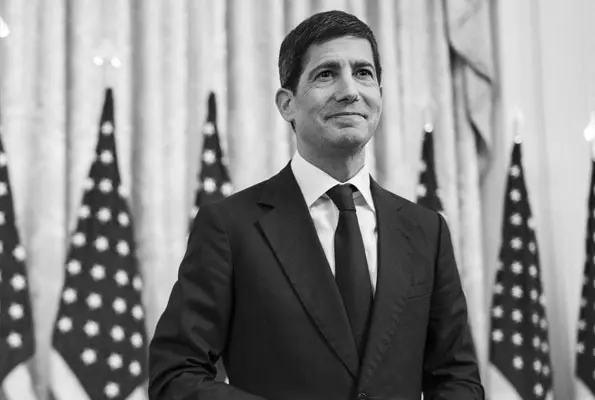
On May 22, Kevin Warsh was sworn in as the 17th Chairperson of the Federal Reserve, the central bank of the United States that sets interest rates for the world’s largest economy. His confirmation was the most contentious in the Fed’s history.
A Senate committee initially blocked him while his predecessor, Jerome Powell, was under federal investigation. Warsh eventually scraped through by the narrowest margin ever, with only one Democrat, Pennsylvania Senator John Fetterman, crossing party lines to support him.
The Fed chair is arguably the most powerful unelected official on the planet. When the Fed raises or lowers interest rates, it changes the cost of borrowing money for everyone, including homebuyers, businesses, and governments. Its decisions have an impact on currencies, inflation, and economies around the world.
What Jerome Powell Left Behind
When the Covid-19 pandemic struck in 2020, the Fed did what central banks do in a crisis. It flooded the economy with cheap money. It cut interest rates to near zero, and began buying up vast amounts of government bonds, a policy known as quantitative easing, or QE.
At its peak, the Fed’s balance sheet swelled to $9 trillion, equivalent to about 36% of America’s entire annual economic output. At the same time, the US government pumped roughly $5 trillion in pandemic relief into the economy across two administrations.
All that money chasing goods and services meant that prices began rising sharply. By early 2021, inflation was clearly climbing above the Fed’s 2% target. Powell and his colleagues kept insisting the price rises were ‘transitory’, a temporary blip caused by pandemic-related supply chain disruptions that would fix themselves without the Fed needing to act. They were wrong.
By June 2022, inflation had hit 9.1%, a 40-year high. Cumulatively, consumer prices ended up 27% higher than before the pandemic. Grocery bills rose by around 30%. The cost of almost everything jumped.
Seeing no other option, the Fed launched the most aggressive interest rate hiking campaign since the 1980s, including three consecutive increases of 0.75 percentage points, a pace rarely seen in modern central banking. By July 2023, the benchmark rate had been pushed to a peak of between 5.25% and 5.5%. This succeeded in bringing inflation down significantly, but not all the way. Inflation plateaued around 3.4%, and refused to fall further to the 2% target.
Despite this ‘last mile’ problem, the Fed then began cutting rates, reducing them by a total of 1.75 percentage points between late 2024 and 2025, bringing the current rate to between 3.5% and 3.75%. Many economists consider this a mistake. The labour market was still healthy, meaning there was no strong economic justification for the cuts.
Powell also spent much of his tenure fighting off political pressure from President Donald Trump, who, since the beginning of his second term in 2025, repeatedly and publicly demanded lower interest rates. His final year was further clouded by a Justice Department investigation into an expensive renovation of the Fed’s Washington headquarters, though the probe was dropped in April 2026.
Two Clashing Forces
America is in the middle of a spending spree on AI infrastructure, covering data centres, computer chips, power generation, and the software to run it all. Major technology companies collectively spent $427 billion on AI-related capital expenditure in 2025. That figure is projected to reach $562 billion in 2026, and $637 billion in 2027. Over the five-year period from 2026 to 2031, total AI investment is forecast to hit $7.6 trillion.
The scale of individual transactions reflects the intensity of this moment. In June 2026, Google’s parent company Alphabet raised a record $80 billion in new equity to fund AI expansion: $40 billion through a rolling share sale programme, $30 billion through public share offerings, and $10 billion in a private placement directly with Warren Buffett’s Berkshire Hathaway.
Meanwhile, the AI company Anthropic is valued at $965 billion following a $65 billion funding round, and OpenAI is reportedly spending $15 million a day just on its Sora video generation platform.
Warsh believes this investment wave should help bring prices down over time by making the economy more productive and efficient. If AI genuinely boosts productivity at scale, that would give the Fed room to safely lower rates.
The problem is that there is little hard evidence of this productivity boost yet. US total factor productivity grew by only 0.8% over 2025. Labour productivity grew by 2.5%. These are not the numbers of a revolutionary economic transformation. Critics point out that past general-purpose technologies, like the internet, took decades to show up clearly in productivity statistics.
The Iran War Energy Shock
On February 28, war broke out with Iran. On March 4, the Strait of Hormuz, the narrow waterway through which roughly 20% of the world’s oil and gas passes, was completely closed. Gulf producers collectively lost 6.7 million barrels per day by March 10, a figure that widened to over 10 million barrels per day within two days.
Oil prices surged 70%, jumping from $72.78 per barrel to nearly $119.50, with intraday peaks hitting $126. Renewed missile strikes in June 2026 have pushed prices back up to around $97.85 per barrel. In the United States, average retail petrol prices jumped to $4.24 per gallon, up 30% from 2024.
The effects have spread throughout the economy. Airline fares jumped 20.7% annually as jet fuel costs soared. Global fertiliser prices rose over 12% in the first quarter of 2026, threatening a secondary wave of food price inflation. The average American household is now spending around $75 more per month on everyday expenses to deal with higher energy and transport costs.
Overall CPI inflation rose to 3.8% in April 2026. The Fed’s preferred measure of inflation, the PCE index, is projected at 3.9% for April. Core inflation, which strips out food and energy, also rose to 2.8%, suggesting that price pressures are spreading beyond energy into the broader economy.
Three Problems, No Easy Answers
Three major problems are stacked on the new chairman Kevin Warsh’s desk.
First, there is the rate dilemma. President Trump nominated Warsh partly because of his stated preference for lower interest rates, and the Republican continues to pressure the Fed for cuts. But cutting rates now, with CPI at 3.8% and rising, risks sending a signal that the Fed no longer takes inflation seriously, which could cause businesses and workers to expect higher prices indefinitely, making inflation self-fulfilling.
Financial markets have already priced out any chance of a rate cut in 2026, and are now pricing in a 40% probability of a rate hike by December. Several regional Fed presidents are also pushing back against any easing.
Warsh has pointed to narrower inflation gauges, specifically the Dallas Fed trimmed mean PCE at 2.40%, and the Cleveland Fed’s trimmed mean CPI at 2.80%, as evidence that underlying inflation is less worrying than the headline numbers suggest. Critics counter that shifting goalposts during a crisis to justify politically convenient decisions would be deeply damaging to the Fed’s credibility.
Second, there is the communication overhaul. Warsh wants to dismantle the Fed’s forward guidance system; the practice of signalling future rate moves through tools like the quarterly dot plot and regular press conferences. He blames this practice for locking the Fed into its ‘transitory’ error. But removing these anchors during a volatile period also risks spooking bond markets, pushing long-term interest rates up, and making mortgages and business loans more expensive.
Third, there is the balance sheet question. The Fed’s holdings have already fallen from $9 trillion to $6.7 trillion, about 21% of GDP, through quantitative tightening. Warsh wants to reduce it further. But draining reserves too fast risks triggering a funding crisis in short-term lending markets, similar to what happened in September 2019 when overnight borrowing rates spiked and the Fed had to intervene urgently.
The responsible path is uncomfortable. Keep rates where they are, resist political pressure to cut, and make any communication changes gradually. Whether Warsh, a Trump appointee navigating a hawkish committee while managing a White House demanding cheaper money, has the institutional independence to do that is the defining question of his early chairmanship.