

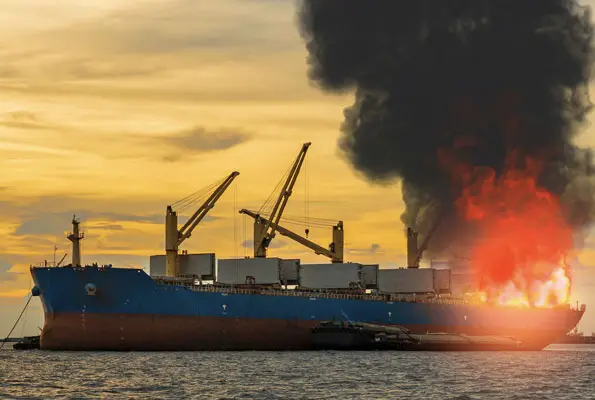
The United States and Israeli forces launched a major air campaign against Iran on 28th of February 2026. Within two days, the world’s most important oil corridor had been shut down, insurance markets had collapsed, and the global shipping industry was being forced to take an unplanned detour around the southern tip of Africa. The effects are still playing out.
The Strait of Hormuz is a narrow waterway between Iran and Oman, barely two miles wide in either direction for commercial traffic. It is also, by some distance, the most strategically significant stretch of water on the planet. Roughly one in five barrels of the world’s daily oil supply passes through it. So does about a fifth of global liquefied natural gas trade.
When Iran’s Islamic Revolutionary Guard Corps (IRGC) formally closed the waterway to vessels from the United States, Israel, and their allies on 2nd March 2026, the consequences were felt almost immediately at petrol stations, power plants, and cargo terminals from Tokyo to Rotterdam.
A Blockade Within a Blockade
The crisis quickly escalated into something that had no real precedent in modern shipping history. On 13 April, the United States Navy established its own counter-blockade in the Gulf of Oman, turning away ships bound for Iranian ports and, in some cases, boarding and disabling them by force. The two blockades ran simultaneously for 110 days, creating what analysts called a “dual blockade,” with each side using commercial shipping as leverage against the other.
The human cost was significant. Between late February and the mid-June ceasefire, the International Maritime Organization confirmed 46 separate attacks on international shipping. At least 17 vessels were damaged, seven were abandoned by their crews, and 14 seafarers were killed.
On 1st March, the oil tanker Skylight was struck by a projectile near Oman’s coast, killing the captain and another crew member. The same day, the tanker MKD Vyom was hit by an IRGC drone boat, triggering an engine room fire that killed one sailor and forced the evacuation of 21 others.
A day later, the US-flagged product tanker Stena Imperative, berthed at Bahrain’s Mina Sulman port and enrolled in a US Department of War fuel supply programme, was struck twice from the air. The crew survived, but a dockyard worker was killed and two others were injured.
By early May, more than 600 laden tankers sat stranded inside the Persian Gulf with nowhere to go.
The Insurance Collapse
For the global shipping industry, the financial shock arrived even faster than the physical one. Before the conflict, the additional “war risk insurance” premium for transiting the Strait was a modest surcharge, averaging around 0.125% of a ship’s value. Within 48 hours of the first air strikes, major insurers cancelled existing policies outright. Lloyd’s of London’s Joint War Committee placed the entire Persian Gulf, Gulf of Oman, and surrounding waters on its high-risk list, and premiums skyrocketed by as much as 4,000%.
At the peak, a single round-trip through the Strait cost ship owners above three million dollars in war risk insurance alone, for one voyage, on one vessel. For context, a standard VLCC (a very large crude carrier) is worth somewhere between 110 and 150 million dollars. Paying a premium of 2% to 3% of that value every time the ship moves through the region was simply not viable. Some shipowners were quoted premiums as high as 7.5%–10% of vessel value for the riskiest voyages.
The result was a near-total rerouting of global container and tanker fleets around the Cape of Good Hope, adding up to 4,000 nautical miles and between 10 and 14 extra days to journeys between Asia and Europe. Each rerouted voyage cost an additional 1.5 to 2 million dollars in fuel and operating expenses.
Across the whole commercial fleet, this came to an estimated 40 to 50 million dollars every week. Freight rates on major trade routes jumped by 150% to 300%. Air cargo rates from South-East Asia to Europe climbed past five dollars per kilogram as companies scrambled to fly urgent shipments rather than wait for ships that had gone the long way round.
Who Suffered Most
The countries that depend most heavily on Persian Gulf oil were hit hardest. Japan, which imports around 1.6 million barrels a day through the Strait, saw its trade deficit widen and its currency weaken sharply. South Korea, which sources 68% of its crude imports from the region, was forced to tap into its strategic petroleum reserves, reserves calculated to last around 200 days.
The exporting nations inside the Gulf had almost no alternatives. Qatar’s LNG fleet was entirely hemmed in; the country has no pipeline route that bypasses the Strait, and more than 100 LNG tankers sat loaded with cargo that could not be delivered. Iraq’s southern oil fields, which account for the bulk of the country’s oil revenues, were completely isolated. Kuwait’s oil income stopped entirely.
Saudi Arabia fared slightly better, having previously built an overland pipeline to the Red Sea port of Yanbu. Even so, operational constraints meant it could only export around 3.65 million barrels a day through that route in May, which was roughly two-thirds of its normal volumes.
The Peace Deal and Its Limits
The diplomatic breakthrough came in mid-June, “brokered” by Pakistan with support from Qatar, Turkey, Oman, and Egypt. The resulting Islamabad Memorandum of Understanding, signed in stages between 14 and 17 June by US Vice-President JD Vance, Iranian Parliament Speaker Mohammad Bagher Ghalibaf, and ultimately by Presidents Trump and Pezeshkian, established a 60-day ceasefire and set out a roadmap for a permanent peace treaty.
Under the deal, the US would begin dismantling its naval blockade immediately, with full withdrawal within 30 days. Iran would use its best efforts to reopen the Strait to commercial traffic without transit fees during the 60-day negotiating window and would clear sea mines and other military obstacles within 30 days. In return, the US and its partners committed to a 300-billion-dollar reconstruction fund for Iran, contingent on verified compliance with the final peace deal.
The announcement triggered an immediate drop in Brent crude futures, which fell below 80 dollars per barrel. But the industry knows better than to expect a smooth return to normal.
Why Normal Is Still Months Away
Three major obstacles are slowing recovery. The first is physical. During the conflict, the IRGC laid a significant number of sea mines in the Strait’s narrow shipping lanes and subsequently lost track of many of them. Maritime security agencies estimate it will take 40 to 50 days of sustained demining operations before the corridor can be declared safe for standard commercial transit.
The second is biological. More than 500 vessels sat idle in the warm, shallow waters of the Persian Gulf for the duration of the blockade. Sea surface temperatures in the region regularly exceed 30 degrees Celsius in summer, which creates ideal conditions for barnacles, algae, and marine organisms to colonise a ship’s hull. This “biofouling” increases drag and can push fuel consumption up by as much as 85%.
Fixing it requires underwater cleaning crews or dry-docking, and regional facilities are overwhelmed by the sudden demand. Several major ports, including those in the United States, Australia, and New Zealand, have strict biosecurity rules that bar vessels with significant marine growth from entering at all.
The third is financial and legal. Insurance markets do not reset on the day a peace deal is signed. War risk premiums will remain elevated until underwriters have accumulated enough incident-free transits to rebuild their risk models. Meanwhile, Iran’s newly established Persian Gulf Strait Authority, created in May to collect transit tolls of up to two million dollars per vessel, has already been sanctioned by the US Treasury as an IRGC-linked entity. Any shipping company that pays the toll faces potential prosecution under US sanctions law. Any company that refuses faces possible detention by Iranian forces.
The shipping lanes that once carried a fifth of the world’s oil quietly and cheaply have been permanently changed. The question now is not whether normalcy will return, but what the new normal will look like and who will bear its costs.