

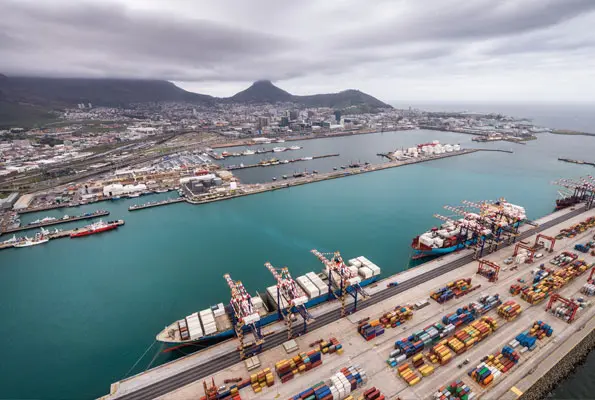
On a stretch of Atlantic coast in the Democratic Republic of Congo, where few commercial ships venture today, a Dubai-headquartered port operator is digging deep. The project is audacious in scale: a deep-water port at Banana, built to handle 450,000 shipping containers annually, capable of slashing trade costs by as much as 12% across Central Africa. But the economic case is almost secondary to what the port truly represents—a strategic node in an emerging infrastructure network that stretches from Shanghai to Rotterdam, threading through African coastlines and the Red Sea, controlled not by Western powers or China alone, but increasingly by the Emirates and Saudi Arabia.
This is not really a story about containers.
It is a story about how ports have become the chessboard on which global power is being rearranged. In the 21st century economy, a single port can determine whether cobalt and copper mined in Zambia reaches battery factories in South Korea, whether renewable energy equipment manufactured in Germany supplies electrification projects across Africa, whether food imports keep East African markets stable, whether China maintains control over critical mineral supply chains, and ultimately, who holds geopolitical influence in regions spanning three continents.
The competition is intense, and it reveals something counterintuitive: as Houthi rebel attacks in the Red Sea have destabilised one of the world’s most crucial shipping corridors, forcing vessels to reroute around Africa at enormous cost, the Gulf states have been methodically positioning themselves as the linchpin of a new global logistics architecture. The United Arab Emirates, through its two major port operators, DP World and AD Ports, has committed over $6 billion to African port expansion. Saudi Arabia has taken stakes in regional infrastructure. Chinese state enterprises, having invested roughly $50 billion in African ports since 2013, continue their relentless march to secure mineral exports. Meanwhile, Europe and the United States are scrambling to maintain relevance through the India-Middle East-Europe Economic Corridor, a counter-initiative to Chinese infrastructure dominance.
Ports as strategic infrastructure
For most observers, a port is simply where containers are loaded and unloaded. It is a logistical asset, measured in 20-foot equivalent units, or TEUs. But this narrow view obscures something profound: modern ports are nodes in systems of power that determine which nations prosper and which lag behind.
Consider what happens when a port improves its efficiency. A cargo of cobalt ore from the Democratic Republic of Congo, destined for battery factories in South Korea, normally requires multiple transshipments through intermediary ports. Each adds cost, each delays delivery. A modern port with rail connections can load the ore directly onto trains that link to inland mining regions. A port with special economic zones can host processing facilities, capturing value locally rather than exporting raw materials. A port with fibre-optic cables can integrate with digital trade networks. A port with the right governance and customs infrastructure can reduce shipping times from weeks to days.
Suddenly, a port is not merely infrastructure. It becomes a tool for manufacturing competitiveness, for food security, for the control of mineral supply chains, for the projection of military power, and for the ability to either integrate into or insulate from global commerce.
This is precisely what major powers now understand. When DP World commits $3 billion over the next five years to African ports, it is not building container terminals out of commercial enthusiasm alone. When AD Ports signs concession agreements to develop multiple Red Sea facilities, it is securing control over chokepoints in global trade. When China methodically acquires stakes in African port operators while simultaneously financing railways and roads that feed those ports, it is constructing integrated supply chains.
The critical minerals imperative
Africa’s strategic importance in global infrastructure competition rests fundamentally on minerals. The Democratic Republic of Congo controls roughly 70% of global cobalt production, essential for lithium-ion batteries. Zambia and Zimbabwe are major copper producers. Namibia, Botswana and Mali host lithium deposits. Over the coming decade, demand for these minerals will intensify dramatically. Global demand for cobalt, lithium, nickel and copper is forecast to increase five-fold by 2035 compared to 2023 levels, driven by the global transition to renewable energy and electric vehicles.
The irony is that Africa produces the minerals but captures relatively little value from them. Africa exported approximately $176 billion worth of critical minerals in 2024, yet the global critical minerals market reached $2.25 trillion. Most African production remains raw or semi-processed; the highest-margin stages of the value chain – battery manufacturing, refining, component production – happen elsewhere, predominantly in China and Asia.
To change this, Africa needs integrated infrastructure networks. Minerals must move from mines to ports efficiently. Ports must connect to manufacturing hubs and special economic zones. Railways must provide reliable transport. This is where the geopolitical competition crystallises. The operator that controls the ports also influences which countries capture downstream value, which companies secure supply contracts, and which geopolitical powers exercise influence over critical supply chains.
China understood this dynamics early. Since 2013, when President Xi Jinping launched the Belt and Road Initiative, Chinese firms have invested approximately $50 billion in African port infrastructure. These investments are not primarily about short-term returns. They are about securing reliable access to minerals. When a Chinese state-owned mining firm operates cobalt mines in the DRC, and a Chinese port operator manages the terminal through which that cobalt is exported, and a Chinese shipping company transports the ore, and a Chinese refinery processes it, the entire supply chain is integrated. This vertical integration provides Beijing with structural leverage over global battery supply.
The United States and European Union have begun responding, but late. The Lobito Corridor, backed by Western development finance and linking Angolan ports to mineral-rich regions in Zambia and the DRC, represents an attempt to build alternative logistics networks. But China’s head start is substantial.
The Emirati strategy
Within this landscape, the United Arab Emirates has emerged as perhaps the most strategically astute player. Unlike China, which prioritises direct ownership and vertical integration, and unlike Europe and America, which operate through formal alliances and development institutions, the UAE has adopted a model of strategic positioning through connectivity.
DP World, registered in Dubai but operating globally, has become the world’s fifth-largest port operator. The company is not content with managing individual terminals. Instead, it is constructing integrated logistical ecosystems. The Ndayane Port in Senegal, currently under development with an initial investment of $830 million, will have capacity to handle 1.2 million containers annually. Adjacent to the port, DP World is developing a special economic zone and coordinating with the nearby Blaise Diagne International Airport to create a multimodal logistics hub. The port will cut Senegal’s trade costs significantly and is projected to generate roughly $15 billion in additional trade value by 2035.
This pattern repeats across the continent. In Tanzania, DP World has expanded operations at Dar es Salaam. In the DRC, the Banana Port project represents a transformative infrastructure investment. In Mozambique, DP World holds a significant stake in Maputo Port and has committed $165 million to expansion, with plans to double throughput capacity.
AD Ports Group, the Abu Dhabi-based port operator, has pursued an equally ambitious but somewhat different strategy. Rather than consolidating positions, AD Ports has spread its presence across multiple regions and sectors. The company now operates thirty-four port terminals across more than eight countries. In Egypt, it has signed agreements to develop and operate cruise terminals at Safaga, Hurghada, and Sharm El Sheikh on the Red Sea, and has secured a multi-purpose terminal concession at Safaga itself. In Tanzania, AD Ports acquired a majority stake in Tanzania International Container Terminal Services in partnership with the Adani Group. In Angola, it operates the Port of Luanda. In Pakistan, it has secured a twenty-five-year concession to develop and manage Karachi Port.
What is striking about the Emirati approach is that it does not require exclusive control of supply chains. Instead, these companies position themselves as essential intermediaries, as the logistics platforms through which trade flows, regardless of who owns the underlying assets. This provides influence without requiring the level of direct investment that China demands, and without the political friction that sometimes accompanies Chinese state ownership of critical infrastructure.
Eritrea’s foreign minister recently accused the UAE of “port imperialism” across Africa, a characterisation that captures both the ambition of the strategy and the concern it generates among some regional powers. Yet for most African governments, the Emirati model appears preferable to alternatives. Unlike China, which demands long-term resource concessions and creates debt dependencies, and unlike the West, which often attaches conditions on governance and human rights, the UAE offers investment capital with relatively few political strings, combined with genuine logistics expertise.
The Red Sea trigger
What accelerated this competition was a crisis that most observers initially viewed as a temporary disruption. Beginning in late 2023, Houthi rebel forces based in Yemen, backed by Iran, began attacking commercial vessels transiting the Red Sea and the Bab al-Mandab strait. These attacks have become increasingly brazen and effective. Over the course of more than a year, Houthi forces have targeted more than 130 vessels, damaging dozens and sinking two.
The disruption of the Red Sea shipping corridor has been staggering. Normally, roughly twelve per cent of global maritime trade passes through the Suez Canal, the gateway to the Red Sea. Container transits through the canal plummeted from approximately 2,068 in November 2023 to roughly 877 in October 2024. Shipping companies like Maersk, MSC, and Hapag-Lloyd began rerouting vessels around southern Africa via the Cape of Good Hope, adding ten to fourteen days to transit times and raising freight costs by as much as eighty per cent.
This disruption fundamentally changed the strategic calculus for shipping companies and cargo owners. If the Red Sea becomes persistently unsafe, alternative routes matter. African ports that can service long-distance voyages around the Cape of Good Hope become economically viable despite higher marginal costs. Facilities in East Africa – Tanzania, Kenya, Mozambique – suddenly offer advantages for cargo destined to Asia that previously would have transited through the Red Sea and Suez Canal.
For the Gulf states, the Red Sea crisis represented both a threat and an opportunity. A threat because it disrupted traditional trade routes that benefited their shipping and logistics sectors. An opportunity because it made their strategic positioning as intermediaries even more valuable. The Emirati port operators can now market themselves not just as efficient logistics hubs, but as the connective tissue that enables trade to flow despite disruptions to traditional corridors.
IMEC and the alternative corridor
In September 2023, even as the Red Sea crisis was gathering momentum, India, Saudi Arabia, the United Arab Emirates, and several Western nations announced plans for the India-Middle East-Europe Economic Corridor, or IMEC. The initiative was explicitly framed as an alternative to Chinese infrastructure dominance. But it is better understood as the Gulf states’ attempt to position themselves as the central node connecting three continents and three major economic spheres.
IMEC envisions integrated rail, maritime, and digital networks stretching from Indian ports like Mundra and Kandla through UAE facilities including Jebel Ali and Abu Dhabi, onward through Saudi Arabian and Jordanian corridors, into Israel’s Haifa port, and ultimately reaching European terminals in Greece (Piraeus), Italy (Trieste and Messina), and France (Marseille). The initiative includes not just maritime infrastructure but also railway corridors, fibre-optic cables for digital connectivity, and energy networks.
For the Gulf states, IMEC represents strategic genius. Rather than being pulled into competition between China and the West, Gulf nations position themselves as the geographic bridge that both sides need. They can serve Chinese interests by facilitating trade between Asia and Europe. They can serve Western and Indian interests by providing alternatives to Chinese infrastructure. They can extract maximum economic advantage by managing the middleman position.
The corridor is not yet operationally seamless. Regional conflicts, particularly the war in Gaza and its spillover effects, have complicated diplomatic coordination. But the infrastructure development has begun. In early 2025, construction commenced on railway links, logistics hubs, and port facilities across the corridor. By positioning themselves as central to IMEC’s success, the UAE and Saudi Arabia have secured a role in shaping how global trade flows for decades to come.
A continent awakes to its leverage
Beneath these great power competitions, a subtler shift is occurring. African nations, increasingly aware that they control mineral resources essential to the global energy transition, are beginning to demand better terms. The Democratic Republic of Congo, which produces roughly seventy per cent of global cobalt, introduced export quotas in 2024 to encourage domestic value addition and increase negotiating leverage. Zimbabwe has restricted exports of raw lithium ore, requiring processing within the country. African governments have begun negotiating longer concession periods, larger revenue shares, and technology transfer requirements.
For African governments, the proliferation of competing port operators and infrastructure developers is advantageous. Rather than negotiating with a single dominant player, they can choose among options. They can demand that port operators contribute to local skill development, that special economic zones create manufacturing opportunities, that port revenues contribute to national budgets. Mozambique, impressed with DP World’s performance at Maputo, extended its concession agreement by twenty-five years—a decade earlier than required. This was not charity; it reflected Mozambique’s assessment that DP World was delivering value.
Yet African nations remain vulnerable to structural dependencies. When a country depends on a single port operator or a single primary mineral export, geopolitical shocks can prove devastating. When cobalt prices collapse, mining regions face unemployment. When shipping routes are disrupted, economies dependent on imports suffer shortages. Building resilient African economies requires not just ports, but integrated networks of ports, railways, roads, and processing facilities – precisely what the current infrastructure investment programs are attempting to create.
The unresolved question of control
Yet unanswered questions loom. As the gulf states expand their port networks across the Red Sea, Indian Ocean, and East African coastlines, as Chinese firms tighten their grip on mineral supply chains, as European and American powers attempt to maintain relevance through IMEC and alternative corridors, one question persists: who truly controls these networks in the long term?
A port is not merely a commercial asset. It is infrastructure with potential military and geopolitical significance. When a nation controls ports along critical sea lanes, it exercises influence not merely over commerce but potentially over security itself. China’s presence in Djibouti, where it operates the port and maintains its only overseas military base, allows Beijing to project power into the Indian Ocean. The UAE’s expanding presence across Red Sea ports and East African coastlines provides similar potential, though the Emirati model has historically been commercial rather than militarised.
For Western powers, the challenge is structural. The United States and Europe have limited appetite for the massive, sustained infrastructure investments that China and Gulf states are willing to commit. American and European development finance is conditional, often requiring governance improvements, anti-corruption measures, and human rights standards. This sometimes impedes their competitiveness against operators willing to work with governments regardless of Western concerns about authoritarianism.
The Lobito Corridor and IMEC represent Western attempts to remain strategically relevant. But these initiatives operate at the intersection of commercial logic and strategic imperative, and the tensions between these objectives sometimes show. Investors seek returns. Governments seek influence. Developing nations seek development. These motivations do not always align.
The emerging chessboard
The ports being constructed and expanded across Africa today will shape global commerce and geopolitics for the next fifty years. A deep-water port in the DRC is not primarily about today’s container volumes. It is about positioning for the economy of 2050, when battery manufacturing may be distributed globally, when renewable energy infrastructure dominates, when supply chains for critical minerals are reshaped by resource nationalism and technological change.
The Gulf states, through their port operators, are betting that they can be essential middlemen in this future, connecting Asian manufacturers to African mineral sources and European customers. Chinese enterprises are betting that vertical integration of supply chains, from mines through ports to shipping to processing, will provide structural advantages. Western powers are betting that inclusive development models and investment in multiple corridors will ultimately prove more durable and beneficial.
What is clear is that the competition is not merely commercial. Ports are infrastructure, yes, but they are also power. A nation that controls a port controls what moves through it, at what cost, and with what political implications. As climate change drives energy transition, as geopolitical competition intensifies, and as supply chains become strategic weapons, the quiet race to own African ports may prove one of the defining competitions of the coming decades.
For African nations, the proliferation of competing investors is simultaneously an opportunity and a challenge. The opportunity lies in being able to demand better terms, to capture more value from resources, to build integrated infrastructure networks. The challenge is navigating great power competition without being captured by any single player, maintaining autonomy whilst leveraging investment. The port operators understand the stakes. The question is whether African governments do.