

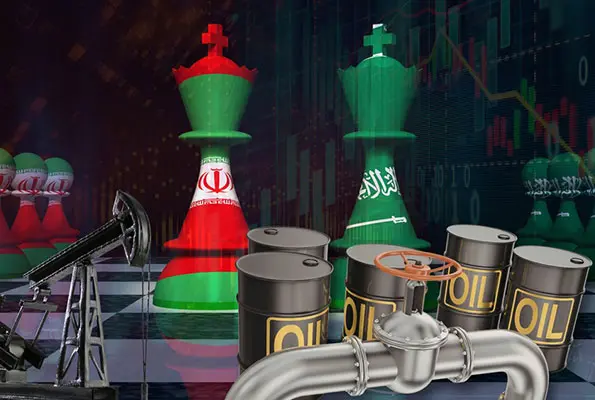
The ongoing Iran war has severely impacted the Saudi economy, with the Kingdom experiencing its most significant quarterly contraction since the COVID pandemic. This downturn is primarily attributed to a sharp decline in the oil industry.
Overall GDP shrank 4.8% year-on-year in the three months through June, compared with 3% growth in the first quarter, according to preliminary data from the General Authority for Statistics (GASTAT). A 24.7% decline in the oil sector appeared to be the major headwind.
The five-month-old conflict, which is showing no signs of ending anytime soon, is putting a domino effect on the Kingdom and the wider Gulf, with energy production and trade, the economic lifeline of the region, taking significant hits.
While Tehran has sporadically struck US allies across the region, including Saudi Arabian energy facilities, the closure of the Strait of Hormuz has also forced the world’s largest crude exporter to use a pipeline workaround to Yanbu port on the Red Sea. However, that route has also come under threat from Iran-backed Houthi rebels.
While the Saudi oil sector plunged in the second quarter, compared with 2.9% growth in the preceding period, non-oil activities, that have emerged as the cornerstone of the Kingdom’s ambitious “Vision 2030” diversification agenda, emerged as the saving grace, by expanding 0.6% in the second quarter versus 2.9% previously.
Saudi’s oil production levels have remained below the pre-conflict rates, although the Kingdom has partially benefited from spikes in the crude price.
Despite the GDP contraction, Saudi Arabia may still manage to be one of only two Gulf countries to record positive growth in 2026, along with Oman, according to Monica Malik, chief economist at Abu Dhabi Commercial Bank. She predicts expansion at 1% in 2026 versus 2025’s tally of 4.5%.
The International Monetary Fund (IMF), however, found Saudi Arabia “showing agility and resilience”, crediting the Kingdom’s “strong macroeconomic fundamentals and diversified oil and logistics infrastructure”.
“A recovery is expected to take hold when maritime traffic through the Strait of Hormuz gradually returns to normal,” the Washington-based global lender said, while predicting Saudi economic growth to slow to 1.7% in 2026, before accelerating to 5.5% in 2027.
“Over the medium term, growth will be supported by buoyant consumption and investment, including government-led projects and major international events, and by sustained structural reforms under Vision 2030,” the IMF remarked.