

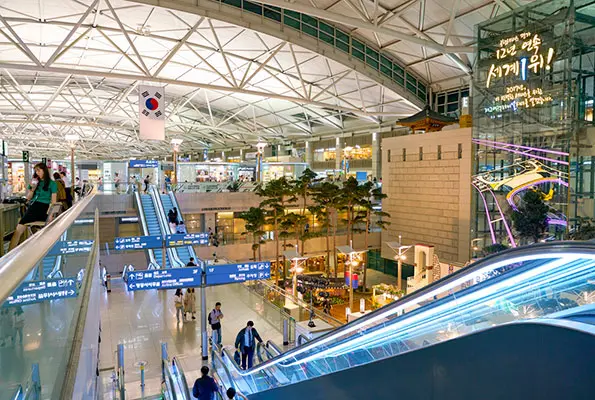
South Korea’s Incheon International Airport has overtaken London Heathrow to become the world’s busiest airport for international passenger traffic for the first time, as Middle East flight disruptions and growing Asian travel boost traffic through the South Korean hub.
Incheon handled 38.39 million international passengers in the first six months of 2026, according to preliminary figures from the Airports Council International (ACI). Heathrow ranked second with 37.79 million, followed by Singapore’s Changi Airport with 34.53 million.
The increase at Incheon has been partly attributed to the US-Iran conflict, which disrupted aviation routes through the Middle East and weakened the role of major hubs such as Dubai. Some passengers who previously transited through Dubai on routes to Europe were instead diverted through Incheon.
Incheon International Airport Corporation said transfer passengers rose 18% year on year in the first half. Transfer traffic to Europe increased 63.2% to 210,000 passengers.
The airport’s international passenger traffic increased 6.3% overall, with a rise in foreign visitors also contributing to the growth. Foreign travellers accounted for 39.3% of passengers in the first half, compared with 35.2% for the whole of 2025. The proportion reached 44.4% in the second quarter, driven largely by increasing arrivals from China and Japan.
Incheon, which opened in 2001, has steadily climbed the global rankings. It was 10th in 2002, fifth in 2018 and third in both 2024 and 2025. Its infrastructure has also expanded significantly, with a four-phase development completed in late 2024 increasing annual capacity to 106 million passengers.
The airport now serves 101 airlines and 158 international passenger destinations, strengthening its position as a major Asian transfer hub.
Heathrow, meanwhile, recorded its busiest first half on record, handling about 40 million passengers across domestic and international services. However, its international traffic has been affected by the Middle East conflict, with capacity to the region falling sharply even as passenger numbers to the Asia-Pacific increased.
The shift in international traffic comes days after Heathrow also lost its position as Europe’s busiest airport by total passenger numbers to Istanbul Airport. Istanbul handled 8.15 million passengers in July, compared with 7.9 million at Heathrow.
Heathrow has used the latest figures to renew calls for airport expansion, arguing that the hub is operating at capacity.
For Incheon, the new ranking highlights the growing importance of Asian aviation routes as geopolitical disruption reshapes global passenger flows.