

Oman’s real estate market recorded RO1.434 billion in total traded value during the first half of 2026, as steady sales, strong mortgage activity, and demand for quality residential and logistics assets supported the property sector, stated a report by Hamptons International.
“Completed sales contracts accounted for RO688.1 million during the six months to June 30, with an average monthly value of about RO115 million. More than 34,000 sales contracts were registered during the period, with monthly transaction volumes ranging from roughly 4,200 to 6,400,” the agency said.
Mortgage activity was even stronger, with contracts reaching RO740.2 million, surpassing the value of outright property sales and highlighting the continued role of bank financing in supporting property purchases and investment in the Gulf nation. A total of 13,383 mortgage contracts were registered during the H1 2026.
June was particularly active, with total property trading reaching RO258.7 million.
As per the Hamptons, sales during the month accounted for RO136.2 million, while mortgages stood at RO122.1 million. June also recorded 6,153 sales contracts and 2,253 mortgage agreements.
Hamptons expects transaction activity to remain robust in the second half of the year, subject to stable economic conditions and a robust availability of mortgage financing sources.
Investors are expected to continue focusing on residential and mixed-use developments, as well as strategically located commercial properties.
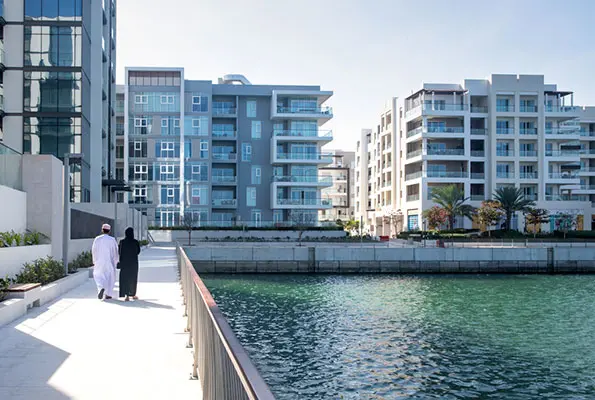
Muscat’s residential property market was among the strongest-performing segments in the first half, with Hamptons finding population growth, economic diversification, and the expansion of master-planned communities becoming the tailwinds for the industry’s growth.
Demand remained healthy across apartments, townhouses, and villas, particularly in integrated developments and established neighborhoods.
“Foreign buyers continued to show interest in integrated tourism complexes, with Al Mouj Muscat, Muscat Hills, Muscat Bay, and Jebel Sifah attracting significant attention,” Hampton said.
Sultan Haitham City is also emerging as an important freehold investment destination. The development of new neighbourhoods is expanding the range of properties available to international buyers, apart from adding another growth center to Muscat’s residential market.
Rental values, meanwhile, continued to vary significantly by location and property quality. Monthly asking rents for unfurnished two-bedroom apartments with facilities were highest in Al Mouj at around RO650.
Muscat Hills, Al Qurum, and Madinat Qaboos followed at approximately RO450, while comparable apartments in Al Khuwair and Al Ghubra commanded rents of around RO250.
The industrial and logistics segment was another strong performer, benefiting from manufacturing and distribution activity as well as investment in Oman’s ports, free zones, and industrial cities.
Warehouse and logistics properties generated average gross yields of around 9.4%, according to Hamptons. This is compared with 8.5% for Grade A offices and 8.75% for retail properties and prime homes in integrated tourism complexes.
Mixed-use buildings with a significant residential component offered the highest average yield, at about 9.75%.
Oman’s office market remained largely tenant-led during the H1, although the gap between modern Grade A buildings and older properties became increasingly pronounced.
Multinational companies, professional services firms, and government-related organisations continued to favour offices with flexible floorplates, energy-efficient systems, and sufficient parking. Space measuring between 500 and 750 square meters was particularly popular among small and medium-sized enterprises.
“The trend points to a more selective office market, where quality and functionality are increasingly influencing leasing decisions. Older buildings, meanwhile, face greater pressure to upgrade or offer incentives to remain competitive,” Hampton said.
Hamptons expects Oman’s property market to maintain a positive trajectory during the second half of 2026, although performance is likely to remain increasingly dependent on asset quality and location.
Prime residential developments, logistics facilities, and mixed-use properties are expected to outperform secondary assets as investors become more selective about rental income, occupancy prospects, and long-term capital value.
New property registration rules introduced under Royal Decree No. 56/2026 could also strengthen the market by improving transparency, streamlining transactions, and boosting investor confidence.