

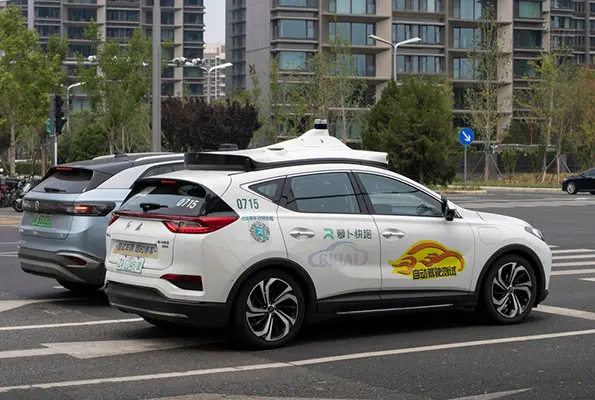
US-based ride-hailing company Lyft’s Freenow unit and Chinese tech giant Baidu have unveiled the Apollo Go RT6 autonomous vehicle in London, with the companies targeting a commercial driverless robotaxi service in the UK capital in 2027.
The companies have already been testing vehicles with human safety operators in London, a follow-up to the strategic partnership announced by the duo nearly a year ago to introduce Baidu’s purpose-built robotaxis across key European markets through Lyft’s platform.
While the initiative represents a significant advancement in the growth of autonomous ride-hailing services in Europe, London is becoming a crucial battleground, with the Freenow-Baidu joint venture anticipated to compete against several major players preparing to launch similar services.
Lyft acquired the German taxi and multi-mobility app Freenow in 2025 for approximately USD 197 million, giving the US company a presence in Europe’s ride-hailing market.
The Baidu partnership is expected to allow autonomous vehicles to become available through Freenow as the service expands its offerings.
The testing programme will place safety drivers behind the wheel.
Close to dozens of vehicles will be operating within London’s borough of Brent, under the current testing regime.
The companies have also engaged local authorities and transport officials as they prepare for a potential commercial deployment.
Freenow UK General Manager Danny O’Gorman said London offered a useful environment for testing autonomous driving technology because of its narrow streets, speed bumps and extensive network of roads with 20-mile-per-hour speed limits.
Speaking to Reuters during a demonstration ride, O’Gorman said the vehicles were learning to navigate local roads and follow traffic rules in conditions similar to those faced by human drivers preparing for a driving test.
Freenow is closely working with Transport for London (TfL) and will come up with regulatory guidelines in the coming days.
While acknowledging the new technology posing a potential concern among a section of London citizens, O’Gorman said many Londoners were equally enthusiastic about the prospect of robotaxi services.
Freenow said it expected to begin with tens of vehicles over the next year or two as it assessed demand and developed its operations.
The company also stressed that autonomous vehicles were not intended to replace London’s iconic black cabs.
Instead, Freenow, owned by Lyft, plans to operate a hybrid network in which robotaxis work alongside conventional taxis and private-hire vehicles.
“As a platform with deep roots in the taxi industry, our priority is ensuring that autonomous technology supports the professional drivers who keep London moving,” Freenow by Lyft CEO Thomas Zimmermann said.
Talking about the rival companies, Alphabet, Google’s parent company, has begun testing vehicles with human safety operators in London in April through its self-driving unit Waymo and aims to introduce a fully driverless ride-hailing service by the end of 2026.
Meanwhile, Uber and British autonomous driving startup Wayve announced plans for a London robotaxi service in September.
Their initial operations will use human safety operators before progressing to fully driverless services.
The Andy Burnham government is developing rules for autonomous vehicles and opened applications in May for a pilot programme that allows companies to test self-driving technology under government supervision.
The London initiative also comes amid political pressure in the United States over Chinese-made vehicles, with the US Senate working towards a permanent ban on Chinese cars.
Such restrictions could encourage companies to focus more heavily on European markets.
While Baidu sees the partnership offering a route to expand its Apollo Go autonomous driving business beyond China, for Lyft, the joint venture provides an opportunity to combine its European ride-hailing network with autonomous vehicle technology.