

In an era when national borders seem to matter less with each passing year, a new hierarchy is emerging that transcends traditional geopolitical boundaries. The 2026 Oxford Economics Global Cities Index, which ranks the world’s 1,000 largest cities across five key metrics, reveals a world in the throes of profound economic reordering. Whilst the metropolitan powerhouses of New York, London and Paris maintain their grip on the summit of global influence, the true story lies in what’s happening beneath the surface: Asia’s meteoric rise, the Middle East’s reinvention, and the unexpected dynamism of Eastern Europe’s tech-driven capitals.
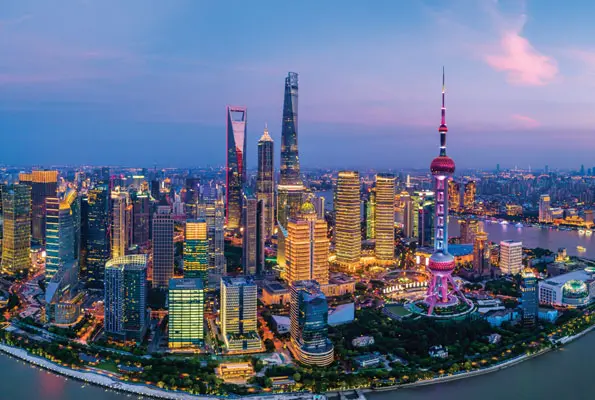
Chinese and Indian cities are combining large population sizes with significant gains in productivity and income, and Shanghai, Beijing and Delhi are projected to see some of the largest increases in GDP through to 2050 despite currently ranking outside the top 100 in the index. For investors and policymakers accustomed to thinking in terms of nation-states, this shift demands a fundamental recalibration of how we assess opportunity and risk in an increasingly urban world.
The enduring crown
New York tops the 2026 rankings for city performance, whilst London and Paris remain unchanged in second and third place, with eight of the top 10 cities remaining unchanged from last year. The persistence of this troika at the apex is no accident. These cities possess an interlocking set of structural advantages – vast, diversified economies, world-class financial infrastructure, deep talent pools, and the gravitational force of institutional strength – that create a self-reinforcing cycle of dominance.
New York and London remain at the pinnacle largely due to the size of their economies and the strength of their labour market, with the upper reaches of the index dominated by cities in Europe and North America, which account for 78 of the first 100 spots in the rankings. What is striking, however, is not that these cities remain at the top, but the narrowing gap between them and the challengers emerging from Asia, the Middle East and Central Europe.
Asia’s unstoppable ascendancy
The real story of the 2026 Global Cities Index lies in Asia. Five of the ten largest GDP increases over the period through to 2050 are found in Asia, with Shanghai’s GDP set to overtake San Francisco next year despite being just a quarter of its size at the turn of the millennium. This is not merely growth; it is transformation at a scale that reshapes global economic geography.
Over the next 25 years, Asian cities will add 54 million high-income households and, by 2050, will account for a third of the world’s urban high-income households, as many as in US cities. The magnitude of this wealth creation is almost incomprehensible. To put it in perspective: the rise in Asian high-income households over the next quarter-century will exceed the total number of high-income households currently residing in the United States. This represents not a cyclical swing but a structural realignment of where wealth is being generated and consumed.
The rapid growth of cities like Shenzhen, Taipei, Kuala Lumpur, and Ho Chi Minh City highlight the scale of growth in Asia. Among these, Ho Chi Minh City exemplifies the momentum. Ho Chi Minh City ranks 205th among the world’s 1,000 largest cities, an increase of 81 places compared to 2025, and has been included by Oxford Economics in the group of noteworthy cities in the Asia-Pacific region, ranking in the top 5% of 1,000 cities in terms of GDP growth.
Yet within Asia’s explosion of growth lie important nuances. Tokyo is easily the largest Asia Pacific city by GDP, but the big four Chinese cities are catching up, with forecasts showing that Tokyo’s economy will be overtaken by Shanghai in 2033 and by Beijing in 2036. What is often overlooked in these raw GDP comparisons, however, is that per-capita income tells a different story. Incomes per head in Singapore are significantly higher than the average for China’s big four cities, and in Hong Kong they are substantially higher still. The story is not one of homogeneous Asian dominance but of differentiated growth paths, each driven by distinct competitive advantages.
The Middle East’s sovereign wealth transformation
Meanwhile, cities across the Middle East are emerging as increasingly credible players on the global stage. Both Dubai and Riyadh have now broken into the top 50 for the first time and are increasingly cementing themselves as key players in the global economy by attracting the world’s brightest workers and most innovative companies.
The numbers underscore the remarkable turnaround. Dubai climbed nine spots to rank 42nd overall, finishing second globally in human capital, driven partly by Golden Visa and retirement visa reforms, whilst Riyadh surged 47 spots to 50th, reflecting significant economic and social transformation driven by targeted investment and policymaking. These are not marginal movements; they represent a step-change in how the world’s most elite talent and innovative firms view these cities.
Whilst the conflict in Iran is proving a serious headwind, the structural advantages of cities in the region, backed by substantial wealth funds, means they will likely continue to climb rankings going forward. The three Gulf cities “have all burst onto the global scene and are increasingly attracting the world’s highest-skilled workers and most innovative businesses”, as Oxford Economics notes. This transformation, driven by decades-long vision and resources, is now visible in the data.
Central Europe’s quiet revolution
Europe itself presents a more complicated picture than headlines typically acknowledge. Whilst established Western European cities maintain their positions, the dynamic edge has shifted to Central and Eastern Europe. Warsaw rose 109 places since last year, as it moved closer to the top 50, while Bratislava and Sofia also delivered huge increases, with Prague, the highest-ranked city in the region, placing 51st this year.
Strong economic and income growth has been central to these developments, capping off over two decades of transformation since accession into the European Union, with current projections suggesting cities like Prague, Warsaw and Tallinn will top European economic growth rankings in the coming years, helping them close the gap on their Western peers. For investors accustomed to associating European opportunity with London, Paris or Frankfurt, the emergence of Warsaw as Europe’s fastest-growing large city – and a soon-to-be peer of Western capitals in terms of living standards – represents a significant reorientation.
The cities to watch framework
Perhaps most significantly, the 2026 Global Cities Index introduces a new “Cities to Watch” classification that flags 28 cities across regions expected to deliver outsized growth over coming years. The new “Cities to Watch” section spotlights the top five picks for each region where city economies are generating significant steam and will move up the rankings going forward.
Five African cities – Accra, Cairo, Dakar, Luanda and Nairobi – and Asia-Pacific’s Bengaluru, Ho Chi Minh City, Kuala Lumpur, Shenzhen and Tashkent made the cut, with these dynamic contenders described as “rapidly evolving markets forging independent growth paths that key stakeholders and policymakers can no longer afford to ignore”.
This framework is a timely reminder that global economic dynamism is no longer concentrated in the handful of cities that dominate the headlines. Opportunity, risk, and structural change are distributed across a far more diverse urban landscape than conventional wisdom suggests.
The divergence widening
Underscoring all of these shifts is a deeper trend: the divergence between the world’s most successful cities and the rest. Cities across Eastern and Southern Asia, Central and Eastern Europe, and the Middle East are closing the gap on their advanced economy peers, with this having significant implications for rankings as the last year has certainly raised challenges – not least in the Middle East – yet the world’s economy and its urban landscape continue to march forward.
The data that underpins the Oxford Economics rankings spans five categories: Economics, Human Capital, Quality of Life, Environment and Governance. In the US, strong scores across the Economics and Human Capital categories drive their elevated position, whilst in Europe it is outperformance across Quality of Life, Environmental and Governance categories that matter most. These differences reflect divergent policy priorities and structural strengths.
Investment implications
What does all of this mean for investors, businesses and policymakers? First, city-level analysis is now essential. National economic forecasts increasingly obscure as much as they reveal; a city can significantly outperform its nation, and vice versa. Second, the traditional centres of finance and business are no longer automatic choices for expansion or investment. Shanghai’s projected path to economic dominance over San Francisco, to take one example, reflects not a reversal in San Francisco’s absolute prospects but rather a reordering of where the fastest growth is occurring. Finally, the Cities to Watch framework offers a structured way to identify second-tier opportunities before they become obvious to the broader market.
For multinational firms and institutional investors, the message is clear: the world’s economic centre of gravity is shifting, and those who fail to adapt their geographic allocations and strategic focus accordingly risk being left behind. The city rankings of 2026 offer both a scorecard of where we stand and a map of where the future lies.