

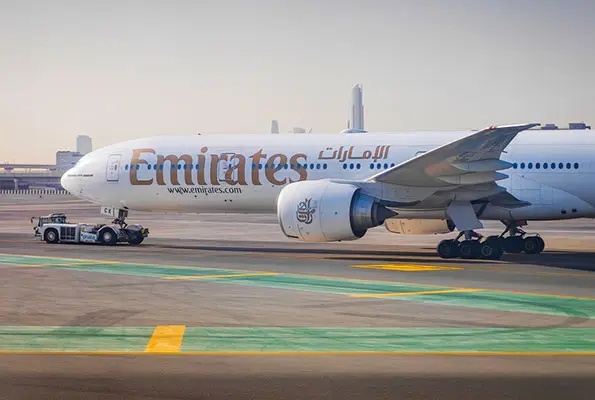
The ongoing war in Iran is impacting Emirates, the largest airline in the Middle East, which is grappling with rising fuel prices associated with the geopolitical conflict, despite robust travel demand in markets like China, Russia, and Africa.
The Dubai-based carrier continues to generate profits despite the challenging operating environment, but rising costs and regional disruptions are narrowing its margins.
Speaking to Reuters on Wednesday, Emirates President Tim Clark said the global aviation industry needed oil prices to return to around USD 70 per barrel to operate under more sustainable economic conditions.
He further warned that persistently high fuel costs could trigger bankruptcies across the sector.
Emirates’ financial performance has already reflected the impact of the nearly nine-month conflict, with the UAE flag carrier reporting a 66% decline in its Q1 net profit after airspace closures and operational disruptions affected travel across the Middle East while pushing up crude oil and jet fuel prices.
Brent crude, which reached as high as USD 120 per barrel earlier this year, has eased to approximately USD 93 in recent weeks amid hopes of a de-escalation in the conflict.
However, as per the analysts, the occasional flare-ups between Washington and Tehran, along with the absence of a permanent ceasefire, will result in volatility on the energy price front.
“The industry needs to have oil back at USD 70,” Clark remarked, arguing that lower prices would improve conditions for airlines and the wider global economy.
Despite the regional aviation slowdown, Emirates continues to report healthy passenger demand across several international markets.
Clark highlighted strong traffic on routes connecting Dubai with Russia, China and African destinations.
The UAE flag carrier’s boss described China’s passenger market as particularly strong, while noting that routes to Oceania required additional support.
The airline has gradually restored its operations following months of geopolitical disruption.
Emirates said it had recovered approximately 91% of its network by the end of September.
However, the passenger seat factor, which measures the proportion of available seats occupied by travellers, declined to 72% in the first half from 79.5% during the corresponding period a year earlier.
The broader aviation market in Dubai has also experienced significant pressure.
Dubai International Airport reported a 28.1% decline in passenger traffic during the first nine months of the year, although it indicated that recovery was underway.
Fuel expenditure remains Emirates’ biggest immediate financial challenge.
Clark said the airline was managing to remain profitable despite elevated fuel prices, emphasising that aircraft were continuing to fill up with passengers and that fuel, rather than labour costs, was the primary concern.
The Emirates Group held AED 54.1 billion (USD 14.7 billion) in cash at the end of September, down AED 5.5 billion from six months earlier as it used its reserves to support operations.
Clark said the airline was monitoring its cash position closely but remained financially healthy and had no immediate requirement to raise debt.
He added that Emirates could approach debt markets if operating conditions deteriorated further, although there were currently no plans to do so.
Clark also addressed speculation about a potential initial public offering (IPO) of Emirates, saying there were no immediate plans to list the airline on the stock market.
Any decision regarding a public listing would ultimately rest with the Dubai government.
He used earnings multiples to value Emirates’ enterprise value at roughly USD 120 billion to USD 130 billion and said a stock-market listing could raise a lot of money.
Clark said the Dubai government had considered the option before but had not acted.