

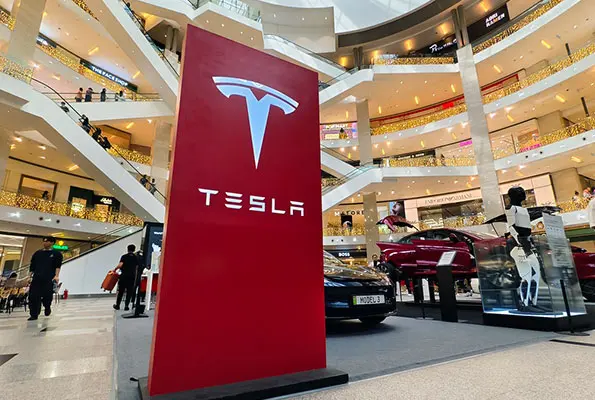
Elon Musk-led Tesla plans to invest 3 billion euro (USD 3.3 billion) in its German gigafactory near Berlin, defying the downsizing trend across the European country’s automotive industry as the American EV giant prepares to expand production capacity for its Cybercab robotaxi.
The proposed expansion at the Gruenheide facility could turn Tesla’s only European manufacturing site into Germany’s largest car plant by production capacity, overtaking Volkswagen’s Wolfsburg headquarters.
The investment comes as traditional German automakers, including Volkswagen, Mercedes-Benz and BMW, face mounting pressure from Chinese competitors and consider job cuts and factory closures.
Tesla said it aims to produce up to one million Cybercab vehicles annually at Gruenheide. However, the robotaxi model has yet to achieve commercial sales at scale, leaving questions about the demand and production requirements underpinning the Musk-led company’s ambitious expansion plans.
The company intends to submit a building permit application for the additional production facility before the end of 2026. Construction is scheduled to begin in the first half of 2027, with production expected to start in 2029.
Tesla also plans to recruit several hundred additional workers during the initial construction and production-planning stages. The company said the expansion would create more employment opportunities at the German site.
The planned investment makes Tesla one of the few major growth stories in German automotive manufacturing at a time when established manufacturers are reassessing their operations.
Volkswagen, Mercedes-Benz and BMW are dealing with weaker market conditions, rising costs and intensifying competition from Chinese EV manufacturers. The pressure has prompted restructuring plans, workforce reductions and discussions about potential plant closures.
Against this backdrop, the decision of Tesla to invest another 3 billion euro in Gruenheide is a positive signal for Germany’s automotive sector.But analysts have questioned how many of the investments will translate into permanent jobs.
The project was finished in March 2022, when Tesla opened its gigafactory in Gruenheide – well before the usual time needed to complete big industrial projects in Germany.
The facility was built amid environmental pushback and permitting hurdles.However, Tesla has faced sustained opposition from environmental activists and clashes with Germany’s potent manufacturing union IG Metall since opening.
Tesla has denied the allegations, which have been made by the union accusing the American EV giant of using tactics to undermine organized labor.
The carmaker has continued to expand the site’s operations amid the tensions.
Recently, it has increased production of the Model Y mid-sized SUV and recruited more than 2,000 employees. Tesla is also targeting the launch of battery cell production at Gruenheide in the middle of 2027.
The proposed Cybercab expansion would therefore represent another major step in the development of the German facility, although its commercial success will depend partly on the rollout and adoption of Tesla’s robotaxi business.
Tesla’s German investment also comes as Musk prepares to shift production priorities at the company’s Austin factory in Texas.
The automaker plans to wind down Cybertruck production there towards the end of summer 2027, with Musk saying the move should make room for additional Cybercab manufacturing.
Meanwhile, Tesla’s expansion plans have attracted political attention in Germany.
Ulrich Siegmund of the Alternative for Germany (AfD) publicly invited Musk to establish a Tesla presence in the eastern German state, as he seeks to become the party’s first state premier in Saxony-Anhalt.
Writing on popular micro-blogging platform X (formerly Twitter), Siegmund said an AfD-led government would support the company’s expansion through business-friendly policies and what he described as non-ideological economic conditions.
He also expressed interest in meeting Musk personally.
Siegmund’s appeal followed the AfD’s historic victory in Saxony-Anhalt’s state elections.
The 36-year-old politician is expected to put himself forward for the state premier position in a parliamentary vote scheduled for December.
Musk has previously voiced support for the AfD, including during Germany’s 2025 federal election campaign.
But as of Tuesday afternoon, he hadn’t publicly responded to Siegmund’s latest invitation.