

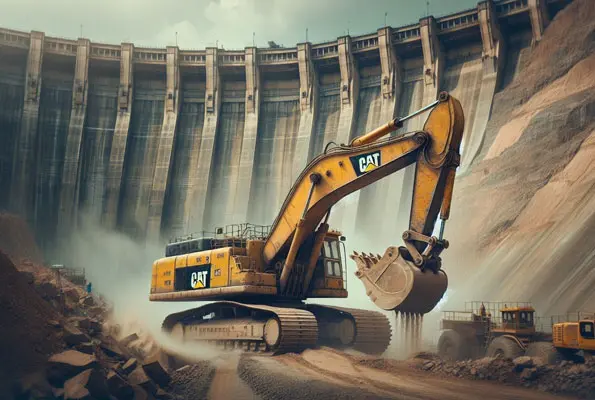
Caterpillar makes the machines that dig the ground and the engines that keep the lights on. Every AI data centre needs both, from the excavators that carve out the site to the enormous reciprocating engines and turbines that generate power when the grid cannot. That simple fact explains why a 100-year-old maker of yellow iron just delivered the best quarter in its history.
Sales rose 24% to $20.54bn. The order backlog, meaning work customers have committed to but not yet received, reached $72.1bn, nearly double what it was a year ago. Some of the engines in that backlog are booked for delivery in 2030, four years from now.
Chairman and chief executive Joe Creed credited ‘substantial investments into data centres and associated infrastructure’ as the primary force behind the volume growth. Investors responded by sending the shares up 12%, the stock’s best single day in more than 17 years.
“Construction leading growth in the quarter was a standout,” Oppenheimer analyst Kristen Owen told CNBC, noting that the share price reaction ‘reflects the importance of the durability of core Caterpillar businesses in sustaining the stock’s momentum’.
On the surface, this is a triumph. But anyone who has followed Caterpillar for long enough will see how this story might unfold, because the company has lived through it before. The last time its order book swelled like this, the years that followed brought falling sales, shuttered factories and tens of thousands of job losses. The question now is whether Caterpillar is about to make the same mistake it made 17 years ago.
The ghost of the China supercycle
Between 2010 and 2012, the customer was not a tech giant but a country. China’s construction boom consumed steel, copper and coal at a pace the world had never seen. Producing those commodities required mines, and mines required Caterpillar’s biggest machines. Orders poured in faster than the company could build them, the backlog swelled, and management drew the obvious conclusion that demand of this scale justified more capacity.
So, Caterpillar expanded. The most visible bet was the roughly $8.8bn acquisition of Bucyrus, a maker of enormous mining shovels and draglines, completed in 2011. It was the largest deal in the company’s history, made at the top of the cycle, on the assumption that mining customers would keep ordering at boom-era rates for years.
They did not. Sales peaked near $65.9bn in 2012 and then slid, year after year, to roughly $38.5bn by 2016, a decline of more than 40%. Factories closed. Tens of thousands of jobs were cut. The Bucyrus business was eventually written down. And the cruellest part of the story is that Chinese demand never actually disappeared. It simply stopped growing, and once it stopped growing, the extraordinary orders of the boom years were not replaced. A backlog, it turned out, was a snapshot of past enthusiasm, not a promise of future revenue.
Same shape, different customer
The parallels with today are not subtle. Once again, Caterpillar’s order book has roughly doubled in a year. Once again, the demand comes overwhelmingly from a single source, this time a handful of American technology firms racing to build AI data centres. Once again, the market is treating the backlog as if it were money in the bank.
The customer concentration deserves closer attention than it usually gets. In the China years, Caterpillar’s fortunes rested on the spending decisions of one government and the miners that served it. Today, they rest on the capital expenditure plans of a small cluster of hyperscalers spending close to every dollar they earn on AI infrastructure, and that is only the visible portion. Hundreds of billions of dollars in future data centre commitments sit off their balance sheets, structured through leases, joint ventures and special purpose vehicles that keep the obligations out of headline debt figures.
That structure matters for a supplier like Caterpillar. Off-balance-sheet commitments are, by design, easier to restructure, defer or walk away from than conventional debt. If the economics of AI shift, or if capital markets simply tire of funding losses, those commitments can shrink quickly. The tech firms would survive such a retrenchment. The question is what happens to the suppliers who built factories to serve it.
Creed does not dispute the concentration, only the risk. “There is a lot of discussion around AI demand. We have constant discussions with our customers. And all I can tell you is what our discussions with them is no one is slowing down at the moment. In fact, if we can get more units out, they’re asking us to give them more units,” he told analysts. That is almost certainly true. It was also true of Caterpillar’s mining customers in 2011, right up until it was not. Customers rarely announce a slowdown in advance. They simply stop calling.
The projects that may never break ground
There is already evidence that the pipeline is softer than the headline numbers suggest. More than $130bn worth of American data centre projects have been blocked or delayed this year by local opposition, as communities push back on the water consumption, the electricity demand, and the sheer scale of these facilities. A project delayed by a county commission does not need Caterpillar’s excavators on the original schedule, and it may not need its engines at all.
Analysts now expect between a third and a half of the data centre capacity planned for 2026 to slip to 2028 or later. Slippage on that scale changes the character of the order book. An engine booked for 2027 against a project that has moved to 2029 is not a firm order in any meaningful commercial sense. It is a placeholder, held in the queue because holding a place costs the customer little, and losing one might cost a lot. Queue-holding behaviour inflates backlogs at precisely the moment they look most impressive.
This is exactly what happened to the mining order book after 2012. Orders were not so much cancelled as endlessly deferred, pushed to the right quarter after quarter, until they quietly evaporated. The revenue never arrived, but the capacity built to serve it remained, along with its costs.
The small print the market is not reading
Which brings us to the most important detail in this story, and the one that has received the least attention. How firm, contractually, is a $72.1bn backlog, and what does an order booked for 2030 actually commit the customer to?
Caterpillar has offered a partial answer. At a Bank of America investor event in May, Jason Kaiser, who runs the power business, described the protections built into its biggest deals. “We’ve been able to put more in place with what we call frame agreements or longer-term agreements with customers that include sometimes cancellation penalties, sometimes prepayments, things that help us build confidence, that it’s a good, long-term opportunity that we can take advantage of,” he said. “We are really excited to now have the six large agreements that we’ve been able to talk about. We have several other smaller ones that we haven’t announced as well.”
Note the qualifiers. Sometimes cancellation penalties. Sometimes prepayments. Protections exist on the largest power agreements, but Caterpillar has never disclosed their size, how much of the wider backlog they cover, or what terms attach to the 2030 bookings. The distinction matters enormously. An order backed by a substantial non-refundable prepayment is real revenue in waiting. An order that can be cancelled at little cost is closer to an expression of interest, a free option held by the customer. The difference between those two things, multiplied across a backlog that has doubled in a year, is the difference between a genuine supercycle and a mirage.
Industrial companies with genuinely firm backlogs tend to quantify it. Aircraft makers disclose pre-delivery payment structures. Shipbuilders talk openly about instalment schedules. When a company celebrating a record backlog confirms that protections exist but declines to describe their reach, investors are entitled to ask why. It may be that the terms are robust and the reticence is habit. It may equally be that a meaningful share of those long-dated bookings could vanish at modest cost to the customer.
The 12% jump tells you what the market is assuming. It is pricing the backlog as revenue. The last time investors made that assumption about Caterpillar, in 2012, they spent the next four years learning the difference between an order and a sale.
What would doing it differently look like
None of this means the AI build-out is fake, any more than China’s urbanisation was fake. The data centres are real, the power constraints are real, and Caterpillar’s engines genuinely solve a problem the grid cannot. Even in a correction, the company will sell a great deal of equipment. The 2012 lesson was never that demand vanishes. It was that growth stops, and that a company sized for permanent growth gets hurt when it does.
The test, then, is not what Caterpillar’s customers do. It is what Caterpillar’s management does. The mistake of the China years was not taking the orders. It was spending $8.8bn on capacity at the top of the cycle, treating a temporary surge as a new normal. The equivalent error today would be a major acquisition in power generation, or a sweeping factory expansion, justified by a backlog whose contractual firmness remains only half described.
There are hints of a more cautious posture this time. Creed himself invokes the lesson. “We took a broad view when we analysed putting this capacity in and took a measured approach,” he told analysts, noting the expansion was sized not on data centre demand alone but on aftermarket growth from a rising installed base of large engines and turbines.
Current management lived through the aftermath of the last boom, and the memory of those factory closures runs deep. Discipline would also mean telling shareholders, plainly, how much of the backlog is protected by prepayments and penalties, so the market can price the risk instead of ignoring it.
But institutional memory has a way of fading when the order book doubles and the share price hits records. Boards that preach discipline in year one of a boom tend to find reasons for boldness by year three, usually just in time for the turn.
For now, investors celebrating the best quarter in Caterpillar’s century of existence might spare a thought for a simple question that has nothing to do with artificial intelligence. When a customer books an engine for 2030, what does it cost them to change their mind? Until Caterpillar quantifies the answer, the $72.1bn order book rests not on the AI boom, but on small print the company has confirmed exists, yet never fully described. Seventeen years ago, the small print lost. It usually does.