

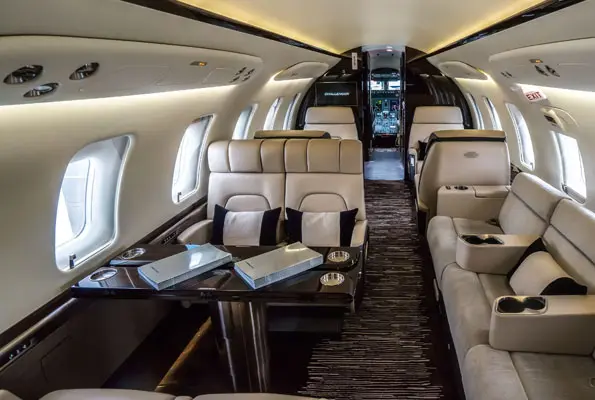
There was a time when flying private meant one of two things: you owned the aircraft, or you knew someone who did. Today, a growing army of bankers, tech founders, hedge-fund managers and—increasingly—aspirational ‘HENRYs’ (High Earners, Not Rich Yet) are skipping the eight-figure purchase altogether and simply tapping an app instead, according to a recent feature in The Wall Street Journal.
The Journal captured the cultural shift neatly, reporting that flying private has overtaken supercars, five-figure Hermès Birkin bags and waterfront Hamptons homes as the ultimate status splurge. For many of those aspiring to join the ranks of the truly rich, having ‘private-jet money’ has become the new goal, dividing the 1% from the 0.1%. The pandemic triggered a surge in demand, but industry figures say popular culture has since amplified both enthusiasm and envy for the fly-private lifestyle—a hedge-fund manager’s birthday weekend in St Barts, a model’s bachelorette party in Los Cabos, all broadcast to millions on social media.
What has changed is not simply demand, but access. Where flying private once required a net worth north of nine figures, the industry has spent the past decade quietly building an entire ladder of entry points beneath outright ownership—and each rung is now easier to climb than the last.
Three broad models now sit between the commercial cabin and full ownership: on-demand charter, jet cards and fractional ownership. Add to that a newer layer of digital marketplaces and empty-leg apps, and the private aviation industry has effectively rebuilt itself around the principle that flyers want the lifestyle without the liability.
The numbers bear this out. The global private jet charter services market is projected to grow from $27.88 billion in 2026 to $48.19 billion by 2034, a compound annual growth rate of 7.1%, according to Fortune Business Insights. Other analysts see the market growing even faster in the near term: one industry tracker puts the charter segment’s value at roughly $48.1 billion in 2026, up from around $24.1 billion in 2025, while broader private-aircraft revenue is estimated to have climbed from about $29.9 billion in 2025 to $31.9 billion in 2026.
Flight activity tells the same story. Data from aviation analytics firm WingX shows that fractional ownership—where flyers buy a share of a specific aircraft rather than the whole plane—has become one of the fastest-expanding segments of the industry, with global fractional departures up 11.5% in the first half of 2026 alone, accounting for 396,600 flights and 20.3% of all private departures worldwide. Over a longer horizon, the trend is even starker: fractional fleets have grown more than 65% since 2019, reaching around 1,300 aircraft in service by 2025. Notably, the average age of fractional owners has fallen by roughly a decade since the pandemic, a sign that private aviation’s customer base is getting younger, richer and considerably less patient about waiting for a hangar slot.
For the newly private-curious, the entry-level option remains the simplest: charter a plane outright, one trip at a time, the aviation equivalent of a taxi rank. Brokers and operators source an aircraft that matches the traveller’s requirements, and—crucially—can usually do so within hours. ‘We can have customers airborne normally within four hours if required,’ one Middle East charter executive told Gulf News, describing a process that begins with not much more than a phone call. Clients are able to depart from a private terminal separate from the main one, meaning they need arrive only around fifteen minutes before departure.
For flyers who go private more than a handful of times a year, jet cards have become the industry’s answer to a pay-as-you-go phone plan. Buyers pre-purchase a set number of flight hours at a locked-in rate, sidestepping both the unpredictability of one-off charter pricing and the long-term financial exposure of ownership. According to one 2026 industry guide, jet cards are increasingly winning favour over fractional shares specifically because they offer budget certainty: fractional owners bear fuel-price volatility directly through fluctuating monthly surcharges, whereas jet-card members often lock in rates for the life of their contract. For those flying under roughly fifty hours a year, the guide notes, the jet card tends to be the more predictable—and often cheaper—choice over a two-year period.
Fly more than that, and fractional ownership starts to make more sense. Under this model—pioneered decades ago by NetJets and now offered by rivals including Flexjet and Sentient Jet—buyers purchase a share of a specific tail number (an eighth, a quarter, a half) and receive a guaranteed number of flight hours a year, along with the tax and depreciation treatment of part-ownership, minus the operational headache of running an aircraft. It sits deliberately in between: more commitment than a jet card, far less than buying a plane outright.
And for the truly infrequent flyer—the once-or-twice-a-year traveller unwilling to commit to any of the above—a new wave of on-demand apps has essentially built the Uber of private aviation. Platforms such as XO, JetXO, Villiers Jets and Wheels Up now let users search, compare and book charter flights from a phone, often with no membership fee at all. JetXO, for instance, offers real-time access to a global fleet with no subscription: travellers input an itinerary and an AI-driven system matches it to available aircraft, with operators required to hold ARGUS or Wyvern safety ratings. XO—part of the Vista Global group that also owns VistaJet—gives customers access to a dedicated fleet of more than 180 aircraft, plus a further 2,100-strong safety-vetted ‘Alliance Fleet’, and does not require membership to book.
If there is a genuine ‘hack’ in this new private-aviation economy, it is the empty leg. When a chartered aircraft flies passengers to a destination, it often has to reposition—flying back empty, or onward to its next booking with no one aboard—and operators would rather sell that otherwise-wasted capacity cheaply than fly it for nothing. Empty-leg flights typically offer savings of 50–75% against standard charter rates, though the real discount depends on how flexible a traveller is on route and timing. Dedicated platforms such as SkyAccess, Jettly and Villiers Jets now refresh their empty-leg inventories multiple times a day, feeding live availability data straight from operators, while aggregators such as Victor and PrivateFly pull listings from multiple operators and verify availability before publishing routes. It is, in effect, the private-jet equivalent of a last-minute hotel deal—you do not choose the destination, the destination chooses you, but the saving can be dramatic.
Part of what has changed is not the aircraft on offer, but who is buying access to them, and how they are paying. Wealth managers have moved decisively into the private-aviation conversation. Around a third of wealth-management firms serving high-net-worth clients now offer concierge or lifestyle services such as private aviation, according to a survey by Cerulli Associates, with dedicated advisers now guiding tech and crypto fortunes on exactly which fractional programme or jet card to buy—and how to finance it. Some of that finance runs directly through the same balance sheets managing a client’s investment portfolio: bankers are increasingly structuring debt against clients’ swelling portfolios so that flyers make monthly interest payments on an aircraft rather than tying up tens of millions of dollars in a single asset.
Regulation and tax policy have also played their part in accelerating the shift towards flexible-access models over outright ownership. In the United States, a provision allowing the immediate 100% deduction of an aircraft’s cost triggered what one report called a market ‘frenzy’ among executives newly able to justify the purchase, and—notably—pushed operators to expand shared-ownership and time-share products specifically to capture buyers who wanted the tax benefit without buying a whole jet. One tax specialist who helps businesses buy aircraft reported a 30% increase in clients in a single year, with roughly four in five asking specifically about the new deduction rules. NetJets’ own chief executive said at the time that growth in the company’s shared-ownership model was outpacing its jet-card programmes, and that the tax changes were expected to fuel that trend further.
Geography matters too. North America remains, by a wide margin, the centre of gravity for this entire industry. First-half 2026 data shows US private jet departures accounted for 69.5% of the global total, up 5% year-on-year and 35% ahead of first-half 2019 levels, with Florida and Texas alone responsible for over a fifth of all worldwide fractional and charter takeoffs. Europe is the second-largest market, contributing 13.9% of global departures, though growth there has been considerably more uneven: Italian private jet departures rose 8% year-on-year and were up 45% on 2019 levels, while Germany dipped 1% year-on-year and remained 8% below its pre-pandemic baseline. Beyond the traditional strongholds, emerging markets are moving fast—Latin America’s private aviation market is growing at almost 10% a year, with Brazil alone now home to 764 private jets, while Asia is projected to command a 21.6% share of the global market in 2026.
For all the talk of democratisation, the industry’s own consultants are careful to underline that flying private, however you access it, remains an expensive habit. The general rule of thumb repeated across the industry: charter and jet cards make sense at low utilisation, fractional ownership at moderate use, and full ownership only once flight hours climb into the hundreds. Chartering is markedly cheaper than owning if a flyer logs fewer than roughly 100 hours a year—the equivalent of a car rental, paying only for what is used—while at the other end of the spectrum, outright ownership starts to look financially sensible only once annual flying time reaches around 240 hours or more. Other industry data broadly agrees, putting the threshold slightly higher still: experts generally recommend considering full ownership only once flight hours exceed 150 a year, with ownership clearly advantageous by 400 hours annually.
That maths explains why the fastest growth is happening precisely in the middle of the market—the jet card and fractional segments serving flyers who travel often enough to want guaranteed access and locked-in pricing, but not so often that the economics tip in favour of buying a tail number outright. It also explains the slight cooling in more rigid membership products: branded charter and jet-card programmes actually softened by 3.1% in the first half of 2026, even as fractional ownership surged—evidence, analysts suggest, of some demand migrating from fixed-hour cards toward the greater flexibility fractional shares now offer.
Perhaps the most telling evidence of how mainstream this aspiration has become lies not in the boardrooms of NetJets or Flexjet, but in the online forums where the merely affluent dream about joining the truly rich. On a Reddit forum for so-called ‘Henrys’, one user earning around $300,000 a year, married with a child in daycare, described flying private as simply ‘my dream’—a sentence that would have sounded faintly absurd a decade ago, when private aviation was still overwhelmingly the preserve of the ultra-wealthy and the corporate flight department.
It is worth noting, too, that private aviation retains its critics, particularly around cost fairness and environmental impact. Advocacy groups have long argued that private-jet travel is subsidised more generously than its commercial equivalent—one US policy report calculated that commercial passengers flying a domestic US route can pay roughly forty times more in taxes than private-jet passengers on the identical route—and the emissions debate has followed high-profile private flyers into the headlines with some regularity. None of that appears to be denting demand.
What the private-jet industry has effectively done is disaggregate ownership from access, in the same way streaming disaggregated music collection from music listening. Buyers no longer need to purchase the aircraft to enjoy what it offers. Jet cards, fractional shares, on-demand apps and empty-leg deals have together built a ladder with a rung for almost every level of wealth, from the once-a-year splurge flyer chasing a discounted empty leg to the family office structuring debt against a portfolio to fund fifty hours a year on a locked-in card rate.
None of it is cheap, and none of it is likely to become so. But the entry price has fallen, the friction has all but disappeared, and the aircraft itself—for the first time in the industry’s history—has become almost incidental. What buyers are really purchasing is something closer to optionality: the ability to be airborne within hours, on their own schedule, without ever having to think about hangar fees, crew rosters or resale value. For an industry once defined by the plane you owned, that is a genuinely different proposition—and, if the growth figures are anything to go by, one a great many more people are now prepared to pay for.