

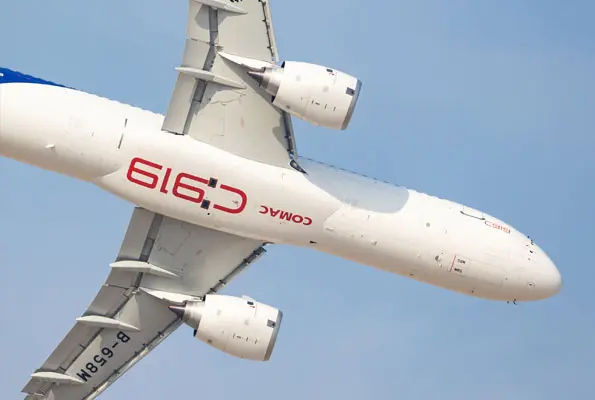
The pictures from Ulaanbaatar were everything Beijing could have wanted. Air China flight CA723, a COMAC C919 registered B-919Y, touched down at the airport in the Mongolian capital on the afternoon of August 12. It was greeted by a water cannon salute and traditional Mongolian dancers. The two-hour hop from Beijing Capital International Airport marked the first scheduled international commercial flight by China’s homegrown narrowbody, and the route will now run daily, seven days a week.
For a programme that has spent two decades absorbing state money and national expectation, the symbolism matters. Since China Eastern Airlines put the C919 into service in May 2023, the type had never crossed a Chinese border on a scheduled passenger service. Earlier flights to Hong Kong do not count, because aviation authorities classify services to the Special Administrative Region as domestic. Ulaanbaatar is the first genuinely foreign stamp in the C919’s passport.
Yet, the asterisk arrives almost immediately. At roughly 1,200 kilometres, Beijing to Ulaanbaatar is shorter than many of the C919’s domestic runs, and Mongolia is not a major aviation market. Air China and COMAC picked a short, low traffic sector in a country that accepts Chinese airworthiness certification, which cut the regulatory and operational risk of a first international departure.
Mongolia’s civil aviation authority recognises the Civil Aviation Administration of China’s airworthiness standards, allowing C919 operations without any Western certification. The same mechanism was road tested from July 2025, when China’s smaller C909 regional jet began flying the Hohhot to Ulaanbaatar route.
In other words, the C919 went abroad through a side door that Beijing had already checked was unlocked.
The arithmetic problem
Strip away the ceremony and the numbers tell a far more modest story. According to Andreas Mischer, an analyst at the Mercator Institute for China Studies, COMAC had delivered a cumulative 32 C919s by the end of 2025, against around 100 narrowbody aircraft that Airbus delivered to China in 2025 alone.
Another eight C919s followed in the first half of this year. That leaves the entire global fleet at roughly 40 aircraft, spread across just three operators. Air China flies 12 of them, and together with China Eastern and China Southern, it constitutes the entire C919 operator base in service worldwide.
The production trajectory has repeatedly disappointed even COMAC’s own revised expectations. The manufacturer originally aimed to deliver 75 C919s in 2025, then slashed that figure to 25, and still managed only around 16, marginally ahead of the 13 delivered in 2024.
Mischer notes the company remains a long way from its goal of producing 200 aircraft annually by 2029.
Rob Morris, a veteran aviation analyst now retired from Cirium, was blunter still. “COMAC’s pace of development and production is simply too slow” to genuinely compete with Airbus and Boeing, he told CNBC, adding that while the jet could eventually eat into duopoly sales inside China, the sluggish pace of execution means that day remains distant.
For context, Airbus and Boeing each build more single-aisle jets in a good month than COMAC has managed in its lifetime. The C919 is not currently taking market share from anyone. Air China previously deployed the Boeing 737 MAX 8 on the daily Ulaanbaatar service. So. the Mongolia route is one of the very few instances anywhere of a C919 directly displacing a Western jet, and it happened on an aircraft count of one.
A Chinese jet built by everyone else
The deeper vulnerability sits inside the airframe. Bank of America analysts estimate the aircraft incorporates parts from 48 US suppliers, 26 European firms, and just 14 Chinese entities. Its engines come from CFM International, a joint venture between America’s GE Aerospace and France’s Safran.
During 2025 the US temporarily suspended export of jet engines and related products to China amid escalating trade tensions. The pause lasted only weeks before shipments resumed, yet it was enough to expose how dependent China’s flagship industrial project remains on the goodwill of Washington and Brussels.
Beijing knows this, which is why the long game runs through import substitution. The indigenous CJ-1000A turbofan has completed flight testing on a Y-20 military transport and is moving towards trials on the C919 itself, while COMAC flew the first prototype of a new high-altitude variant, the C919-600, from Shanghai in late July, calling it a significant step forward for the series.
But the timelines are long. AECC projects Chinese certification of the CJ-1000A around 2027 with entry into service near 2030, and analysts at OAG Aviation expect mass production only from about 2030.
COMAC had initially aimed to have its jets entirely made in China by 2025, and to capture 10% of the domestic market. Both goals have slipped.
The wall called EASA
Even if COMAC could build jets faster, it could not sell them to most of the world. The C919 holds only Chinese certification, and the gatekeeper that matters is the European Union Aviation Safety Agency. Without European or FAA validation, many airlines and leasing companies remain reluctant to order the aircraft, because lessors, insurers and financiers anchor their risk models to Western certification standards.
Progress is real but glacial. On January 15, 2026, EASA confirmed to Reuters that it had carried out test flights of the C919 in Shanghai as part of its validation activities, while declining to give any timeline. Those flights sit in the third of four certification stages, the in-flight evaluation phase, with a full compliance review and closure of open findings still to come.
EASA’s executive director Florian Guillermet has indicated that European certification could take between three and six years, suggesting the process may run towards the end of the decade.
Some industry observers put completion in the 2028 to 2031 window. Until then, the C919’s international map is limited to countries willing to accept Chinese airworthiness paperwork, which means places like Mongolia and a handful of closely aligned markets.
Beijing reaches for the paperwork weapon
This is where the story stops being about one aeroplane and becomes about leverage. China has been stalling the approval of Airbus deliveries to signal impatience with European regulators’ delay in certifying COMAC aircraft, Bloomberg reported in May. The Civil Aviation Administration of China held up the final approvals required for Airbus aircraft to enter service, affecting nearly 20 jets bound for Chinese customers, and contributing to Airbus delivering its fewest commercial aircraft in a first quarter since 2009.
The financial sting was real. Airbus accumulated approximately €5 billion worth of undelivered aircraft inventory during the quarter, with China’s approval delays playing a significant role. Chief executive Guillaume Faury publicly played it down, describing the issue on the company’s April earnings call as ‘an administrative topic’, and later assured investors the matter had been resolved, with the retained aircraft ferried to customers through the second quarter.
Resolved, perhaps, but not forgotten. The episode demonstrated that Beijing can impose a nine-figure quarterly cost on Europe’s champion planemaker with nothing more than slow stamping. Airbus has built a deep industrial footprint inside China, opening a second A320 family final assembly line in Tianjin in October 2025 alongside the original line that has turned out more than 780 aircraft since 2008.
George Xu, chief executive of Airbus China, said at the inauguration that the company’s fleet market share in the country had climbed from around 20% in 2008 to over 50%, adding that China had become the manufacturer’s largest single-country market for commercial aircraft.
The leverage, therefore, runs one way. Airbus cannot retaliate against its biggest single market, one where it has more than 2,200 aircraft in service. It can only lobby Brussels and wait.
The regulator that cannot be hurried
The awkward truth for Beijing is that its pressure lands on the wrong target. EASA certification is technical by design, insulated from trade and industrial policy considerations. Squeezing Airbus does not make flight test campaigns run faster, and being seen to politicise safety validation arguably makes European regulators more cautious, not less. EASA officials have repeatedly stated that the certification process requires extensive technical evaluations and cannot be rushed.
There is also a mirror irony in the standoff. China complains that Europe is slow walking the C919 while itself slow walking Airbus deliveries, and each side can plausibly describe its own delay as routine process.
Airlines pay the bill
Caught between the two are carriers that simply need aircraft. Global demand for narrowbodies far outstrips supply, with delivery waits stretching years into the future, and every held up approval disrupts capacity plans.
Chinese carriers cannot fill the gap domestically. In March 2026, China Eastern signed up for 101 more A320neo family jets worth roughly $15.8 billion at list prices, with deliveries scheduled from 2028 to 2032. The airline told the Shanghai Stock Exchange that at least 53 of its existing A320s would retire over the same window. This is the carrier that ordered 100 C919s in 2023.
The order carries a telling condition. China Eastern’s filing noted that the transaction was not effective until approval by the relevant national departments, which is to say the same government now using approvals as a lever against Airbus also holds the switch on its own airline’s fleet plan. When Beijing slows Airbus paperwork, the first casualties are Chinese carriers’ growth plans.
Bargaining chip today, threat tomorrow
So, real threat or bargaining chip? On any horizon that matters to a fleet planner this decade, the answer is chip. A manufacturer producing fewer than 20 jets a year, dependent on American engines and locked out of Western skies, does not threaten a duopoly delivering thousands. What the C919 does give Beijing is a credible pretext, a national project whose grievances justify pressure on Airbus whenever broader EU relations sour.
The longer view is less comfortable for Toulouse and Seattle. In a 2025 assessment, consultancy IBA forecast that COMAC’s share of new narrowbody deliveries to Chinese operators could reach around 65% by 2030, though it cautioned that this would still represent only about 7% of the in-service narrowbody fleet in China once older Airbus and Boeing jets are counted. That is a captive slice of the world’s fastest growing major market which the duopoly once assumed was theirs. The direction of travel is set, even if the pace remains pedestrian.
The flight to Ulaanbaatar changed nothing about the arithmetic. It changed the story Beijing gets to tell, and in a standoff fought through paperwork and patience, the story is the point.