

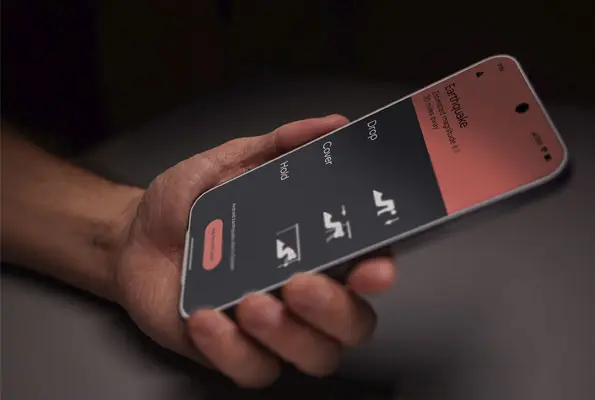
In the seconds before the earth moved beneath their feet, some Venezuelans received a message on their Android phones. It told them an earthquake was coming, gave a rough estimate of the magnitude, and noted the distance from their location to the source of the shaking. Then the tremors arrived.
To many, it felt like science fiction. It was not. It was a system that Google has been quietly building for years, one that harnesses the collective power of hundreds of millions of smartphones to do something that dedicated scientific instruments have historically struggled with. The ability to warn ordinary people before they feel a quake.
Understanding how it works requires a brief detour into the physics of earthquakes, and once you grasp the basics, the whole thing becomes remarkably elegant.
Two waves, one window
Every earthquake sends out more than one type of wave. The first to travel through the earth is called a Primary wave, or P-wave. It moves fast, typically at around six to eight kilometres per second through rock, and while it does cause movement, it is relatively mild.
Think of it as a gentle push. The wave that causes the most destruction, the one that shakes buildings off their foundations and sends objects flying across rooms, is the Secondary wave, or S-wave. It travels slower, usually about half the speed of the P-wave, and carries far more energy.
That gap in arrival times is everything. Between the moment a P-wave passes through a given location and the moment the S-wave hits, there is a brief window, sometimes just a few seconds, sometimes as long as a minute for people far from the epicentre. Early earthquake warning systems are built around exploiting that gap.
Traditional systems do this with seismometers, sensitive instruments installed in the ground that detect P-waves and relay that information to central servers. Japan, the United States, and Mexico have run such systems for years with considerable success. What Google has done is build a parallel system that uses a sensor most people do not think of as a scientific instrument. They employ the accelerometer inside a smartphone.
The phone as seismograph
Every modern smartphone contains a small component called an accelerometer. Its primary job, in everyday use, is to detect whether you have rotated your screen or to count your steps. But an accelerometer is also, in principle, a motion detector. It can sense vibrations. And when millions of them are networked together, they become a distributed seismic sensing grid spread across entire cities, countries, and continents.
Google’s “Android Earthquake Alerts System” works by having opted-in Android phones continuously monitor their accelerometers in the background. When a phone detects shaking that could be seismic, it sends a small, anonymised signal to Google’s servers. The signal includes information about the intensity of the movement and the phone’s approximate location. Crucially, it does not send data about any single phone but rather waits to see whether multiple phones in the same area are detecting the same thing at the same time.
When the server sees a cluster of phones in a region all registering unusual movement simultaneously, it begins calculating. It estimates the epicentre, gauges the likely magnitude, and if the event exceeds a threshold, it pushes an alert outward to Android devices in the affected area. The entire process, from the first phone detecting movement to the alert reaching users, takes seconds.
Those seconds are the point. An alert transmitted at the speed of light across mobile networks travels far faster than an S-wave moving through rock. A person fifty kilometres from an epicentre might receive a warning fifteen to thirty seconds before the destructive shaking reaches them. That is enough time to drop and take cover, to move away from windows, to pull a car off a bridge, or to pause a surgical procedure.
What the system does not do
It is important to be clear about what smartphone-based earthquake alerts cannot accomplish, because the language of “prediction” can create false impressions.
No current technology can predict an earthquake day or hours before it happens. The geological processes that produce seismic events are not yet readable in that way, despite decades of research into possible precursors. What systems like Google’s do is detect and relay, not predict. They sense an earthquake that has already begun, and they race to get a warning to people before the worst of it arrives.
This also means that people very close to an epicentre may receive no useful warning at all. The P-wave and the S-wave arrive almost simultaneously at short distances. In those scenarios, the phone might buzz at exactly the moment the ground starts shaking, or even after. The system is most useful for people at a moderate distance from the source.
The accuracy of magnitude estimates can also vary, particularly in the earliest seconds of a detected event, when data is still flowing in. Alerts may initially under- or overestimate the size of a quake. Google’s system, like all early-warning systems, is calibrated to err on the side of alerting rather than staying silent, which means some alerts may turn out to correspond to weaker shaking than anticipated.
Beyond earthquakes
The infrastructure that makes earthquake alerting possible has attracted attention from researchers thinking about other natural hazards.
Tornadoes, for example, are notoriously difficult to warn for at the hyperlocal level. A tornado warning in the United States typically covers a county, which can span hundreds of square kilometres.
Dense networks of sensors, including phones, could in theory help narrow that. Similarly, researchers have explored whether air pressure sensors in smartphones could detect the atmospheric signatures of severe weather events.
Some studies have examined the use of smartphone GPS receivers to detect the subtle ground deformation that precedes or accompanies seismic and volcanic events. The precision of consumer GPS is not yet sufficient for fine-grained monitoring, but with enough devices and sophisticated signal processing, aggregate data has shown promise.
Cameras and microphones in phones, combined with machine learning models that can identify the visual or acoustic signatures of rising water, represent a possible layer of detection. None of these applications are deployed at the scale of Google’s earthquake system, but the conceptual groundwork is being laid.
How good is the accuracy
Studies comparing Android Earthquake Alerts performance against traditional seismometer-based systems have generally found that phone-based networks can perform well in densely populated areas where there are enough devices to generate reliable aggregate data. In rural areas, or in regions where smartphone penetration is low, the system has fewer sensors to work with and its effectiveness diminishes.
Independent analyses have found that the system tends to perform better for larger earthquakes, which generate stronger P-waves that are easier to distinguish from everyday phone movements such as someone jogging or a device being dropped. Smaller quakes, or quakes in areas where phones are less common, represent a harder problem.
The system is also continuously improving. Each event provides data that helps calibrate thresholds, refine magnitude estimates, and adjust the timing of alerts. Google has expanded the system to dozens of countries since its initial rollout, and the company has published research findings in conjunction with seismologists who study its performance.
A sensor in every pocket
Perhaps the most striking aspect of this technology is that it required no new hardware. The sensors already existed. The network already existed. What changed was the software, the will to use it, and the partnership with the science of seismology.
In a world where dedicated early-warning infrastructure remains expensive and unevenly distributed, a system that leverages devices people already own represents a meaningful equalisation. Countries with limited investment in formal seismic monitoring networks can still offer their populations a layer of protection.
The phones in Venezuela buzzed before the shaking came. For the people who received those alerts, a few seconds was enough to brace themselves. That, at its core, is the impossible gift of a sliver of time between what has already begun underground and what is about to arrive at the surface. In emergencies, a few seconds can be everything.