

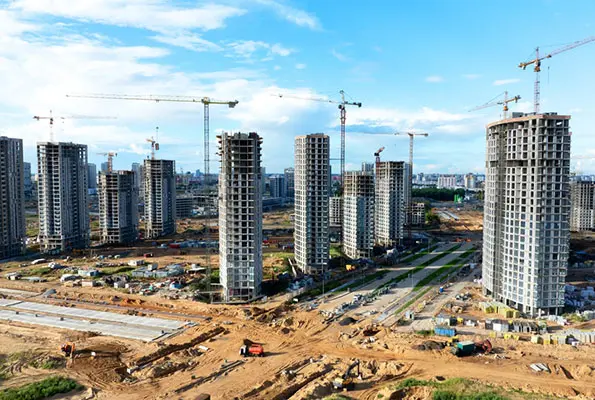
Global construction costs are settling into a permanently higher baseline, altering the real estate sector’s key priorities like capital planning, development feasibility, and asset viability on a global scale.
According to JLL’s “Global Construction Costs Index 2026 Report,” global pressures on the property industry have established a new annual cost escalation baseline between 3% and 6%, well above the pre-2020 norm of 2% to 3%.
“Complex interactions between global supply chains, politics, AI-driven demand, and a wide array of local factors are generating constant upward pressure on costs, even if the underlying source or trigger isn’t exactly the same month-to-month. As a result, real estate investors, developers, and occupiers can no longer rely on static cost assumptions or attempt to wait out the market through project deferrals,” the report said.
“The issue facing real estate developers and investors is operating effectively within a permanently higher cost environment,” said Ben Jackson, Global Head of Development Services, Project and Development Services (PDS) at JLL.
“Developers who delay projects waiting for a return to 2019-era costs are paying for that wait twice—once in carrying costs, and again when the project restarts into a market that’s moved further away, not back. The firms protecting returns right now are re-testing project viability every time rates, materials, or labor shift, instead of only at financial closure. They’re locking long-lead materials early, phasing projects so later stages can be repriced without killing the deal and building contingency into the base plan rather than treating it as a buffer for surprises,” he noted further.
Following years of economic disruption, material volatility, and geopolitical shocks, JLL sees global construction tender prices increasing by an additional 3.1% to 4.2% in 2027.
Regional forecasts highlight continued upward momentum, led by the Middle East (3.4% to 5.4%), Asia Pacific (3.8% to 4.7%), North America (3.2% to 4.2%), and Europe (2.2% to 3.5%).
Labor shortages, especially in high-demand skilled trades, and the consequentially elevated wage growth continue to push overall construction costs higher.
Globally, construction wages jumped 8% to 35% across key markets between 2020 and 2026, consistently outpacing general consumer price inflation.
“Labor constraints have created a structural shift rather than a temporary disruption,” said Ruth Hynes, Senior Director, Research at JLL.
“Demographic shifts, trade training deficits, and intense competition from technical sectors like data centers and advanced manufacturing mean skilled workers and specialized trades command significant pricing power. This gap is widening rather than closing, setting a higher floor for building costs globally,” she stated further.
Beyond macroeconomic drivers, the JLL report emphasises that elevated construction costs are creating a clear performance divide across property sectors, as project viability is now directly tied to how well asset value growth can absorb cost escalation.
Build typology varies widely in baseline costs across sectors.
Commercial developments, including office and retail properties, are currently carrying the highest global average costs at USD 2,600 to USD 3,410 per square meter due to urban site complexity and demanding tenant specification requirements.
High-rise residential construction, on the other hand, sits at a comparable range of USD 2,280 to USD 3,710 per square meter globally.
In contrast, industrial and logistics assets remain markedly less expensive, averaging USD 980 to USD 1,520 per square meter, although constrained urban sites in markets such as Hong Kong and Singapore push regional averages higher.
Consequently, stronger-performing sectors such as industrial logistics and data centers are absorbing cost increases more effectively because rental growth and capital values have outpaced construction inflation over the past five years.
“Conversely, sectors experiencing softer value growth face a much tighter viability equation, forcing sponsors to adopt more sophisticated value-creation strategies,” JLL noted.
“With cost stabilisation replacing acute volatility, waiting for construction pricing to drop carries financial risk,” the leading global commercial real estate services and investment management company observed.
“Costs have continued to increase, and global events have proven incredibly disruptive to assumed timelines for even modest price relief actions, like central banks lowering interest rates. Real estate stakeholders attempting to wait prices out have seen costs escalate faster than any relief effort could offset,” it added further.
Furthermore, delayed decision-making exposes projects to compounding lead-time risks, as key mechanical, electrical, and plumbing (MEP) systems currently carry lead times exceeding 20 weeks.
While potential monetary policy easing and interest rate cuts offer some relief on financing costs, elevated tender price inflation means rate cuts alone cannot fully offset higher overall capital outlays.
Rather than pausing capital deployment, JLL sees market leaders focusing capital on premium assets that command greater returns, applying full-lifecycle value models that prioritise long-term operational performance, and expanding portfolio retrofits to avoid the high expense of new ground-up construction.
“Construction costs have reset at a higher level, and owners should plan around that rather than wait for relief,” said Cynthia Kantor, CEO of Project & Development Services at JLL.
“The owners who keep delivering returns are the ones who test feasibility against live cost data from day one, reconfirm it at every design and procurement gate, and favor retrofit and repositioning where it beats ground-up on cost, speed, and carbon,” she concluded.