

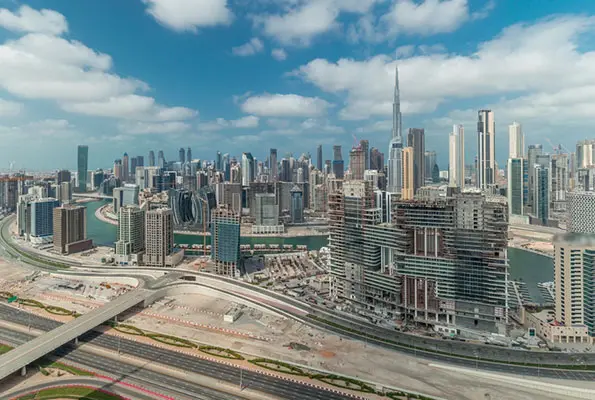
As the H1 2026 comes to a close, the UAE’s real estate industry depicted an overall picture of resilience, despite the geopolitical disruptions in the form of the Iran war.
Dubai, the main hub of the industry, during the period, saw a 37.4% year-on-year increase in the number of licensed buildings, reflecting continued momentum in urban development and sustained confidence in the Emirati city’s real estate market, stated Arabian Gulf Properties while quoting its own data and that of the Dubai Municipality.
The number of licensed buildings in the Emirati city increased from 3,134 in the first half of 2025 to 4,305 during the same period this year, representing an increase of 1,171 licensed buildings.
Badar Rashid Al Blooshi, Chairman of Arabian Gulf Properties, said, “These figures reflect the scale of development activity taking place across Dubai and continued confidence in the outlook for its real estate market. This growth isn’t just about starting new projects; it also includes improving and upgrading existing buildings and projects, showing that the market is active and can adapt to the changing needs of people, businesses, and investors.”
“The strength of Dubai’s real estate market is underpinned by an integrated ecosystem that combines long-term urban planning, advanced infrastructure, and efficient regulatory processes, alongside the emirate’s ability to attract residents, businesses, and investment. As urban development continues, project quality, efficient delivery, and sustainability will remain essential to maintaining the market’s competitiveness and strengthening its long-term appeal,” he added further.
As per Al Blooshi, the scale of projects currently under construction is an important indicator of the depth of development activity in Dubai.
“Having more than 24,000 buildings under construction reflects the scale of Dubai’s ongoing urban transformation. It also highlights the importance of continuing to develop supply in line with market needs while maintaining the high standards that have established Dubai as a global destination for living, working, and investment,” he noted.
Abu Dhabi’s residential property sales values, on the other hand, climbed 178% year-on-year to reach AED 67.8 billion (USD 18.46 billion) in H1 2026, according to the leading real estate advisory and property consultancy, Cavendish Maxwell.
“There were 15,500 transactions from January to June—around double the amount recorded in H1 last year. However, sales moderated in Q2,” noted the agency’s “Abu Dhabi H1 2026 Residential Real Estate Report.”
Andrew Laver, Director at Cavendish Maxwell Abu Dhabi, said, “As delays in recording transactions are resolved, the Q2 2026 numbers give us a first look at market activity, and the Q3 data will help us understand if the slowdown is just a short break or a bigger change in the market.”
“The robust performance in H1 reflects continued investor confidence and resilience in the wider economy. Despite heightened regional uncertainty, transactions, values, prices, and rents all continued to rise year-on-year,” he remarked further.
The UAE capital’s residential market started the second half of the year with strong momentum.
“While all the factors supporting demand remain in place, the timing of new supply, which includes more than 53,000 units between now and the end of 2028, along with developer launch activity and broader economic conditions, is likely to have a greater influence on transactions and price performance. The key consideration is whether demand can continue to absorb the planned supply pipeline,” Laver observed.
“Although the regional geopolitical environment remains the main downside risk, Abu Dhabi’s strong fiscal position and substantial external buffers help absorb these pressures,” he added.
As per the real estate consultancy, the off-plan sector, which saw sales rise by 173% compared to H1 2025, dominated the market, accounting for 83% of transactions and 12,800 of total sales.
Sales prices and rental rates also continued upward trajectories in the first six months of the year, with Cavendish Maxwell’s report revealing apartment prices going up 16.4%, followed by villa prices (over 10%), compared to H1 2025.
“The cost of renting an apartment rose 9.4%, with villa rents up nearly 4%. The temporary rent freeze, introduced in June, should limit further rental hikes in the near term,” the company added.
“Al Reem Island dominated apartment sales, with more than 4,470 transactions, while Al Hudayriyat secured the biggest share of villa sales, with over 1,570 purchases. Abu Dhabi delivered 5,700 new homes in H1, taking its total residential stock to 323,600 units. Another 10,500 are set for handover by the end of the year,” Cavendish Maxwell concluded.