

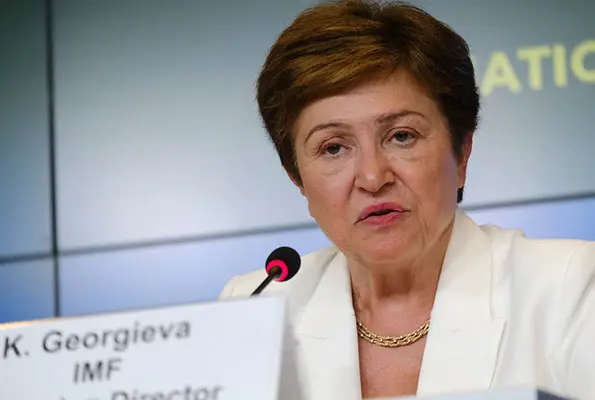
The latest take from Kristalina Georgieva, Managing Director of the International Monetary Fund (IMF), sees the global economy weathering the energy shock from the Iran war better than feared.
However, she raised concerns about deteriorating fiscal conditions in some countries, shown by rising bond yields and a stalled disinflation process.
Georgieva told reporters in a briefing ahead of the upcoming Group of 20 (G20) finance leaders meeting in Asheville, North Carolina, that there was a “tug of war” between the negative Gulf energy supply shock and growth tailwinds from the artificial intelligence (AI) investment boom that has started to spread beyond the American borders.
“Risks to the global outlook were more balanced than in April but still tilted to the downside due to mounting fiscal pressures and the potential that central banks will have to maintain tight monetary policy to control inflation,” the IMF boss noted.
“Global growth is resisting powerful headwinds from high debt levels, stubborn inflation, and trade tensions. Thus far, it has weathered the energy shock caused by the closure of the Strait of Hormuz better than we feared, thanks to a combination of factors,” Georgieva observed.
The factors helping the global economy stay resilient include drawdowns of energy reserves, increases in non-Gulf energy supplies, lower energy demand, increased renewable energy capacity, and a return to coal power generation in some places.
“Artificial intelligence investment in the U.S. is keeping corporate earnings and consumer spending strong, and other countries are ramping up data center construction and AI hardware supplies,” Georgieva said.
The IMF in July lowered its 2026 global growth forecast to a sluggish 3.0%, while warning of further downside risks from the Middle East war, trade fragmentation, and potential AI uncertainty.
As per Georgieva, the global economic watchdog will next update its global growth forecast in mid-October at IMF and World Bank annual meetings in Bangkok.
However, she warned against complacency by policymakers amid benchmark Brent crude oil prices that have been hovering in the USD 80-USD 90 per barrel range since mid-June, well below their spring peaks of over USD 118.
“The energy shock is not over. A renewed rise in oil prices could fuel inflation, forcing central banks to retain a restrictive policy stance with knock-on implications on debt service costs and on economic activity. All countries need to tackle their fiscal problems and formulate and present credible plans to ensure their debt and deficits are on a sustainable path,” Georgieva told the media.
The IMF boss also asked the central banks to stay “laser-focused” on their price stability mandates amid continued inflation risks, despite expressing concern that tight monetary policy would cool growth.
She also said countries needed to address “excess global imbalances” that were causing trade tensions. While the senior official didn’t name anyone, Georgieva, in the past, called on China to rebalance its growth model away from cheap and large-scale exports towards one driven by internal consumer demand.
“A better balanced economy is a stronger global economy, and that is good for everyone,” she said, adding that such a goal was harder to achieve in a more fragmented world.
“The IMF is improving how it looks at external balances and will take a closer look at what causes these imbalances, including how macroeconomic trends, trade, and industrial policy work together in a series of upcoming papers,” Georgieva concluded.