

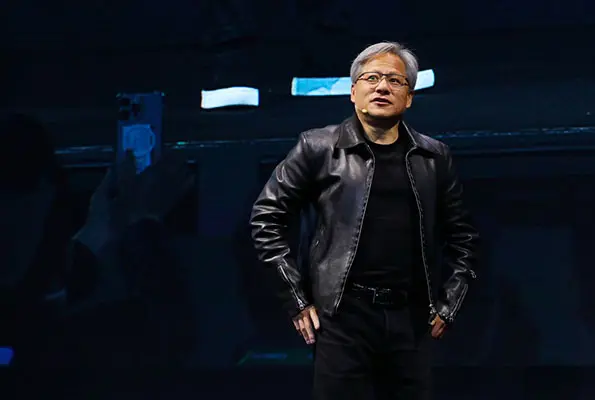
Jensen Huang-led Nvidia has forecast a 70% jump in revenue next fiscal year, a development that gives a solid testimony of how the chip giant is gaining rapidly from the Big Tech’s ever-increasing demand for AI computing.
However, the venture has also warned that shortages of memory components would continue to curb how quickly it can expand its production run to meet the accelerating demand.
“AI has reached its inflection point. It’s doing useful work. Its tokens are productive and profitable. Now, compute is revenue,” Huang said.
The outlook will also reassure investors who were questioning the longevity of the AI spending surge, wondering whether the “explosive growth” was a sustainable one in the long run.
Nvidia has made it clear that the market for AI computing is expanding rather than peaking by forecasting revenue growth well above Wall Street expectations and outlining demand from Big Tech and AI labs.
However, the supply constraints will end up being the deciding factor in terms of determining how much business, be it Nvidia or its rivals, can capture.
Executives shared a road map for growth over the coming years, including a ramp in its next-generation Vera Rubin processors and expanding sales at AI labs such as OpenAI.
“We’ve never forecast or never guided to a year in advance,” Huang said.
Ahead of Wednesday’s results, analysts, on average, projected 44% revenue growth in the same period.
“What makes (the forecast) even more credible is that demand is broadening beyond the original hyperscalers, with AI clouds, enterprises, sovereign buyers, and industrial customers now growing materially faster,” said Shay Boloor, chief market strategist at Futurum Equities, while interacting with Reuters.
Nvidia’s Vera Rubin platform, which has now started shipping to customers, will account for about a fifth of its overall data center revenue in the current quarter, which ends in October.
In its fiscal second quarter ended July, data center revenue more than doubled to USD 89 billion, beating estimates of USD 85.08 billion, according to LSEG data.
Nvidia now expects demand from AI labs to contribute roughly a quarter of its overall business in 2027, indicating a diversified customer base.
The so-called neo-clouds (specialised cloud computing providers focused exclusively on delivering GPU-as-a-Service), which include companies like Nebius and CoreWeave, are set to exit this year with more than eight gigawatts in Nvidia GPU capacity, a surge from the three gigawatts at the end of 2025.
During the event, Nvidia also announced an expansion of its partnership with Amazon Web Services. The pair will deploy an additional two million Nvidia graphics processors across Amazon’s global infrastructure in 2027 and 2028.
“We are seeing demand acceleration even at our scale. Customers’ forecasts point to our growth doubling next year. However … we are supply-constrained,” Nvidia’s finance chief Colette Kress told analysts during the earnings call.
“Soaring memory prices and higher component costs will continue to pressure Nvidia’s margins. The latter would bottom in the fourth quarter at roughly 71% to 72%, down from about 74% in the third quarter,” she stated further.
Nvidia’s China business has been highly uncertain. In May, Washington cleared roughly 10 Chinese firms, including Alibaba, Tencent, and ByteDance, to buy one of Nvidia’s most powerful AI chips, the H200.
Then the following month, the chip giant began pitching its new Vera CPU to Chinese clients, promising them the product could be available by August, as China separately weighed allowing top AI firms limited H200 purchases.
In July, a US Commerce Department official said shipments had begun but remained “very few.”