

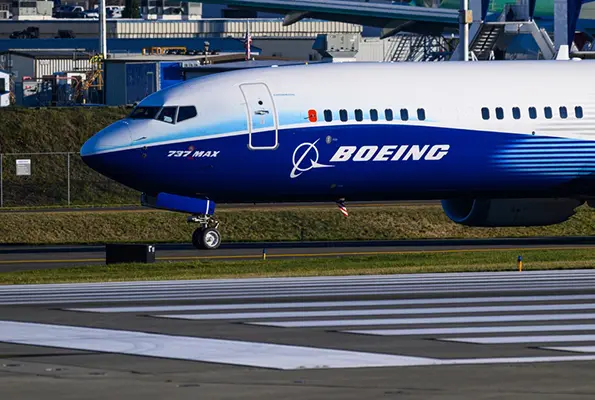
In a big win for Kelly Ortberg-led Boeing, the latter has secured final approval from the US Federal Aviation Administration (FAA) for its 737 MAX 10, clearing a major hurdle for the aviation giant as it seeks to restore financial stability and strengthen its position against European rival Airbus.
The decision, announced on Tuesday, brings Boeing closer to delivering the largest aircraft in its best-selling 737 MAX family.
The company expects the jet to become an important contributor to cash flow as it recovers from years of operational setbacks, safety controversies, and production challenges.
Airlines have ordered more than 1,550 Boeing 737 MAX 10 aircraft, with the model accounting for 31% of the company’s outstanding 737 backlog, according to aviation analytics consultancy IBA.
Through the 737 MAX 10, Boeing is trying to compete with Airbus in the lucrative single-aisle aircraft market, where airlines increasingly seek higher-capacity jets for busy short- and medium-haul routes.
Speaking at Boeing’s Everett, Washington, facility, US Transportation Secretary Sean Duffy welcomed the FAA’s decision while calling for faster aircraft approval processes.
“We want to beat the Europeans; we want to beat the Chinese,” Duffy said, arguing that manufacturers needed to be allowed to certify aircraft more quickly to maintain US competitiveness.
The lengthy review of the MAX 10 has given Airbus’ A321neo a significant lead in terms of capturing a greater share of the high-capacity single-aisle market.
The MAX 10, like the A321neo, can accommodate up to 230 passengers, compared with a maximum of 195 for the 737 MAX 9 and 160 for the MAX 7.
The increase in capacity makes the aircraft attractive to airlines seeking to increase passenger numbers without switching to larger, more expensive widebody aircraft.
As of now, MAX 10’s major customers include United Airlines, Alaska Airlines, Ryanair, Delta Air Lines, and American Airlines.
Boeing has already built several MAX 10 aircraft awaiting delivery, but the FAA certification has delayed the process.
Although US approval is complete, Boeing still needs authorisation from Transport Canada and the European Union Aviation Safety Agency before the aircraft can enter service with customers in those markets.
Mike Sinnett, senior vice president of Boeing Commercial Airplanes, said the remaining approvals could be completed in a couple of months.
“Boeing expects to deliver the first 737 MAX 10 to Canadian carrier WestJet early next year, subject to the outstanding regulatory steps,” Sinnett remarked.
Boeing has also expanded its manufacturing capacity.
In July, the American aviation behemoth opened a new production line at its Everett facility to increase 737 output, complementing existing assembly operations in nearby Renton, Washington.
The FAA applied heightened scrutiny to the aircraft following two fatal Boeing 737 MAX 8 crashes in 2018 and 2019 that killed 346 people.
After a cabin panel blew out during an Alaska Airlines 737 MAX 9 flight in January 2024, regulators intensified their oversight.
For the MAX 10, regulators required improvements to the flight control system, including an enhanced angle-of-attack sensor.
Boeing plans to introduce the relevant changes across the existing fleet in the coming years.
Problems involving the engines’ anti-ice system, identified in 2023, also complicated the development of the MAX 7 and MAX 10.
In late September, Boeing disclosed another issue involving an update to the 737 MAX navigation software, raising further concerns about the programme’s timeline.
The FAA subsequently determined that the software issue did not pose a safety concern and did not require a fix as a condition of approval.
In August, the regulator approved the smaller 737 MAX 7 following a review lasting more than eight years, illustrating the extensive oversight facing the aircraft family.
Some members of the MAX 10 certification team will now turn their attention to the 777-9, Boeing’s largest jetliner in production.
The widebody aircraft is six years behind schedule, with the company expecting to complete certification and begin deliveries in 2027.
Chris Payne, who oversaw the MAX 10 programme, said discussions between the administration, FAA, and Boeing were helping establish a framework for improving the approval process.