

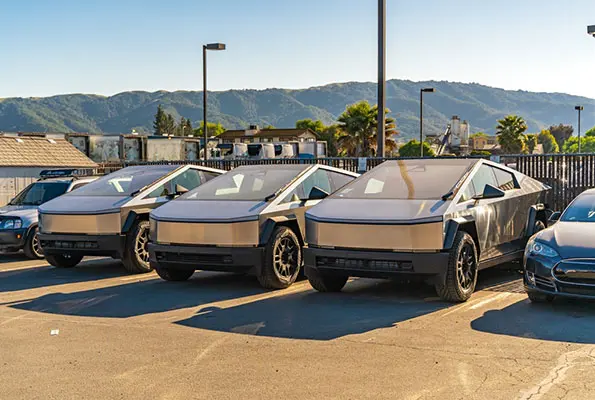
Tesla CEO Elon Musk has said the electric vehicle maker will be refunding deposits to many Cybertruck customers in the coming days as outstanding orders exceed the production capacity available before the company shuts down the pickup truck’s production line in 2027.
In a post on popular micro-blogging platform X (formerly Twitter) on Monday, Musk said Tesla would attempt to manufacture as many vehicles as possible before winding down production in approximately eight months.
However, he acknowledged that the company would not be able to fulfill all outstanding orders.
Musk’s announcement follows Tesla’s decision to redirect resources at its Texas factory towards expanding production of the Cybercab, a two-seat autonomous vehicle that forms a central part of Musk’s ambitions to transform the American electric vehicle giant into an AI and robotics business.
Musk had previously said Tesla would introduce an additional production shift to clear its existing Cybertruck order backlog before dismantling the production line around June or July 2027.
“The Cybertruck order backlog is currently far more than Tesla can make before dismantling the line for Cybercab expansion,” the maverick tech titan said in an earlier X post.
The additional shift is intended to help the automaker complete as many pending deliveries as possible before the production transition.
However, customers who cannot receive their vehicles before the shutdown will have their deposits returned.
Tesla began delivering the Cybertruck in late 2023, generating considerable attention with its unconventional stainless-steel exterior and futuristic design. However, sales have fallen significantly short of Musk’s earlier expectations.
According to Kelley Blue Book, in 2025, US Cybertruck sales declined 48% to 20,237 vehicles, compared with nearly 39,000 units in 2024.
The figures remain considerably below Musk’s initial projection that annual sales could eventually reach 250,000 vehicles.
The electric pickup has also faced repeated recalls and quality-related concerns since its launch.
Its unconventional styling has further limited its appeal in overseas markets, particularly Europe.